

The Silent Drag: Why Japan’s Communication Culture Slows Its Strongest Companies
Understanding the hidden system behind Japanese decision-making, and why global teams misread it until they work inside it.
Japanese companies communicate in ways that outsiders rarely understand until they sit in the room. Meetings unfold without clear conclusions. Email threads avoid direct requests. Teams wait for unspoken approval. Decisions appear made, then quietly reopen. What feels like indecision from a global perspective is often a structural pattern built into the communication system itself.

This system is logical inside Japan. It developed from long-tenure organizations, stable hierarchies, and a cultural expectation that teams share the same context. But once a business interacts with global partners, cross-border teams, or younger generations with different working assumptions, the system produces friction that becomes measurable. Deadlines stretch. Ownership blurs. Projects lose rhythm. Ambiguity becomes operational cost.
For professionals outside Japan, this article offers an insider view of how communication actually works inside Japanese companies, why it slows execution, and what principles help teams move with greater clarity. For Japanese organizations, it highlights the adjustments needed to stay competitive in a world that operates on explicit messaging and direct accountability.
1. Strategic Focus
Clarity over assumption.
High-context communication is one of Japan’s cultural strengths, yet it becomes a barrier when strategy must be transmitted quickly across diverse teams. Senior leaders often rely on shared atmosphere rather than explicit direction. Subordinates read tone more than words. This system functions when everyone has spent decades in the same company environment. It breaks when teams include mid-career hires, foreigners, or external partners.
Global business relies on clarity to protect speed. Japanese strategy often relies on familiarity. When the two collide, interpretation replaces execution.
2. Practical Operation
Explicit ownership in a consensus culture.
Consensus is a stabilizing force in Japanese organizations. It also slows operational momentum. Instructions soften as they travel down the hierarchy. Responsibility spreads across groups rather than resting with a named owner. Decisions require repeated confirmation because no one wants to act without certainty that everyone is aligned.
Outsiders entering Japan often describe the same experience. Work feels active but progress feels slow. Many Japanese firms have recognized this operational drag. Companies in manufacturing, logistics, and retail are now adopting clearer communication frameworks that define owner, action, and timeline with no implied meaning.
3. Cultural Alignment
Nuance preserved, ambiguity removed.
Nuance is not the problem. Ambiguity is. Japanese workplaces value maintaining harmony, but harmony should not compromise clarity. Teams avoid direct statements to preserve relationships, yet this can obstruct movement. The goal is not to replace Japanese communication with Western bluntness. The goal is to allow nuance to support work rather than slow it.
System Effect
Teams align faster.
Explicit intent ensures that employees, whether junior, mid-career, or international, interpret direction consistently. This shortens onboarding cycles and reduces dependency on cultural literacy.
Work flows cleaner.
Departments operate in parallel rather than waiting for subtle cues. Toyota, Komatsu, and other global leaders use standardized communication routines because precision protects operational rhythm.
Progress holds rhythm.
Once a decision is made, teams move forward without reopening settled issues. This is critical in fast-moving markets where timing influences competitiveness.
Communication Principles
Precision in message.
One meaning. No layered intent. No reliance on tone for interpretation. Fast Retailing uses this approach to keep its global teams aligned with headquarters.
Purposeful communication.
Meetings decide. Memos instruct. Redundant confirmations disappear when messages specify expectations and timelines.
Discipline of engagement.
Information flows to owners rather than broad groups. This reduces the diffusion of responsibility that slows large Japanese organizations.
The Japan Gap
Japan’s communication system evolved for organizations that valued stability, lifetime employment, and shared history. Global business expects directness, explicit ownership, and rapid alignment. The gap between these models creates inefficiency that outsiders notice immediately when they begin working inside Japanese companies.
This gap is not a flaw of character or capability. It is a structural issue created by a communication style designed for a different era of work. Once understood, it becomes solvable.
The Shift
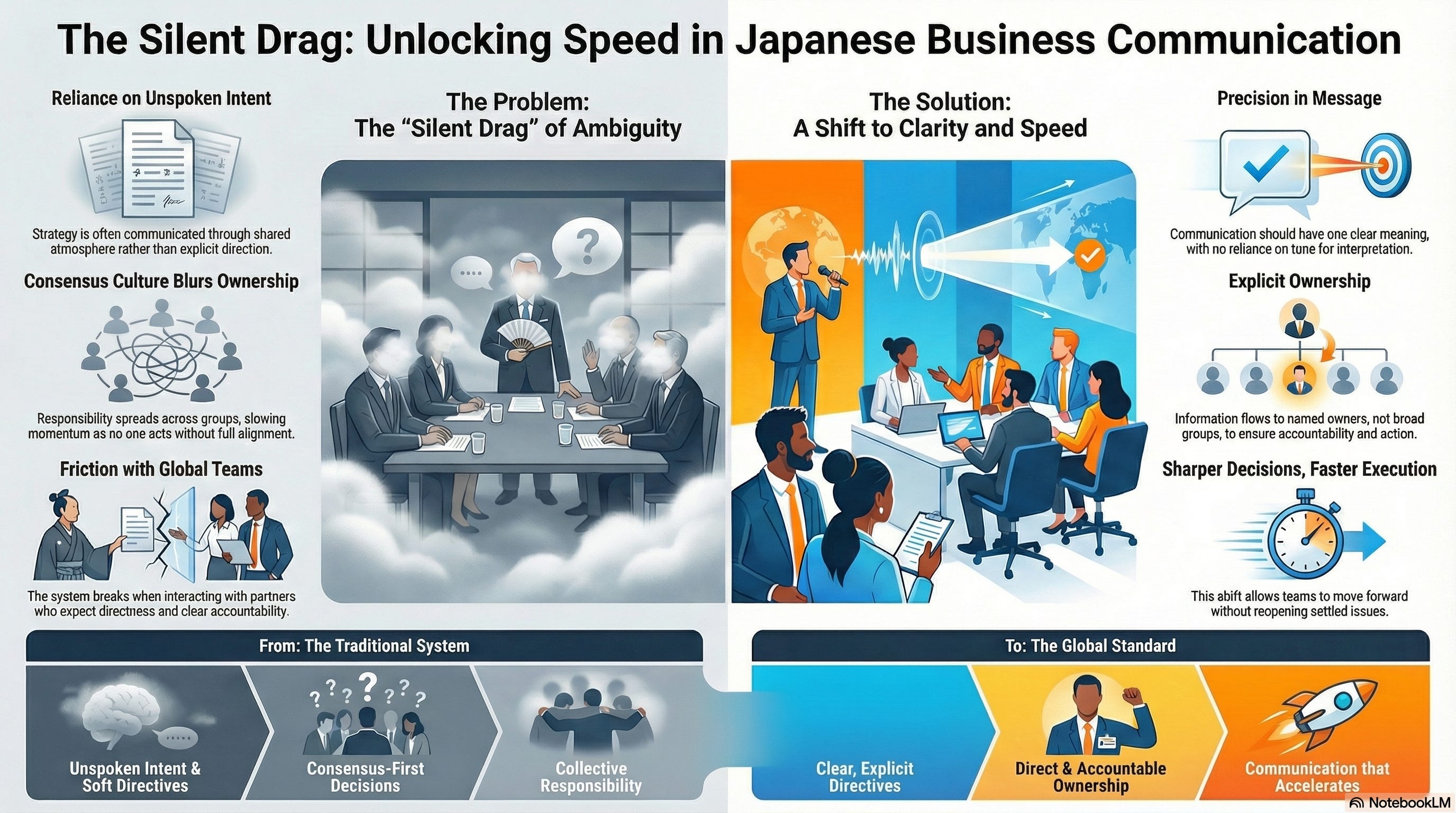
From:
Unspoken intent
Softened directives
Consensus-first decisions
Collective responsibility
To:
Clear directive
Direct ownership
Decisions that move work forward
Communication that accelerates rather than preserves
Outcome
Sharper decisions.
Stronger alignment.
Faster execution across borders.
Organizations that no longer require cultural translation to operate at speed.
Why This Matters for Outsiders
Professionals working with Japan often assume hesitation where there is caution, or confusion where there is harmony. Understanding the communication system behind Japanese organizations allows global teams to collaborate more effectively and avoid misinterpretation. It reveals how Japan makes decisions, how progress is negotiated, and where friction originates.
For anyone entering the Japanese market, leading Japanese teams, or building partnerships with Japanese firms, this clarity becomes an advantage. It turns cultural opacity into operating insight.
Essence
Japan does not need to abandon nuance. It needs to remove ambiguity where it interferes with progress. Communication becomes a strategic asset when it is structured to move work forward. In today’s global environment, this shift is no longer optional. It is a requirement for sustaining momentum and maintaining competitive strength.
If you want deeper clarity on how global brands operate in Japan, follow Inside Brand Japan.
For brand system work, market alignment, or organizational restructuring, learn more at YF or connect with us on LinkedIn.