


The quarterly board meeting of a major telecommunications subsidiary in Minato is deadlocked. The foreign chief executive has put forward a brilliant, legally sound proposal to acquire an emerging digital infrastructure provider. The numbers are pristine, the legal audit is clean, and the commercial logic is undeniable. Yet, the atmosphere remains thick with hesitation.
The CEO glances toward the end of the table, where a seventy-two-year-old senior advisor sits in absolute silence. This gentleman possesses no direct operational responsibilities, has not uttered a single word during the two-hour technical presentation, and spends most meetings looking benignly out the window. When the CEO asks him directly for his perspective, the elderly advisor offers a polite, non-committal smile and says, “The timing may require a bit more consideration from the ministry.”
To an executive raised in Western corporate environments, this response looks like the redundant interference of a ceremonial retiree. The instinct is to bypass this quiet figure, treat his vague caution as a minor bureaucratic hurdle, and push the acquisition forward through a majority board vote.
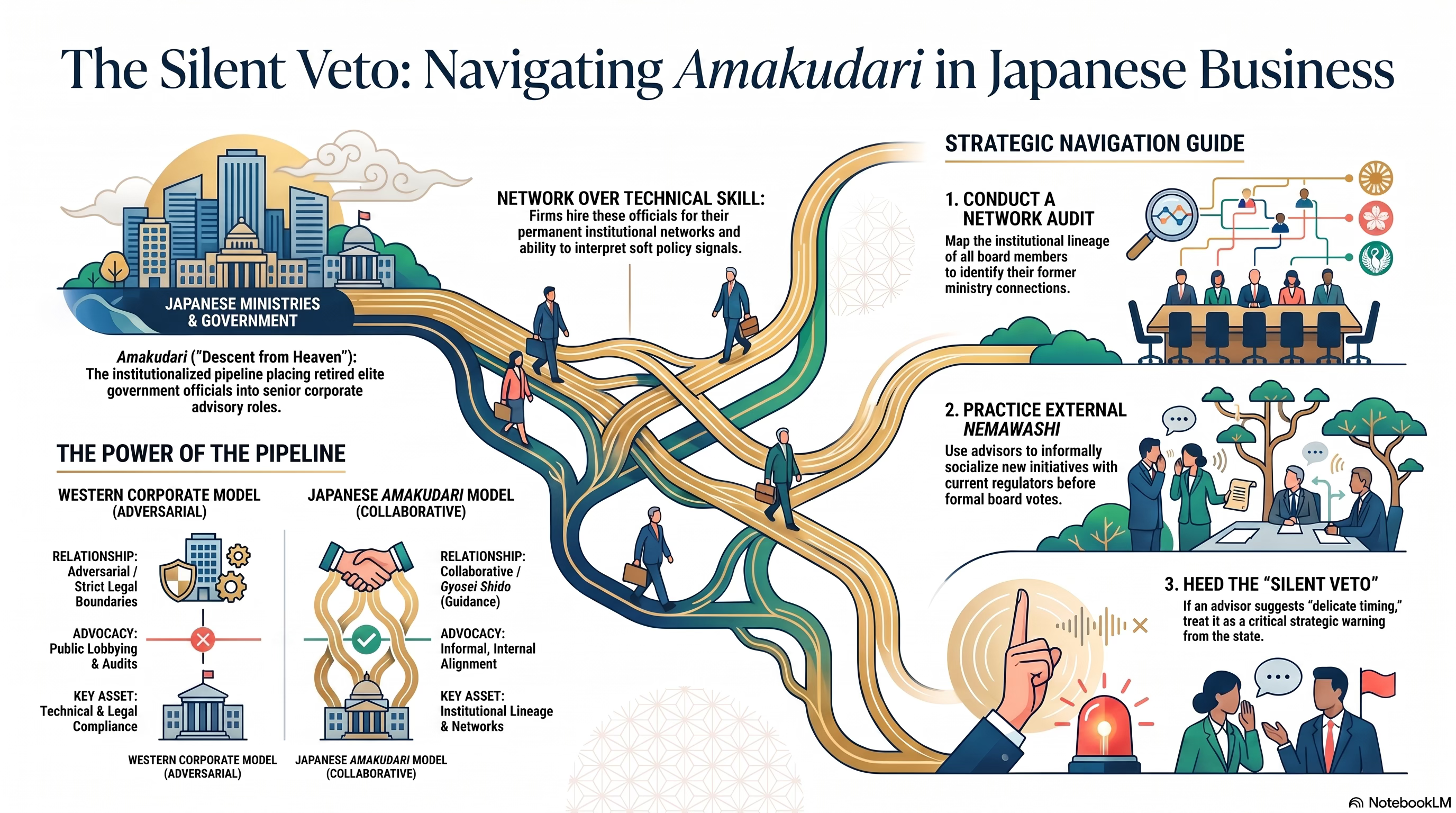
That move would be a terminal strategic error. The silent elder is not a powerless figurehead; he is an alumnus of one of Japan’s elite central ministries. He is a participant in amakudari, literally translated as the “descent from heaven”, the institutionalized pipeline that places retired government officials into senior corporate roles. He does not need to raise his voice or cite specific regulations to block a strategy. His presence alone represents the invisible umbilical cord connecting the private enterprise to the regulatory heart of the state.
The Iron Pipeline of the Public-Private Monolith
Amakudari is a core structural pillar of Japan’s post-war economic architecture. In the West, the relationship between private corporations and government regulators is inherently adversarial, governed by public lobbying, strict legal boundaries, and transparent compliance audits. The Japanese model operates on a principle of collaborative guidance (gyosei shido).
When top-tier bureaucrats finish their careers at elite institutions like the Ministry of Economy, Trade and Industry (METI) or the Ministry of Finance (MOF), they vacate their offices to clear the path for younger cohorts. They then “descend” into senior advisory or board positions within the industries they once regulated.
This system serves a vital strategic purpose for the Japanese firm. A corporation does not employ an amakudariexecutive for their current technical skill or knowledge of modern software architecture. They employ them for their permanent institutional network.
The retired official knows exactly who sits at every desk inside the ministry, who is writing the upcoming regulatory frameworks, and how to interpret the soft, ambient signals of government policy long before they are formalized into law. They provide the private enterprise with a level of political insulation and foresight that a foreign competitor simply cannot buy through standard public relations firms.
The Invisible Guardrails of the Energy Sector
This structural reliance on bureaucratic alumni is highly visible within Japan’s heavily regulated utilities and infrastructure giants. Consider the historical operational framework of Tokyo Electric Power Company (TEPCO) and its long-standing relationship with the government apparatus.
For decades, the executive suite of TEPCO regularly reserved prominent board seats for retiring senior bureaucrats from the ministry responsible for energy policy.
This structural link ensured that the company’s long-term capital investments, pricing structures, and risk parameters were perfectly aligned with national strategic objectives. The relationship was built on a shared institutional background.
When a regulatory challenge emerged, it was solved through quiet, informal alignment between current ministry officials and their former seniors sitting on the corporate board. While this system faced intense scrutiny following the 2011 Fukushima crisis leading to public demands for reform, the underlying reality remains unchanged: in highly regulated sectors, an enterprise cannot move faster than the unspoken boundaries set by the state.
Utilizing the Power of the Elder Statesman
For a global executive operating a subsidiary or managing an investment in Japan, successfully navigating this landscape requires a fundamental shift in how you evaluate corporate power. Looking exclusively at operational titles will cause you to completely misread the true decision-making pipeline.
The transformation begins by conducting an immediate network audit of your local board and joint-venture partners. Identify the institutional lineage of every senior advisor and non-executive director. If an advisor spent thirty years within a ministry relevant to your industry, treat them as your most critical strategic asset, rather than a ceremonial figure.
When drafting long-term strategies, product launches, or cross-border acquisitions, engage these advisors in private, one-on-one consultations long before bringing a proposal to the formal boardroom table. Frame the discussion around a request for systemic guidance.
Present your plan and ask a direct, culturally intelligent question: “How will the ministry perceive the structural timing of this initiative?”
The elder statesman will listen through the lens of their bureaucratic background. If they suggest that the timing is delicate, heed the warning. Invite them to use their personal network to socialize the concept informally with current regulators, a process of external nemawashi. By allowing your amakudari advisor to clear the path with the ministry in advance, you transform a potential regulatory roadblock into a secure, frictionless slipstream for your corporate growth.
The Bottom Line
A senior amakudari advisor in a Japanese corporation is the gatekeeper to the state’s regulatory alignment, not a passive retiree. True executive velocity in Tokyo is achieved by utilizing the deep institutional networks of these elder statesmen to validate your strategy before formal execution. By treating their quiet caution with absolute respect, you secure the vital political insulation required to win in the local market.
Over to You
How can global corporations effectively integrate the strategic insights of bureaucratic advisors without compromising their own global compliance and governance standards?


