

The negotiation room on the eighth floor of an office tower in Toranomon is perfectly quiet. A visiting European chief operating officer sits directly opposite his local counterpart, a senior managing director of a major Japanese industrial group. The discussion has been fluid, moving across logistics timelines and regulatory approvals. The European COO, eager to maintain momentum, leans forward and poses a direct, complex operational question regarding regional supply chain vulnerabilities.
Instead of an immediate reply from the managing director, an unexpected sequence occurs. The managing director remains entirely motionless, his expression neutral. A younger employee sitting at the far end of the table, a mid-level manager who has spent the entire hour silently taking notes, shifts his posture, clears his throat, and delivers a highly detailed, technically precise five-minute answer. Throughout the response, the senior managing director nods slowly, validating the words without uttering a single syllable. The European COO watches this play out with internal confusion, wondering who is actually driving the strategy of the enterprise.
To a professional accustomed to flat, meritocratic structures where the most qualified voice speaks instantly regardless of rank, this interaction appears inefficient or even baffling. The instinct of the outsider is to view the junior employee’s intervention as the true locus of expertise, assuming the senior executive is merely a ceremonial figurehead. This conclusion is an operational mistake. What the COO witnessed was the meticulous execution of a vertical relationship matrix that organizes every physical movement, vocal cue, and decision within the Japanese workplace. It is the invisible architecture of the senpai (senior) and kohai (junior) dynamic, a system that dictates the flow of power long before a single document is signed.
The Iron Law of the Office Grid
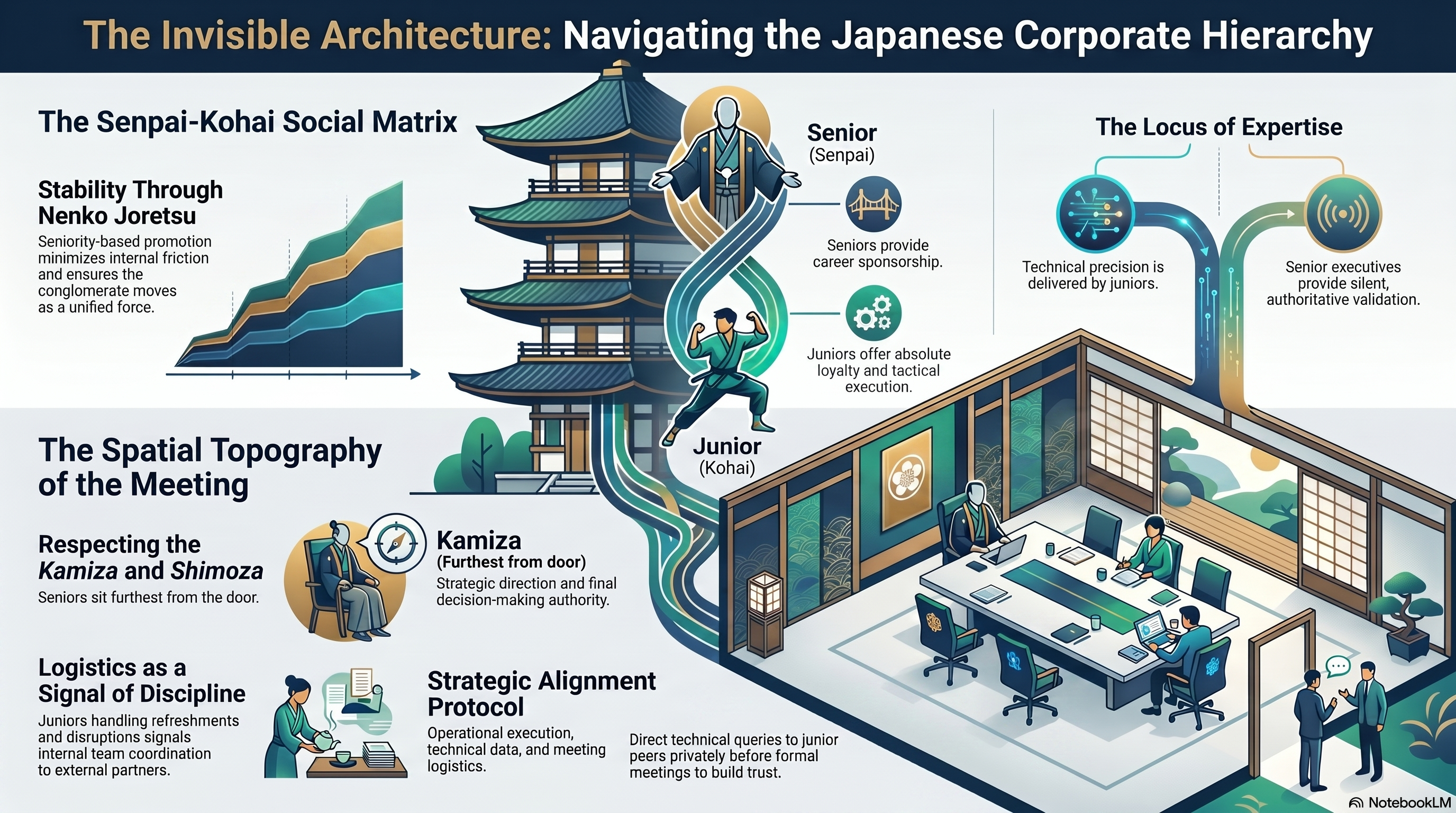
This relationship structure is an fundamental organizing principle that creates order out of potential organizational chaos. It traces its lineage to the classical Confucian social hierarchies that emphasize mutual obligation based on age, tenure, and societal position. In a traditional Japanese corporation, this framework manifests as a highly structured mentorship ecosystem. The senpai provides protection, career sponsorship, and institutional wisdom, while the kohai offers absolute loyalty, operational execution, and meticulous deference.
This vertical alignment dictates the physical layout of the corporate environment through an intricate protocol known as kamiza (the upper seat) and shimoza (the lower seat). When a group enters a meeting room, seating is never an arbitrary choice. The highest-ranking individual, the ultimate senpai is positioned at the kamiza, the seat furthest from the entrance, traditionally considered the safest and most honorable spot.
Conversely, the most junior employees, the kohai, must sit at the shimoza, the seats closest to the door. This spatial arrangement serves a practical, historical function: the junior staff are positioned to handle incoming disruptions, receive guests, manage the temperature controls, and orchestrate the flow of refreshments.
This structural division of labor explains the ritual of pouring tea or serving refreshments during a negotiation. When a junior employee handles the beverages, they are performing a vital social function within the group. They are signaling to the external world that their team possesses internal discipline, clear lines of authority, and flawless coordination.
When the foreign executive ignores these spatial boundaries or addresses technical questions directly to the lowest-ranking staff member simply because they speak fluent English, they disrupt the internal equilibrium of the room. They force the junior employee into an exposed position that threatens the authority of the senior leader, inadvertently causing the entire meeting to stall.
The Operational Discipline of the Keiretsu
This absolute adherence to vertical authority and group discipline remains a core reason why Japan’s largest conglomerates navigate complex industrial transitions with immense stability. Consider the historic organizational model of a titan like the Sumitomo Group.
Within these massive industrial ecosystems, projects involving multiple subsidiaries are executed with militaristic precision. This efficiency relies on the fact that every employee understands their precise location within the seniority matrix.
When a strategic pivot is required, the directives move down the vertical chain with absolute clarity. The senior executives establish the strategic direction, the mid-level senpai govern the operational boundaries, and the junior kohai execute the tactical details without the friction of internal competition or insubordination.
The system functions because the kohai knows that their current deference guarantees their future advancement. In exchange for their flawless execution of the senior leader’s vision, they are granted institutional safety, comprehensive training, and a predictable career path through the seniority-based promotion system (nenko joretsu). The vertical hierarchy minimizes individual friction, ensuring the entire weight of the conglomerate moves as a singular, unified force.
Navigating the Vertical Matrix
For a global executive operating within this environment, accelerating project timelines requires a complete shift in how meetings are structured and conducted. Attempting to force a flat, open-ended debate during a formal gathering with mixed ranks will consistently produce silence and hesitation.
The strategy lies in respecting the vertical matrix by utilizing separate communication channels for different organizational tiers. Before a formal meeting ever occurs, utilize your own mid-level staff to engage with the kohai of the Japanese partner company. Route your highly detailed, technical queries through these private, peer-to-peer exchanges. This allows the junior staff to gather the necessary data, consult with their superiors, and formulate a unified corporate position in private.
When you enter the formal boardroom, adjust your focus to align with the kamiza. Direct your high-level strategic statements exclusively to the senior executive present, honoring their position as the ultimate decision-maker.
Accept that the junior staff will handle the operational details and the note-taking. By allowing the local team to display their internal discipline and hierarchy without disruption, you build deep institutional trust and ensure that your proposals are carried smoothly up the chain of command.
The Bottom Line
The vertical hierarchy of the Japanese workplace is a sophisticated system designed to maintain organizational order, group safety, and execution velocity. Success in this market requires global executives to understand and respect the unspoken rules of spatial arrangement and rank-appropriate communication. By aligning your strategy with the natural topography of local seniority, you transform an unfamiliar cultural framework into a powerful accelerator for your corporate initiatives.
Over to You
How can global enterprises structure their local teams to effectively interface with both the senior decision-makers and the execution-focused junior staff within a traditional Japanese corporate hierarchy?


