


A veteran American automotive executive sits at the head of a mahogany table in Aoyama, presenting a meticulously designed restructuring plan for a regional dealership network. He has spent months optimizing the data, refining the logistics, and stripping away operational inefficiencies. As he speaks, he watches his audience for the standard indicators of corporate engagement. He looks for direct eye contact, sharp nods of agreement, or immediate, clarifying questions.
Instead, the room offers an entirely different set of data. The Japanese joint-venture partners sit with their bodies slightly angled away from the projector screen. Their pens remain uncapped, resting horizontally across legal pads. A senior director shifts his posture by a fraction of an inch, crossing his arms and letting out a soft, almost imperceptible exhalation through his nose. The presenter interprets the absence of verbal objections as clear alignment. He closes his laptop, confident that the implementation phase will begin by Monday morning.
Three weeks later, the project remains completely stalled in committee. The executive is furious, perceiving the delay as passive-aggressive sabotage or institutional paralysis. What he failed to realize is that his proposal was rejected within the first ten minutes of the meeting. The partners had communicated their profound discomfort with absolute clarity, using the primary medium of Japanese corporate life. They had spoken through the atmosphere, and the executive had walked right through their words without hearing a sound.
The Geography of the Invisible Ether
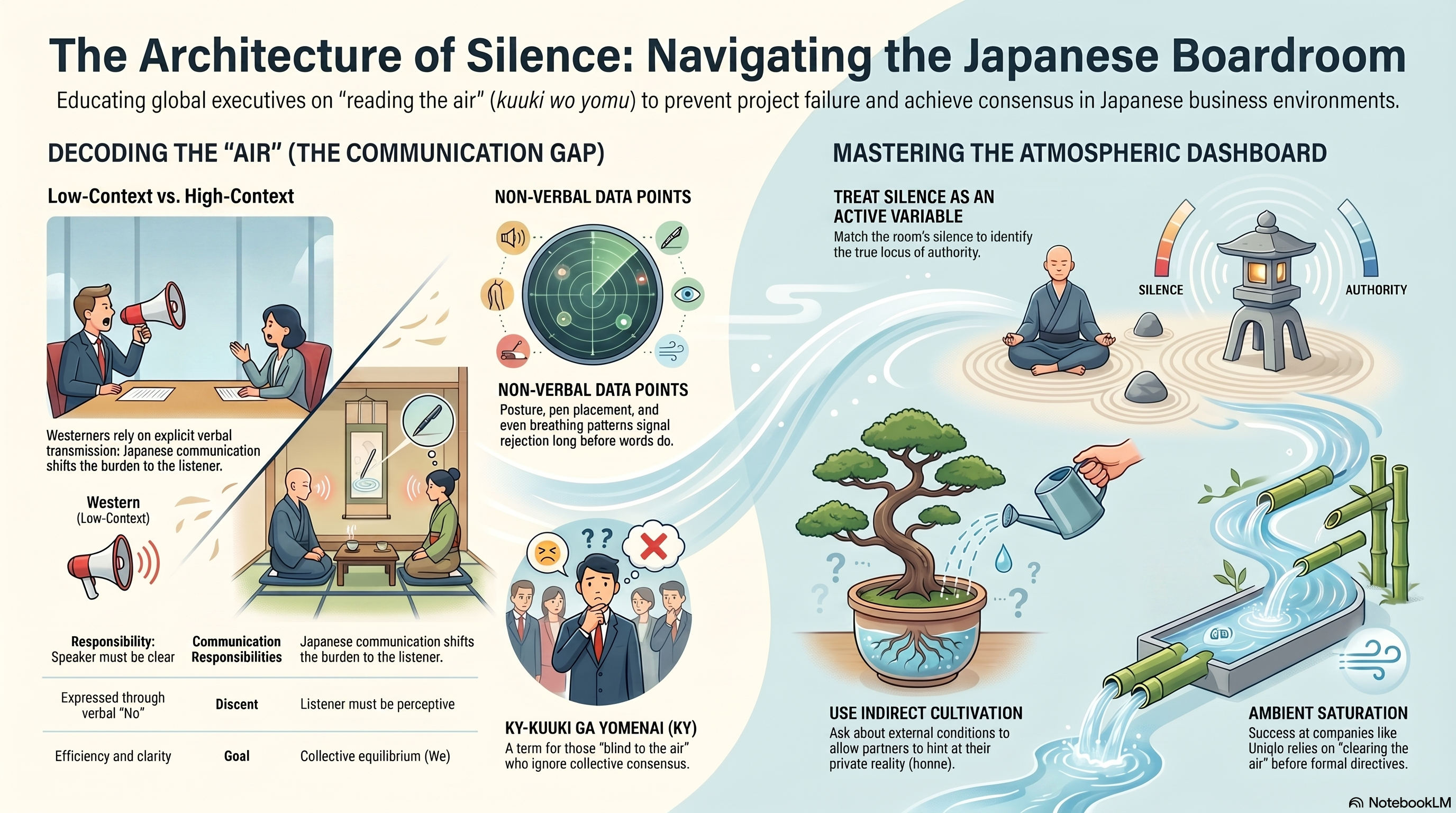
Western corporate communication relies almost entirely on explicit transmission. Ideas must be articulated, metrics must be displayed, and dissent must be voiced to exist. This low-context environment places the entire burden of clarity on the speaker. In Tokyo, the responsibility shifts entirely to the listener. Business is conducted within a high-context ecosystem governed by the practice of kuuki wo yomu, literally translated as “reading the air.”
This skill is an essential survival mechanism engineered to preserve the collective equilibrium of the enterprise. The “air” is the dense matrix of unvoiced sentiments, historical hierarchies, and emotional currents that fill a room during any human interaction. To ignore the air is to commit a grave social error, signaling that an individual is kuuki ga yomenai, someone completely blind to the collective consensus.
In a culture that views open confrontation as a failure of basic professionalism, the air functions as a protective shield. It allows organizations to register dissent, signal hesitation, and negotiate boundaries without forcing anyone to lose face through a public disagreement. The slight tilt of a head, the rhythm of a collective silence, or the specific manner in which a business card is held are all highly precise data points.
When the foreign executive drives an agenda forward simply because no one said “no,” they mistake the performance of polite harmony for strategic endorsement. They treat the boardroom as an empty vessel to be filled with their voice, remaining oblivious to the fact that the vessel is already full of an established, collective reality.
The Quiet Pivot of the Fast Retailing Empire
This reliance on ambient data is visible even within Japan’s most aggressive global enterprises, where speed is celebrated as a core value. Consider the operational methodology of Tadashi Yanai, the founder of Fast Retailing and the architect of the global Uniqlo empire.
Yanai is famous for his demanding leadership style and his desire to challenge traditional corporate stagnation. Yet, the internal mechanism that drives Fast Retailing’s rapid global supply chain pivots relies on a profound mastery of the consensus-driven atmosphere.
When Yanai introduces a radical shift in retail strategy such as completely re-engineering the logistics network to match changing consumer behavior, the transition succeeds because the leadership team reads the air of the market and the internal organization simultaneously.
The strategy is never rammed through a fractured executive board via a raw majority vote. Instead, the intent is allowed to saturate the corporate environment through a series of quiet, ambient signals long before the formal directives are issued.
The managers absorb the direction of the wind, aligning their respective divisions with the founder’s trajectory in advance. When the official policy is finally articulated, execution occurs with immediate velocity because the internal atmosphere has already been cleared of all resistance. The organization moves as a single organism because every leader has read the same air.
Mastering the Atmospheric Dashboard
Navigating this hyper-sensitive environment requires global leaders to completely recalibrate their sensory apparatus. Accelerating an initiative in Tokyo demands that you stop listening to what is said and start measuring what is felt.
The transformation begins by treating silence as an active variable rather than an empty pause. When a proposal is met with a prolonged, heavy quiet, resist the instinctive urge to fill the void with more explanation or defensive arguments.
Instead, match the silence. Allow the room to hold its posture, and observe who among the local team dominates the quiet. The individual who commands the silence is almost always the true locus of authority, regardless of their official title on the organizational chart.
Furthermore, shift your vocabulary from direct interrogation to contextual cultivation. Instead of asking a partner point-blank if they agree with a specific timeline, introduce the concept as a fluid possibility. Use phrasing that invites them to comment on external conditions rather than their personal stance.
Ask how the current market environment might impact the timeline, or how adjacent departments might perceive the transition. This indirect approach provides the local team with the necessary space to communicate their true honne (private reality) through the safe veneer of tatemae (public facade). By monitoring the subtle shifts in the room’s energy during these indirect exchanges, you gather the precise intelligence required to adjust your strategy before hitting a wall of institutional resistance.
The Bottom Line
The air in a Japanese boardroom is a highly accurate indicator of corporate alignment and institutional risk. True strategic velocity is achieved by learning to decode the non-verbal currents that govern the collective long before any formal vote is taken. By mastering the art of reading the atmosphere, you transform potential cultural friction into a powerful, invisible slipstream for your corporate goals.
Over to You
How can global executives effectively train their cross-cultural teams to monitor and document ambient feedback during high-stakes negotiations without relying on explicit verbal confirmations?


