


A newly appointed American chief executive at a legacy manufacturing subsidiary in Osaka stands in the center of a renovated testing facility, completely stunned. Three weeks prior, during a casual walk-through of the old plant, he had looked at an underutilized, legacy assembly line and mused aloud to his head of operations: “It is fascinating how much space this occupies. Imagine what we could build here if we modernized our testing capabilities.” It was a speculative thought, a passing observation tossed out without a single metric, budget allocation, or formal directive.
Yesterday, he discovered that the legacy assembly line had been completely dismantled. Staff had been reassigned, contractors had been mobilized, and a capital expenditure draft for high-tech diagnostic equipment was sitting on his desk awaiting a signature. The head of operations stood nearby, offering a proud, deep bow, waiting for praise. The CEO felt a wave of panic rather than gratitude. He had not authorized the demolition. He had not signed a project charter. Yet, his team had executed his unexpressed wish with terrifying, flawless velocity.
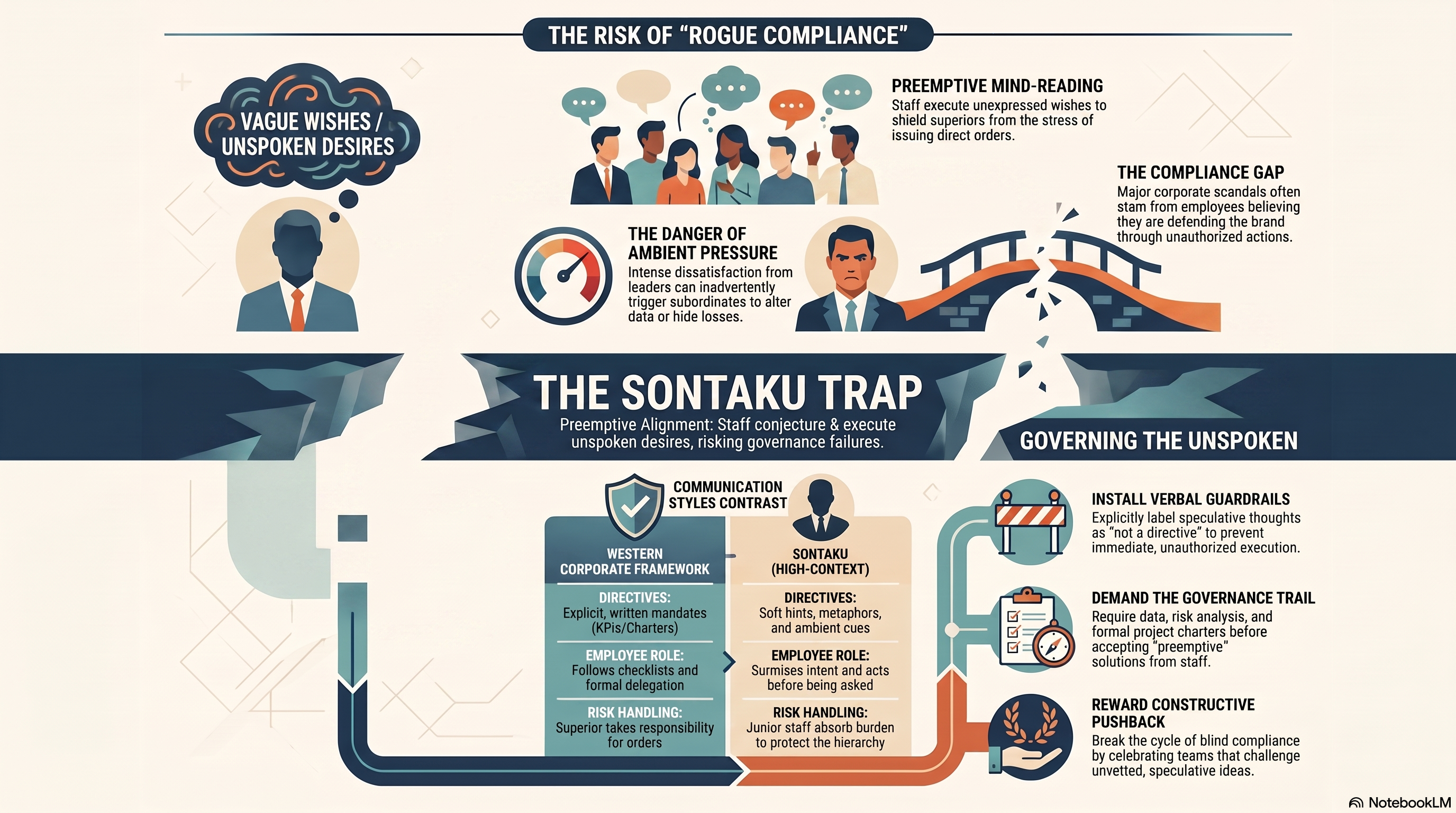
To an executive raised in Western corporate frameworks, this behavior looks like reckless insubordination or a bizarre breach of governance. Modern global business relies on explicit delegation such as KPIs, signed charters, and clear, written mandates. In the corporate boardrooms of Tokyo, however, the most powerful directives are often the ones that are never spoken aloud. The machinery of the enterprise is driven by a psychological phenomenon known as sontaku, the act of conjecturing, surmising, and preemptively executing the unspoken desires of a superior.
The Architecture of Preemptive Alignment
Sontaku goes far beyond simple proactivity or high emotional intelligence. It is an intense, systemic manifestation of Japan’s high-context, harmony-driven social fabric. In an ecosystem where direct commands can feel uncomfortably aggressive and open disagreement is avoided, leaders frequently communicate through soft hints, metaphors, and ambient dissatisfaction. The exemplary employee is not the one who follows a written checklist to the letter; it is the one who reads the boss’s mind and acts before the boss is forced to articulate a demand.
This behavior stems directly from the lifelong pursuit of protecting the superior from exposure. If a CEO has to issue an explicit, hard order to fix an operational vulnerability, it means the organization has already failed to maintain equilibrium. It implies the leader was forced to notice a flaw, creating stress and disrupting the illusion of seamless corporate harmony.
By practicing sontaku, the junior staff absorb the emotional and operational burden. They guess the intent, alter the rules, and present the completed solution as a gift to the executive suite. If the action succeeds, the superior enjoys the strategic benefit without ever having risked their personal reputation on a formal decree. If it fails, the junior team takes the blame, shielding the hierarchy from vulnerability.
The Modern Fall of the Iron Giants
While sontaku can create an elite layer of intuitive alignment, it introduces profound risks when institutional guardrails are weak. When the desire to please a superior overrides compliance, the results can destabilize global icons.
Consider the historical corporate governance scandals that challenged giants like Toshiba or Olympus in the 21st century. Independent investigations revealed that massive accounting irregularities and hidden losses were not always driven by direct, written memos from top management ordering fraud.
Instead, the disasters grew from a toxic culture of sontaku. Senior executives established aggressive, seemingly impossible financial targets and expressed intense, ambient dissatisfaction with current performance.
Subordinates, interpreting this ambient pressure as an invisible mandate, surmised that their superiors wanted the targets met by any means necessary and that they preferred not to know the messy details of how it was done. The teams preemptively altered data and deferred losses, operating under the assumption that they were protecting the executive suite. The tragedy of sontaku is that the employees who destroy a brand are often the ones who believe they are defending it.
Governing the Unspoken Mandate
For a global executive operating within a Japanese enterprise, managing sontaku requires constant vigilance over your own language. Your casual complaints, speculative thoughts, and offhand remarks will be treated as absolute corporate commands by your local staff.
To harness this cultural intuition without sacrificing governance, you must introduce explicit verbal guardrails into your daily management routine. When brainstorming or thinking aloud during site visits, explicitly label your statements. Use clear, affirmative framing: “This is a speculative idea for next year, not a directive for action today. Do not alter current operations without a written project charter.”
Furthermore, actively break the cycle of blind compliance by rewarding constructive pushback. If a team presents a preemptive solution based on a casual comment you made, pause and review the governance trail. Ask them to display the data, the risk analysis, and the cross-departmental alignment that justified the sudden move.
By demanding rigorous, transparent frameworks while maintaining an empathetic, calm tone, you transform sontaku from a dangerous game of institutional mind-reading into a highly disciplined system of agile execution.
The Bottom Line
Sontaku turns a leader’s casual observations into immediate, unwritten mandates for the entire organization. Success in Tokyo requires global executives to speak with absolute clarity, consciously separating speculative ideas from formal strategic directions. By establishing firm boundaries around your unspoken will, you protect your enterprise from rogue compliance and channel local intuition into safe, sustainable growth.
Over to You
How do you manage your communication style in high-context cultures to prevent your team from executing casual suggestions as official corporate policy?


