


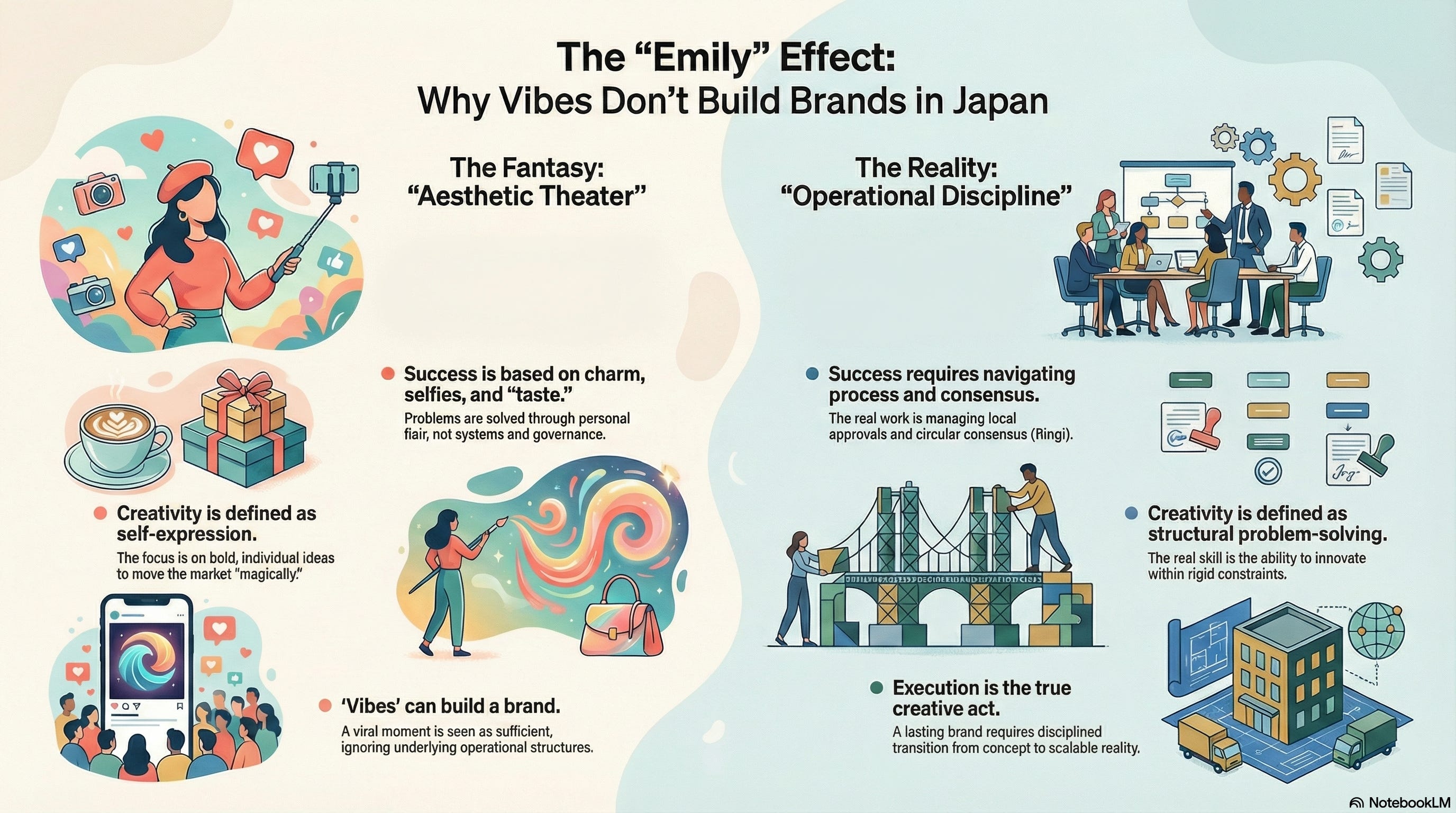
At Inside Brand Japan, we see this friction firsthand. Each year, a fresh cohort of interns and young employees arrives in Tokyo with a vision of brand-building shaped by the “Emily” archetype: a world where problems are solved through charm, selfies, and “taste” rather than systems and governance.
This portrayal is more than just entertainment; it is a structural risk. When talent enters the market expecting an aesthetic theater of “vibes,” the collision with reality is immediate, expensive, and demoralizing.
The Cost of the Lifestyle Myth
In Japan, the system is designed to evaluate proven readiness and long-term stability. The “Emily” fantasy trains talent to seek “lifestyle proximity”, the desire to be near the brand instead of the operational depth required to actually manage it.
Even if you haven’t seen the show, the archetype is recognizable: the belief that a bold idea is enough to move a market. Japan exposes the flaws in this logic immediately:
Creativity is misdefined: Young talent arrives thinking creativity is self-expression. In a consensus-driven environment, true creativity is structural problem-solving, the ability to innovate within rigid constraints.
Friction is misinterpreted: In the fantasy, things happen “magically.” In reality, navigating local approval flows and circular consensus (Ringi) is the work. When talent expects magic, they see this friction as a failure rather than the process itself.
Vibes lack Governance: You can create a “viral moment,” but without alignment between HQ and the local retail structure, that moment has no shelf life. “Vibes” collapse the moment they hit the supply chain.
Post-Fantasy Brand Building
The future belongs to firms that trade romance for precision. To scale in Japan, we must move beyond the model of creative authority without responsibility. The true creative act is not the idea itself, but the execution, the disciplined transition from a high-level concept to a functional, scalable reality.
Dismantling this fantasy allows our teams to see that accountability is not a burden. It is the structural requirement that turns a fleeting “moment” into a lasting brand.
Over to You
Are you recruiting for “lifestyle proximity,” or are you building a team that understands brand-building as a high-stakes operational responsibility?


