


The quarterly review for the Tokyo-based pharmaceutical subsidiary was, on the surface, a masterclass in stability. Every KPI was met with surgical precision. The turnover rate was a flat zero percent, a figure that the visiting American COO touted as a sign of “unshakeable loyalty.” For three years, the local team had manually reconciled thousands of regulatory compliance entries into an aging, proprietary database that crashed twice a week. The process was agonizingly slow, redundant, and stripped the researchers of their actual creative bandwidth.
When the COO finally suggested an upgrade to a global, streamlined cloud system, he expected a sigh of relief. Instead, he was met with polite, opaque hesitation. “We are managing,” the local director said, his smile tight. “The current system is our responsibility.”
What the COO didn’t see was the “Shadow Shift.” To meet those perfect KPIs, the team was staying until 11:00 PM every night, not out of passion, but to compensate for the broken software. They were performing a ritual of endurance. Two months later, the local director suffered a stress-induced collapse, and three senior researchers resigned on the same day. The “loyal” team hadn’t been thriving; they had been burning at a low, invisible heat until there was nothing left but ash.
The Virtue of Gambaru
To understand why a Japanese team will walk into a fire without mentioning the heat, one must understand the cultural weight of Gambaru. Often translated as “to do one’s best,” its literal roots are closer to “to stand firm” or “to persist.” In a Western context, persistence is a tool used to achieve a goal. In Japan, persistence is often the goal itself.
There is a profound moral status granted to those who endure hardship without complaint. This is the “Aesthetics of Suffering.” To complain about an inefficient process or a toxic manager is seen as a lack of character (shuyo). It suggests that the individual is placing their personal comfort above the harmony of the group. If the rest of the team is suffering in silence, to speak up is to betray your peers by implying their endurance is unnecessary.
This creates a “Spiral of Silence.” Because Japanese communication is high-context meaning the most important information is often unsaid, the lack of complaints is frequently misread by global leaders as an endorsement of the status quo. In reality, the team may be trapped in a cycle of Gaman (stoic endurance), waiting for a leader with enough “situational intuition” (kuuki wo yomu) to notice the strain and intervene without being asked.
Reading the Air for the Breaking Point
In a traditional corporation, the “breaking point” does not look like a heated argument or a formal grievance. It is a subtle, atmospheric shift. If you wait for a whistleblower, you will wait until the office is empty. Instead, you must look for the “Fracture Signals” that precede the collapse.
The first signal is The Ritualization of Inefficiency. When a team stops trying to improve a broken process and instead begins to build elaborate “workarounds” to protect it, they have moved from engagement to survival. They are no longer working for the company; they are working to protect the kata (the form) from failing.
The second signal is The Death of “Small Talk” (Zatsudan). In a healthy Japanese office, the space between tasks is filled with low-stakes social grooming, discussions about the weather, lunch, or minor office news. When a team is nearing a breaking point, this disappears. The office becomes unnervingly silent. The “air” feels heavy, and interactions become purely transactional. This is a sign that the collective energy required to maintain the mask of Gambaru has depleted their capacity for social connection.
The third signal is The Rise of “Safety Presenteeism.” You will see staff staying late not to finish specific tasks, but because they are afraid that being the first to leave will signal a lack of commitment to the shared struggle. If your team is consistently in the office two hours after the work is done, they aren’t being productive, they are performing a vigil for a dying process.
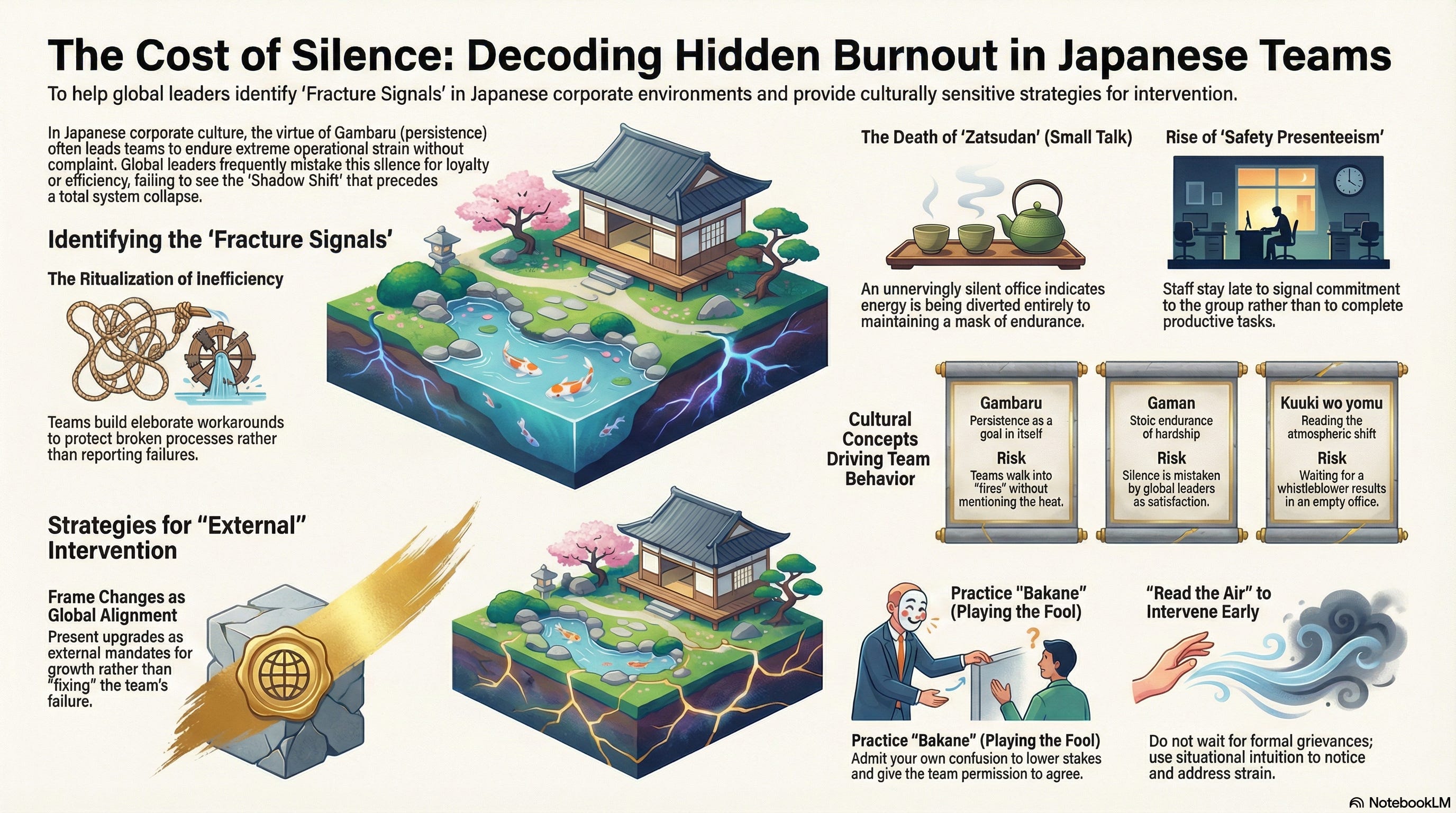
The Strategy: The “External” Intervention
The mistake most global leaders make is asking directly: “Is there a problem?” This forces the Japanese employee into a binary choice: lie to preserve harmony or speak the truth and lose face. Neither is an attractive option.
Instead, the effective strategy is to frame the change as an External Mandate for Growth, rather than a correction of a failure. Do not ask if the process is broken; assume it is outdated and frame the new solution as a “Global Alignment Initiative.” This allows the team to abandon the toxic process without admitting they couldn’t handle it. You are not “fixing” them; you are “upgrading” the firm’s capabilities.
Furthermore, utilize the Nomikai (after-work drinks) or 1-on-1 “off-the-record” chats to practice Bakane, playing the fool. By admitting your own confusion about a process (”I’m struggling to understand why we do step five this way; it seems so difficult for you all”), you lower the stakes. You give them permission to agree with you without feeling like they are initiating a complaint. You are essentially “pulling the heat” out of the room so they don’t have to carry it.
The Bottom Line
A Japanese team’s silence is not a sign of satisfaction; it is often a sign of immense, sacrificial effort. If you do not learn to read the invisible strain of Gaman, you will mistake their endurance for efficiency, right up until the moment the system breaks beyond repair.
Over to You
Have you ever discovered a major operational flaw that your team had been quietly “working around” for months without telling you? Would you like me to draft a set of “low-stakes” questions you can use to gauge your team’s actual stress levels?


