


The digital clock on the wall of the Osaka manufacturing firm clicks to 8:45 AM. A soft, electronic chime echoes through the open-plan office, a sound that in any other culture might signal a coffee break or a shift change. Here, it triggers a physical transformation. From the youngest intern to the gray-haired department head, every employee pushes back their ergonomic chair in unison. They move toward the center of the room, forming a large, slightly uneven oval.
A senior manager steps into the center. He begins to speak, his voice projecting a disciplined energy that feels at odds with the early hour. He recites the Kigyo Rinen, the corporate philosophy line by line. The team responds in a rhythmic cadence, their voices overlapping in a practiced drone. They speak of harmony, of contribution to society, and of the pursuit of perfection. For the newly arrived European executive standing at the edge of the circle, the experience feels intensely uncomfortable. It feels liturgical. It feels like a relic of an industrial era that the rest of the world has long since abandoned for the sake of agile workflows and individual autonomy.
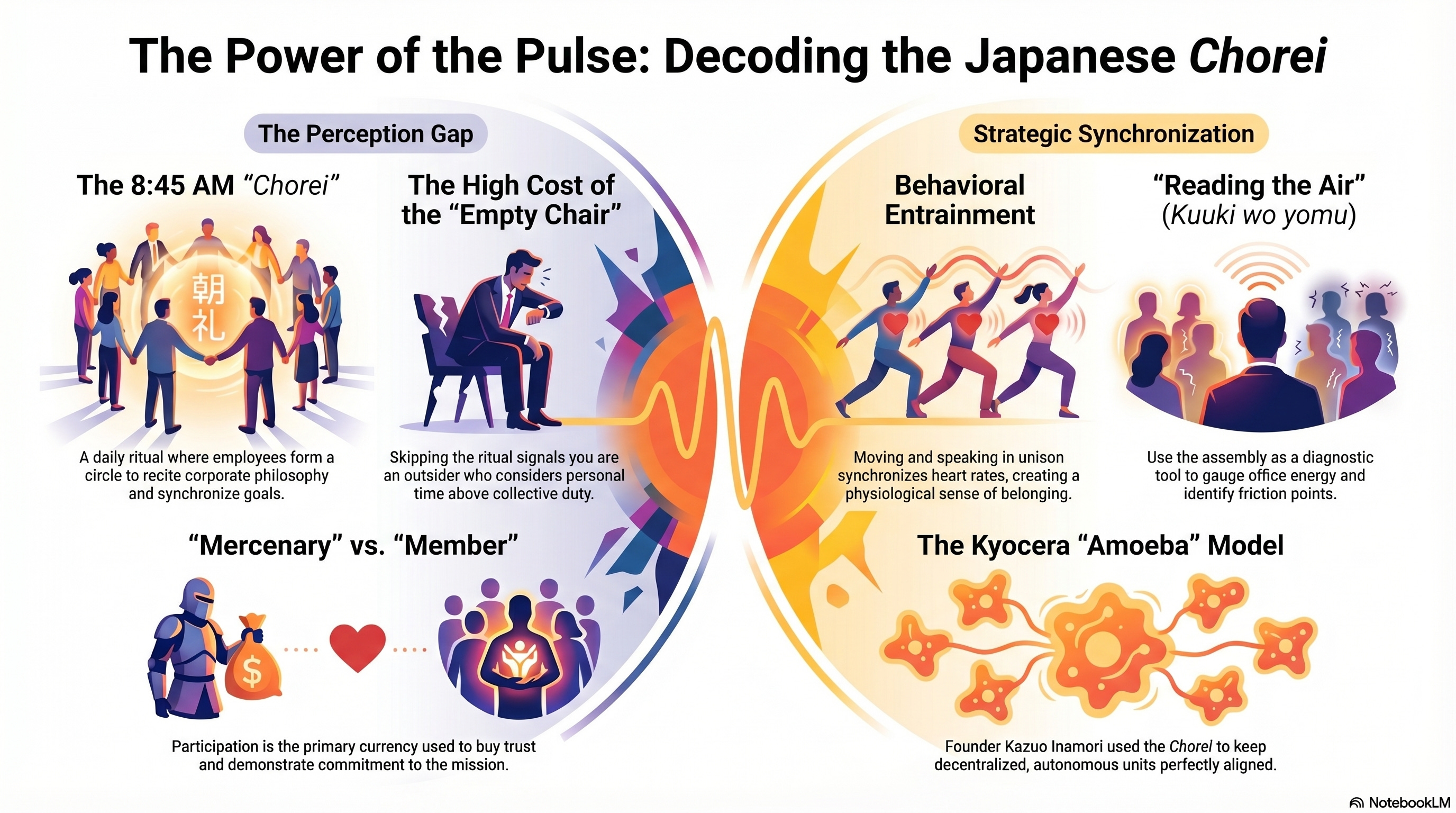
This is the Chorei, the morning assembly. To the uninitiated, it looks like a waste of billable minutes or a performative display of mindless obedience. To the seasoned insider, however, the Chorei is the most important diagnostic tool of the workday. It is the moment when the company’s internal clock is calibrated. It is the physical manifestation of the “Membership-type” employment system, where the individual’s identity is temporarily subsumed by the goals of the collective.
The Mechanics of Corporate Resonance
The survival of the Chorei in 21st-century Japan is a testament to the enduring power of Wa (harmony). In a high-context culture where much of what is important remains unsaid, the morning assembly provides a rare moment of explicit synchronization. The act of standing in a circle is a deliberate choice. A circle has no head and no foot; it represents a closed system where everyone is visible and everyone is accountable.
The psychological impact of the ritual is grounded in the concept of “behavioral entrainment.” When a group of people moves, breathes, and speaks in unison, their heart rates tend to synchronize. This creates a physiological sense of belonging that precedes any intellectual agreement with the corporate mission. The Chorei bypasses the logical brain and speaks directly to the social animal. It reinforces the idea that the firm is a living organism rather than a mere collection of contracts.
Consider the example of Kyocera, the multinational ceramics and electronics giant. Its founder, the legendary Kazuo Inamori, built the company on a foundation known as the “Kyocera Philosophy.” Inamori believed that for his revolutionary “Amoeba Management” system to work where small units of employees operate with significant autonomy, every single person had to be perfectly aligned with a core set of ethical and operational values.
At Kyocera, the Chorei is the theater where this philosophy is kept alive. Employees do more than just recite slogans; they reflect on how the philosophy applies to their specific tasks for that day. This practice transformed a small suburban workshop into a global titan. For Inamori, the Chorei was the glue that prevented the “Amoebas” from drifting apart. It provided the shared gravity necessary to hold a decentralized organization together. Without this ritual, the autonomy he granted his workers would have devolved into chaos.
The High Cost of the Empty Chair
For the global executive, the temptation to skip the Chorei is immense. There are emails to answer, global calls to schedule, and a general sense that one’s time is too valuable for “corporate chanting.” However, in a Japanese organization, your presence in the circle is a measure of your commitment to the team’s shared burden.
Skipping the ritual sends a clear, albeit silent, message: “I am an outsider.” In the eyes of your Japanese colleagues, your absence suggests that you consider yourself above the rules that govern everyone else. This creates a rift that is nearly impossible to close through professional competence alone. You may be a brilliant strategist, but if you are not in the circle at 8:45 AM, you are perceived as a mercenary, someone who is there for the paycheck, but not for the mission.
The reputational damage of skipping the Chorei is compounded by the Japanese concept of Giri (duty). Your participation is a form of social payment. By standing with the team, you acknowledge the difficulty of the day ahead and signal your willingness to share in the collective effort. When a leader is absent, the “rhythm” of the office is disrupted. The junior staff feel less seen, and the middle management feels less supported.
Turning the Philosophy into Performance
Mastering the Chorei requires a shift from viewing it as a chore to seeing it as a strategic vantage point. The ritual offers a unique opportunity to “read the air” (Kuuki wo yomu) of the office. By observing the posture, tone, and energy of your colleagues during the assembly, you can identify potential friction points before they manifest in meetings. Is the energy low in the sales department? Is there a subtle tension between two managers in the circle? The Chorei provides a baseline of the organization’s health.
Instead of merely enduring the ritual, use it to ground your leadership. Standing in the circle allows you to be visible in a non-authoritarian way. It humanizes you. It shows that despite your global title and your foreign background, you are subject to the same rhythms as the person who manages the warehouse.
The most effective strategy for the global leader is “Engaged Observance.” You do not need to chant with the fervor of a true believer, but you must be physically present and mentally attentive. Stand with a posture that signals respect. Follow the movements of the group. If there is a moment for a short speech, a common feature of many Chorei use it to connect the corporate philosophy to a real-world win the team achieved the day before. This bridges the gap between the abstract slogans and the practical reality of the business.
By treating the Chorei as a vital synchronization of the company’s internal clock, you validate the culture of your Japanese partners. You transform a potential point of cultural friction into a powerful tool for building rapport and demonstrating your status as a core member of the collective.
The Bottom Line
The Chorei is the physical heartbeat of the Japanese corporation, a ritual that prioritizes collective resonance over individual expression. Participation is the primary currency of belonging in a culture where presence often carries more weight than words. To stand in the circle is to accept the social contract of the Japanese workplace; to stay at your desk is to signal your departure from the team.
Over to You
Have you ever noticed a change in how your Japanese colleagues approach you after you began consistently showing up for the morning rituals?


