


Imagine a crisp autumn morning in a high-rise overlooking Marunouchi. A newly appointed European managing director sits at his desk, nursing an espresso, feeling a sense of accomplishment. He has spent the weekend drafting a streamlined, elegant project proposal. To demonstrate agility and transparency, he hits send, routing it directly to the three department heads whose teams will execute the strategy. He deliberately spares the executive suite and adjacent departments from yet another email.
By 2:00 PM, an unsettling quiet pervades the floor. The responses from his department heads are polite, non-committal, and icy. Later that evening, over a tense glass of sake in Yurakucho, a senior Japanese colleague leans in to deliver the diagnostic blow: “You blindsided them. And worse, you left out the rest of the family.”
To the uninitiated western executive, hoarding information is the ultimate corporate sin, while radical transparency is the virtue that unlocks velocity. In the glass towers of Tokyo, however, information is handled with a completely different set of rules. It is treated as communal property, managed through a system that global insiders call information socialism.
The Commune of the Corporate Inbox
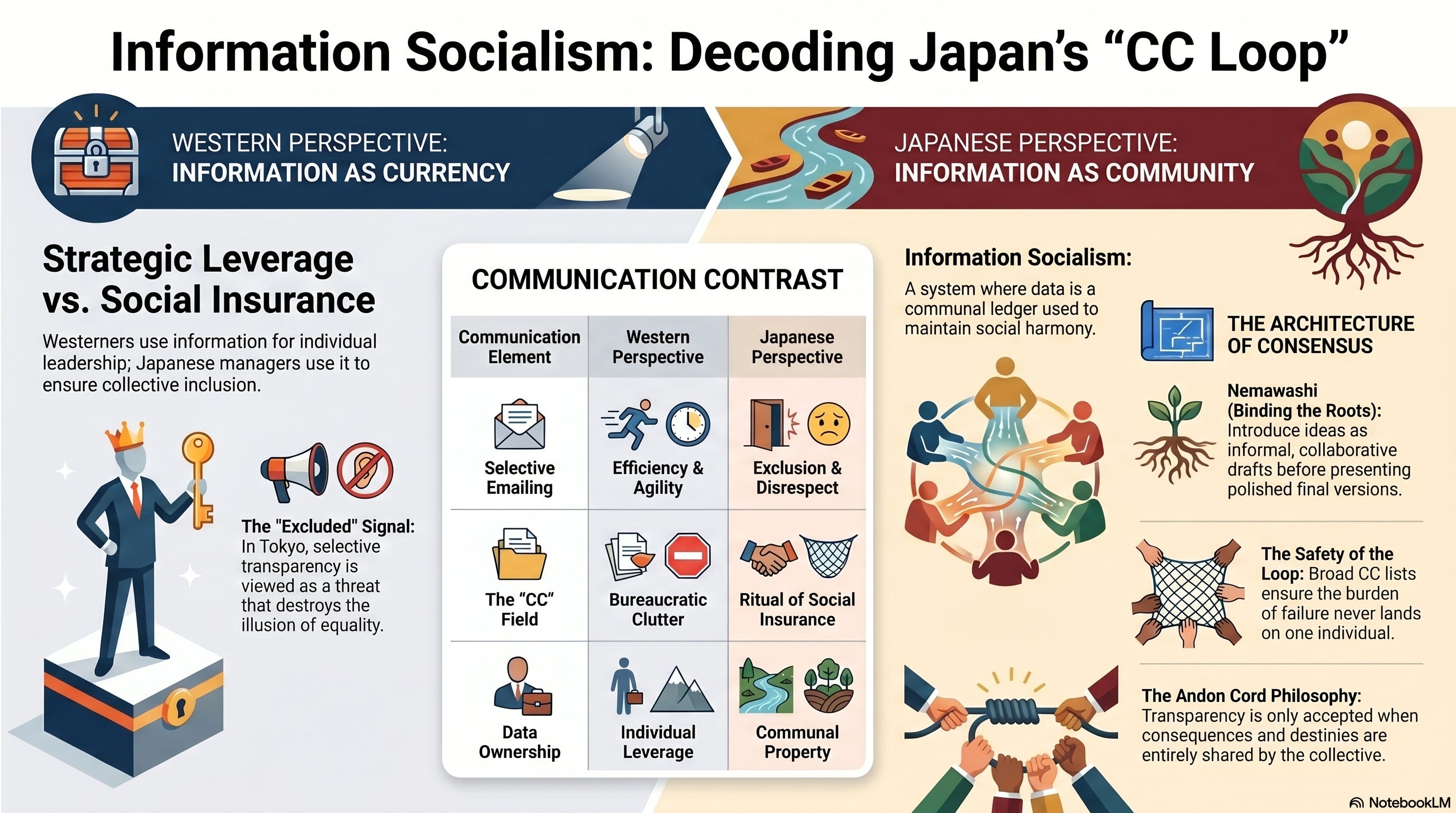
Western corporate structure treats information like currency, individuals hoard it for leverage, or distribute it strategically to demonstrate leadership. The Japanese organization operates on a communal ledger. Information belongs to the collective, and hoarding it is a profound disruption of the social fabric. Conversely, distributing it selectively creates an immediate hierarchy of the “included” versus the “excluded,” which destroys the foundational illusion of corporate equality.
This explains the phenomenon of the endless CC loop. When a Japanese manager copies twenty people on a seemingly mundane operational update, they are not practicing inefficient bureaucracy. They are executing a sophisticated ritual of social insurance. Inclusion signals respect; it reassures every tangential stakeholder that they remain a valued node in the corporate network.
When our European managing director emailed only the three direct executioners, he inadvertently committed a double offense. He signaled to the omitted parties that their opinions were irrelevant, and he isolated the recipients, forcing them into a spotlight they did not ask for. In a culture where safety resides in numbers, being the sole custodian of a new corporate directive feels less like empowerment and more like being left out on a limb during a storm.
This communal ownership of data is deeply tied to the philosophy of ringisho, the traditional bottom-up consensus-building document. Long before a formal decision is ever stamped with a hanko seal, information must slowly saturate the organization, drifting horizontally across departments like smoke. This deliberate saturation ensures that when a crisis occurs, the burden of failure never lands on a single pair of shoulders. Responsibility, like the information itself, is socialized.
The Precedent of the Shared Destiny
This absolute insistence on collective awareness is not a modern corporate quirk. It is an evolutionary adaptation that has preserved some of Japan’s oldest institutions through centuries of economic volatility. Consider the operational philosophy of a titan like Toyota.
The famous Andon cord system where any assembly line worker can pull a cord to halt the entire production ecosystem is often celebrated in Western business schools as a triumph of quality control. The deeper cultural reality, however, focuses on the absolute democratization of information. When the cord is pulled, a light flashes on a public board. The problem is instantly visible to everyone, from the factory floor to the plant manager.
Toyota’s success with this model relies on a profound cultural understanding: transparency is safe only when the consequences of that transparency are entirely shared. The line worker is never penalized for stopping production, because the defect is viewed as a collective challenge, not an individual failure.
[Western Model]   Information -> Strategic Leverage -> Individual Accountability
[Japanese Model]  Information -> Communal Property  -> Collective Security
Problems arise when global companies attempt to import the transparency of the Andon cord without importing the communal safety net that supports it. When a foreign leader demands radical transparency in a typical Tokyo subsidiary, employees hear a threat. They assume that open information will be used to assign individual blame. Without the absolute guarantee of collective destiny, total openness feels like exposure. Suspicion arises because the sudden distribution of unpolished data looks like an attempt to bypass the traditional, protective architecture of consensus.
The Architecture of the Soft Launch
Navigating this terrain requires shifting from a mindset of “informing” to one of “saturating.” True alignment in Japan is achieved not through a singular, dramatic presentation, but through a series of quiet, informal steps.
Successful leaders utilize the practice of nemawashi, literally meaning “binding the roots” of a plant before it is moved. Instead of sending a polished proposal to a select group of decision-makers, the strategy must be introduced in its infancy as a collaborative draft.
Phase 1: The Seed (Informal, one-on-one chats with trusted peers)
Phase 2: The Saturation (Broadening the CC circle to include tangential stakeholders)
Phase 3: The Formalization (The group meeting where everyone already agrees)
Begin by sharing early-stage ideas individually and informally with key stakeholders, asking for their guidance rather than their approval. This removes the defensive posture that sudden transparency creates.
When utilizing email, embrace the communal loop. Include adjacent teams and senior advisors in the CC field, explicitly framing the message as a shared update for their reference rather than an action item demanding their immediate response. This simple adjustment transforms an exclusive directive into an inclusive, respectful invitation to maintain harmony.
The Bottom Line
Information in a Japanese organization is the connective tissue that holds the collective together, not a tool for individual advancement. True executive velocity in Tokyo is achieved by honoring the communal loop, ensuring that every stakeholder is included in the flow of knowledge well before the final decision is reached. By socializing your insights early, you transform transparency from an institutional threat into your greatest strategic asset.
Over to You
How have you adjusted your communication style to build consensus across diverse corporate cultures?


