


The lighting in the windowless conference room of a Tier-1 electronics manufacturer in Kawasaki was aggressively neutral. On the table sat a single Manila folder and a lukewarm cup of canned coffee. Tanaka-san, a fifty-four-year-old manager who had spent thirty-one years at the firm, sat opposite a human resources director half his age. Tanaka-san had survived the “Lost Decade,” the 2008 crash, and the pandemic by being invisible, by being the ultimate “membership-type” employee who arrived early and left late. He assumed his loyalty was a currency that never devalued.
The HR director spoke with a rehearsed softness. He used the term Kibo Taishoku, voluntary retirement. It was a euphemism for a structural purge. The company was pivoting to software-defined vehicles, and Tanaka-san’s decades of expertise in analog circuit procurement were suddenly a liability on the balance sheet. For the first time in his adult life, Tanaka-san realized the “shojiki” (honesty/integrity) of the company was a ghost. The invisible cord that tied his identity to the corporate logo had been severed with a polite bow and a severance check.
This scene is currently playing out across the Japanese archipelago as the pillars of Shushin Koyo (lifetime employment) crumble under the weight of global competition and a shrinking workforce. For decades, the “lifelong contract” was the bedrock of Japanese social stability. It provided a predictable path: hire at twenty-two, marry at twenty-eight, buy a house at thirty-five, and retire with a golden watch at sixty. Today, that path is obstructed by a new reality where tenure is a secondary metric and “reskilling” is a survival requirement.
The Architecture of the Membership-Type Trap
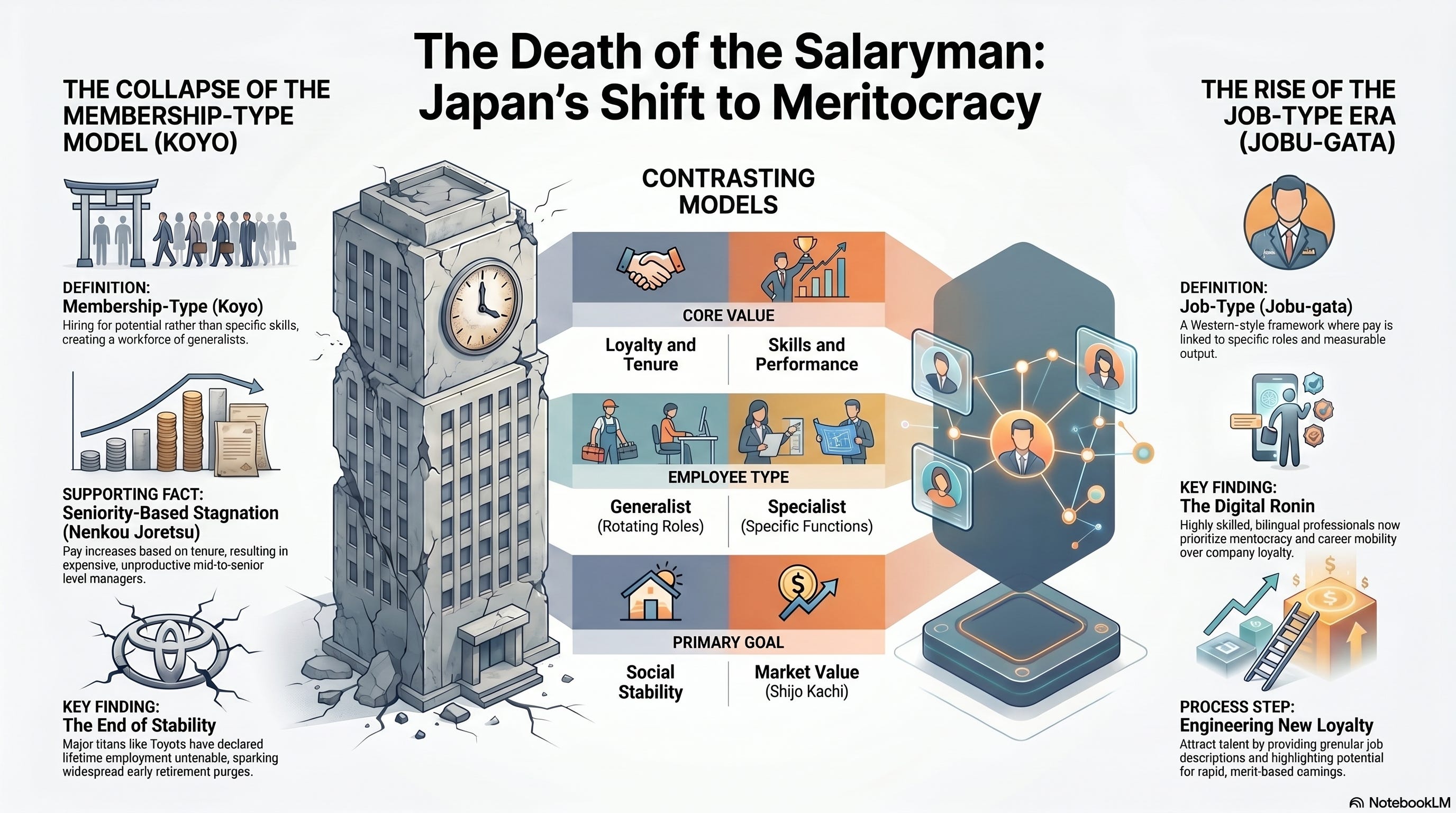
The collapse of the traditional model is a structural necessity rather than a cultural choice. The post-war economic miracle was built on the “Membership-type” (Koyo) model. In this system, the firm hires “potential” rather than “skills.” The employee is a blank canvas, expected to move between departments every three years, from accounting to sales to logistics, creating a workforce of generalists who know everything about the company but very little about the global market.
This model relies on a perpetually expanding economy. When growth stalled, companies were left with a top-heavy demographic of expensive, mid-to-senior level managers whose salaries continued to rise based on seniority (Nenkou Joretsu) rather than productivity. The “window-seat tribe” (Madogiwazoku), veteran employees who have no actual duties but remain on the payroll to preserve the appearance of lifetime employment became a symbol of this systemic inefficiency.
A definitive turning point occurred when Akio Toyoda, the former president of Toyota Motor Corporation and a titan of the Japanese establishment, admitted in a press conference that “lifetime employment is becoming difficult for companies to maintain.” When the head of the company that perfected the “Toyota Way” admits the model is untenable, the signal is clear: the safety net is gone.
Since that declaration, we have seen a surge in “Early Retirement Programs” at companies like Panasonic, Fujitsu, and Honda. These are not signs of failure; they are signs of a desperate pivot toward the “Job-type” (Jobu-gata) model. In this new framework, Japanese firms are attempting to mirror Western structures where pay is linked to a specific role and measurable output. This shift is creating a psychological schism in the Japanese workplace. Older workers feel betrayed by a contract they thought was sacred, while younger workers are embracing a newfound, albeit anxious, mobility.
The Rise of the Digital Ronin
For the global executive, the death of lifetime employment provides a rare strategic opening. Historically, the best talent in Japan was “locked up” in the Keiretsu systems. Attracting a top-tier engineer from Hitachi or a brilliant strategist from Mitsubishi was nearly impossible because the social cost of “betrayal” was too high. Today, that talent is increasingly “on the move.”
The new Japanese professional is a “Digital Ronin.” They are often highly skilled, bilingual, and disillusioned with the slow-moving, seniority-based hierarchies of legacy firms. They are looking for the very things that global firms excel at providing: meritocracy, clear career paths, and the ability to contribute to global projects. However, leading this new class of talent requires a fundamental shift in management style. You are no longer managing “members” of a family; you are managing “contractors” of a mission.
Engineering the New Loyalty
Navigating this fluid labor market requires a strategy that balances the desire for Western-style performance with the lingering Japanese need for psychological safety. To attract and retain the best talent in this post-lifetime era, global leaders must implement three specific affirmative shifts:
Implement “Job-type” Clarity Immediately: The greatest source of anxiety for Japanese professionals transitioning from legacy firms is the ambiguity of the “global” role. In a Japanese firm, your “job” is whatever your boss says it is today. You must provide “Job Descriptions” (Jobu-disukuripushon) that are granular and stable. This clarity acts as a substitute for the old security of the lifelong contract.
Create “Lateral Mobility” Within the Firm: One reason the old model was attractive was the variety of internal roles. You can replicate this by offering “internal gig” systems where employees can spend 20% of their time on projects in different departments. This satisfies the Japanese comfort with generalism while focusing on specific skill acquisition.
Focus on “Career Wealth” Over Tenure: In the old system, wealth was accumulated through time. In the new system, you must demonstrate how working for your firm increases the employee’s “Market Value” (Shijo Kachi). Frame the employment relationship as a “mutual investment.” You provide the platform for them to become a global-tier professional, and they provide the high-level output to drive your Japan strategy.
Instead of fighting the instability of the market, use it as a recruiting tool. Highlight the fact that in your organization, a thirty-year-old can out-earn a fifty-year-old based on merit. For the high-potential Japanese professional who has watched their father or uncle get “retired” early after a lifetime of loyalty, this meritocratic promise is the most persuasive argument you have.
The transition to a fluid labor market is also driving the growth of the “Side-Hustle” (Fukugyo) culture in Japan. Many firms now explicitly allow employees to take on outside projects. Supporting this trend within your own team can act as a powerful retention tool. It signals that you trust your employees and that you value their multi-dimensional growth. This builds a new kind of loyalty, one based on mutual respect and shared growth rather than the outdated obligation of the “company man.”
The Bottom Line
The collapse of lifetime employment in Japan is a structural correction that is finally unlocking the country’s latent talent. For the global executive, this shift represents the end of the “talent lock” and the beginning of a truly competitive meritocracy. Success in this new landscape depends on your ability to provide the clear, performance-based structures that legacy Japanese firms are currently struggling to build.
Over to You
Does your current recruitment strategy in Tokyo still rely on the old assumptions of corporate loyalty, or are you actively targeting the “Digital Ronin” who are fleeing the legacy system?


