


The digital display above the ATM in the lobby of a Roppongi Hills tower flickered as a mid-level director from a German automotive firm inserted his card. It was mid-December. Outside, the streets were draped in the crystalline blue lights of the “Keyakizaka Illumination,” and the air carried the festive hum of a city preparing for the year-end Bonenkai parties. The director had spent the last twelve months exceeding every KPI set by his headquarters in Stuttgart. He expected the “Winter Bonus” notification to reflect his personal triumph, a windfall to fund a luxury family vacation or a significant investment.
When the slip printed, his brow furrowed. The amount was exactly 2.5 times his monthly base salary. It was the same amount his peers in the logistics and HR departments received, despite their vastly different performance metrics. He realized, with a sinking feeling, that his “performance bonus” had been decided months ago by a collective bargaining agreement he had never read. He had mistaken a structural salary deferment for a meritocratic reward.
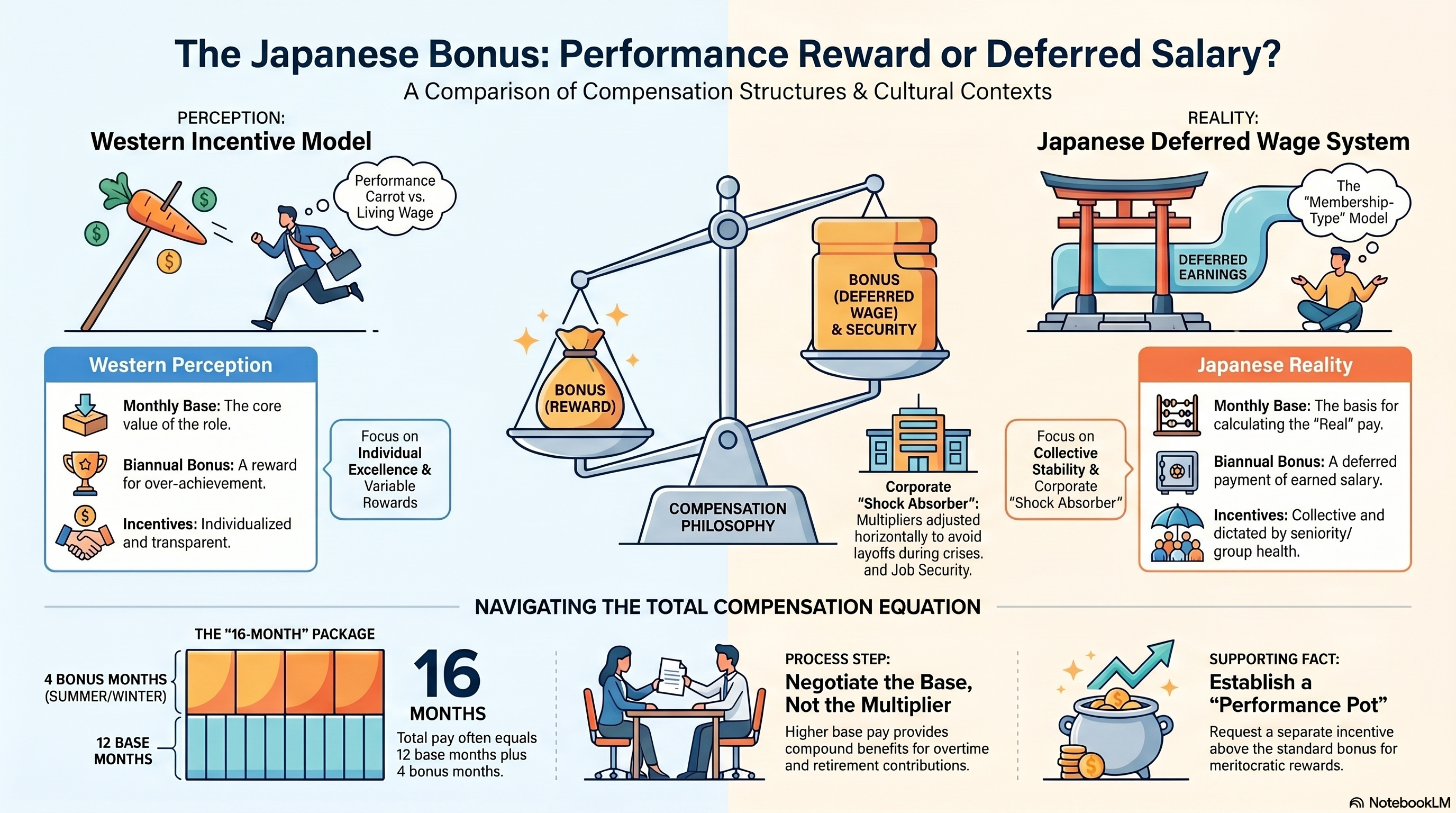
This scenario is the primary source of “compensation shock” for foreign professionals entering the Japanese market. In the global West, a bonus is a variable “extra”, a carrot dangled to drive individual excellence. In Japan, the shoninkyu (starting salary) and the subsequent shoyo (bonus) are two halves of a single, indivisible whole. To understand the Japanese bonus is to understand the Japanese definition of financial security: it is a system designed to protect the collective’s survival by withholding a portion of the employee’s earnings until the company is certain the season’s bills are paid.
The Seasonal Recalibration of the Living Wage
The Japanese bonus system functions as a forced savings mechanism. Most major corporations distribute these payments twice a year, once in the summer (夏季賞与 - Kaki Shoyo) and once in the winter (冬季賞与 - Toki Shoyo). These payments are so deeply integrated into the national economy that entire industries, from electronics retailers to department stores, calibrate their major sales events to coincide with these two specific months.
The logic of this system is grounded in the “Membership-type” employment model. In this framework, the company assumes a paternalistic responsibility for the employee’s long-term financial health. By paying a lower monthly base salary and providing two large lump sums, the firm ensures the employee has the liquidity required for major life expenses: the down payment on a home, the seasonal change of clothes, or the significant cost of New Year’s celebrations.
This structure provides the corporation with a massive, interest-free “liquidity buffer.” By deferring 20% to 40% of the total annual compensation until the end of each half-year, the company maintains a cash reserve that protects against sudden market downturns. If the company faces a temporary crisis, they can reduce the bonus multiplier slightly across the entire workforce to avoid layoffs. The employee trades the potential for a massive, performance-linked upside for the certainty of long-term employment.
The Solidarity of the Variable Margin
A definitive example of this collective resilience occurred at Toyota Motor Corporation during the global financial crisis and the subsequent “recalls” crisis of 2009-2010. While many of its global competitors were forced into massive layoffs and structural liquidations, Toyota maintained its “Lifetime Employment” ethos. The mechanism that made this possible was the bonus.
During those lean years, the labor union and management agreed to significant cuts in the bonus multiplier. The “pain” was distributed horizontally across the entire organization. Every employee, from the assembly line to the executive suite, accepted a smaller lump sum. This variable portion of the pay act as a shock absorber. Because a significant portion of the total compensation was not “guaranteed base pay,” the company possessed the financial flexibility to retain its talent through the storm.
This highlights the cultural divide in the definition of “Fairness.” In a Western firm, fairness means rewarding the high performer while letting the low performer go. In a Japanese firm, fairness means ensuring the survival of the group, even if it means the high performer’s “extra” effort is used to subsidize the group’s security. When a foreign hire complains that their bonus is “fixed” or “linked to the company’s performance rather than mine,” they are essentially arguing against the very insurance policy that guarantees their job security during a recession.
Navigating the Total Compensation Equation
For the global executive or the foreign hire, negotiating a package in Tokyo requires a shift from “Monthly Thinking” to “Annual Calculation.” In London or New York, the negotiation focuses on the “Base.” In Tokyo, the base is merely the numerator in a complex fractional equation.
When a Japanese recruiter or HR manager quotes a salary, they often lead with the Total Annual Compensation (TAC). This figure includes the expected bonus, which is typically expressed in “months.” For instance, a “16-month package” implies 12 months of base pay plus 4 months of bonus (2 in summer, 2 in winter). The trap for the outsider is assuming that the 4-month portion is a “variable” they can influence through hard work.
The strategy for a successful negotiation involves three affirmative steps:
Establish the Floor: During the offer stage, clarify the “Guaranteed Multiplier.” Many foreign-affiliated firms (Gaishikei) offer a hybrid model where a portion of the bonus is fixed (the deferred salary) and a portion is performance-linked. Ensure that the fixed portion is codified in the contract as “base deferment” rather than “discretionary bonus.”
Negotiate the Base, Not the Multiplier: It is far more effective to push for a higher monthly base salary than a higher bonus multiplier. Because the bonus is a multiplier of the base, an increase in the base provides a compound benefit. A higher base also increases the value of other benefits, such as overtime pay (zangyo-dai) and retirement contributions.
Define the “Performance Pot”: If you are in a high-impact role like Sales or Strategy, request a “Performance-Linked Incentive” (PLI) that sits above the standard corporate bonus. Frame this as an “Acceleration Premium” for exceeding targets that fall outside the standard group KPIs. This allows the Japanese firm to maintain its internal harmony for the standard bonus while providing you with the meritocratic reward you require.
For a Substack audience, you want to highlight the “cultural shock” between these two systems. Using bold headers with bulleted comparisons creates a much better reading experience than a dense table, especially for subscribers reading on their phones.
Here is the breakdown for the Compensation Comparison:
1. Monthly Base Salary
Western Perception: This is the “core value” of the role and the primary number used for negotiations and lifestyle budgeting.
Japanese Reality: The base salary is the mathematical anchor. It is the specific figure used to calculate everything else—from your biannual bonuses to your social insurance contributions and retirement payouts.
2. Biannual Bonus
Western Perception: An “extra” reward or “cherry on top” given for exceeding KPIs or company-wide over-achievement.
Japanese Reality: This is essentially deferred salary. It is common to have a “16-month salary” structure where 4 months of pay are held back and paid out in summer and winter. It is expected income, not a performance-based surprise.
3. Overtime (Zangyo)
Western Perception: An exceptional burden or a sign of poor resource management; often paid as a premium or managed via “time off in lieu.”
Japanese Reality: A regularized expectation. Many contracts include Fixed Overtime (Minashi Zangyo), where the first 20 to 45 hours of overtime are already baked into your monthly pay, regardless of whether you work them or not.
4. Incentives & Raises
Western Perception: Highly individualized and transparent, usually tied directly to personal performance reviews and market data.
Japanese Reality: Often collective and seniority-based. Incentives are frequently dictated by the “health” of the entire department or the company’s age-based pay scale, rather than individual rockstar performance.
Instead of fighting the fixed nature of the bonus, use it to your advantage during relocation discussions. Since you know exactly when these liquidity injections will arrive, you can plan your major capital outlays such as the high initial costs of a Tokyo “Key Money” lease, to align with the December or June cycles.
The Bottom Line
The Japanese bonus is not a prize to be won; it is a portion of your own salary that the company holds in trust to ensure collective stability. By recognizing the bonus as a deferred living wage rather than a performance incentive, the global professional can negotiate more effectively and avoid the psychological exhaustion of chasing a “reward” that was never actually variable.
Over to You
When calculating your value in a new market, do you prioritize the immediate monthly cash flow or the long-term security of a guaranteed seasonal windfall?


