


The first business day of January in a central Tokyo office begins with a sound that has become rare in the digital hubs of the West: the heavy, rhythmic thud of a massive stack of cardstock hitting a mahogany desk. While the rest of the global business world is clearing out a backlog of thousands of emails, the Japanese executive is engaged in a far more tactile and high-stakes ritual. He is sorting through his Nengajo.
To the uninitiated foreign partner, these postcards, brightly colored, often adorned with the year’s zodiac animal appear to be a charming, if slightly archaic, festive tradition. They look like the corporate equivalent of a Christmas card, destined for a quick glance before being recycled. This is a profound strategic miscalculation. As the executive moves through the stack, he is performing a silent, systematic census. He is looking for who is still present, who has moved, and, most critically, who has forgotten the unspoken obligation of the network.
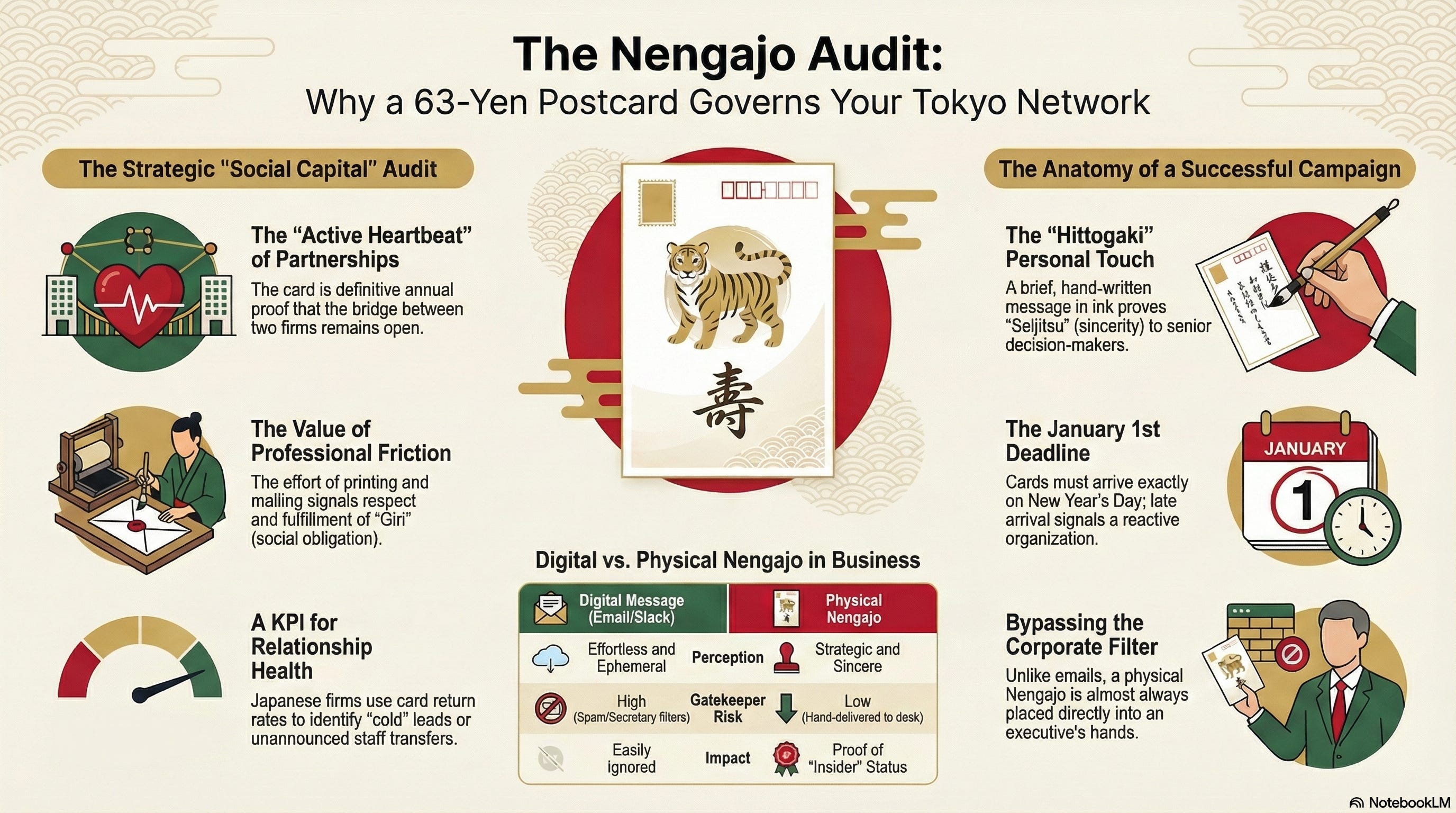
The Nengajo is the “Active Heartbeat” of a Japanese business relationship. In an environment where silence often precedes a quiet exit from a partnership, the arrival of that card is the definitive proof of life. It is the annual confirmation that the bridge between two firms remains open.
The Annual Census of Corporate Relevance
The persistence of the physical postcard in the age of Slack and LinkedIn is a testament to the Japanese priority of Giri, the complex web of social and professional obligation. A digital message is effortless, ephemeral, and easily ignored. A physical card requires a budget, a mailing list audit, a printing schedule, and the physical act of stamping or signing. This friction is exactly what gives the Nengajo its value. The effort required to send the card is the direct measurement of the sender’s respect for the recipient.
Historically, the practice of Nengajo served as a way for people living far apart to inform their network that they had survived the winter and remained in good health. In the corporate world of 2026, it serves a similar, if more professional, survival check. When a major firm like Mitsubishi UFJ or a traditional trading house like Mitsui sends their annual cards, they are asserting their continued dominance and stability. Conversely, if a vendor fails to send a card to a long-term client, the client does not assume the vendor is “going paperless.” They assume the vendor has become disorganized, disinterested, or is perhaps facing a decline.
The “Audit” function of the Nengajo is literal. Many Japanese firms use the return rate of their New Year’s cards as a KPI for their sales teams. If a contact from the previous year does not send a card back, it triggers an internal red flag. It suggests that the relationship has gone cold or that the contact person has been transferred without a proper Aisatsu (formal greeting/introduction) to their successor. The stack of cards on an executive’s desk is a physical manifestation of his “Social Capital.” A shrinking stack is a leading indicator of a shrinking business.
The Hand-Penned Signal of Sincerity
For the global executive, the Nengajo represents a rare opportunity to bypass the layers of corporate bureaucracy and land directly on the desk of a senior decision-maker. While a cold email from a foreign CEO might be filtered by a secretary or lost in a spam folder, a physical Nengajo addressed to a specific individual is almost always placed in their hands.
The strategy for a successful “Nengajo Campaign” requires a blend of industrial efficiency and personal touch. The most effective cards are those that include a hittogaki, a brief, hand-written message at the bottom. Even a simple “Looking forward to our success in the coming year” written in ink elevates the card from a mass-produced marketing asset to a personal gesture of Seijitsu (sincerity). It proves that the foreign leader has taken five seconds to acknowledge the specific human on the other side of the contract.
A specific example of this strategy in action involves a European luxury brand that struggled to maintain its “prestige” status among older, conservative Japanese distributors. The brand’s local CEO began a tradition of hand-writing 200 Nengajo every December, specifically mentioning a personal detail from a previous dinner or meeting. Within two years, the brand saw a marked increase in “priority” floor space in department stores. The distributors weren’t moved by the brand’s global marketing budget; they were moved by the CEO’s willingness to engage in the traditional ritual of the network. He proved he was an “insider” who understood the weight of the paper.
Furthermore, the timing of the Nengajo is a test of organizational precision. To be considered a proper greeting, the card must be delivered on exactly January 1st. Japan Post operates a massive, precision-engineered operation to ensure that billions of cards are held and then released simultaneously on New Year’s Day. To achieve this, cards must be posted within a specific window in mid-December. A card that arrives on January 5th is a “Late Signal.” it suggests that your firm is reactive rather than proactive. In the world of Japanese high-stakes commerce, being late is often as damaging as being absent.
The Bottom Line
The Nengajo is a physical audit of your corporate presence and a mandatory ritual for maintaining institutional trust. Neglecting this analog tradition signals a lack of commitment to the long-term health of the partnership. By treating the postcard as a strategic asset, you secure your place in the active network for the year ahead.
Over to You
Does your team maintain a “Physical Network Audit” each December, or have you fully transitioned to digital greetings that might be losing the “weight” of your brand’s intent?


