


The boardroom on the 42nd floor of a Marunouchi skyscraper smelled of expensive green tea and the faint, ozone-heavy scent of a high-end air filtration system. Across the polished mahogany table, the CEO of a major Japanese logistics firm sat flanked by five directors. All were men. All were over sixty. In the corner, a younger woman in a sharp navy suit sat perfectly still, a digital recorder and a notebook before her. She was the Head of Strategy, a graduate of a top-tier US business school, and arguably the most brilliant mind in the room.
Throughout the two-hour merger negotiation, she spoke exactly zero times. When the tea arrived, she instinctively shifted her posture to ensure the cups were placed correctly, a reflexive nod to a hierarchy that her MBA had failed to erase. For the foreign delegation sitting opposite, the cognitive dissonance was jarring. They had read the glossy annual report. They had seen the “Womenomics” badges pinned to the lapels of the executives. They had seen the data points claiming a twenty-percent increase in female “management” roles. Yet, in the moments where decisions were forged, the reality was stark. The talent was in the room, but the power was elsewhere.
This scene repeats daily across Tokyo. Global partners often mistake presence for influence. They see a woman in a high-ranking role and assume the Western rules of meritocracy apply. They soon realize that in many legacy Japanese firms, titles are often “window dressing” designed to satisfy ESG (Environmental, Social, and Governance) requirements from foreign investors. The “Womenomics” initiative, launched with great fanfare over a decade ago, created a flurry of activity, yet the core of the Japanese corporate engine, the decision-making apparatus remains remarkably resistant to the inclusion of women.
The Architecture of the Inner Circle
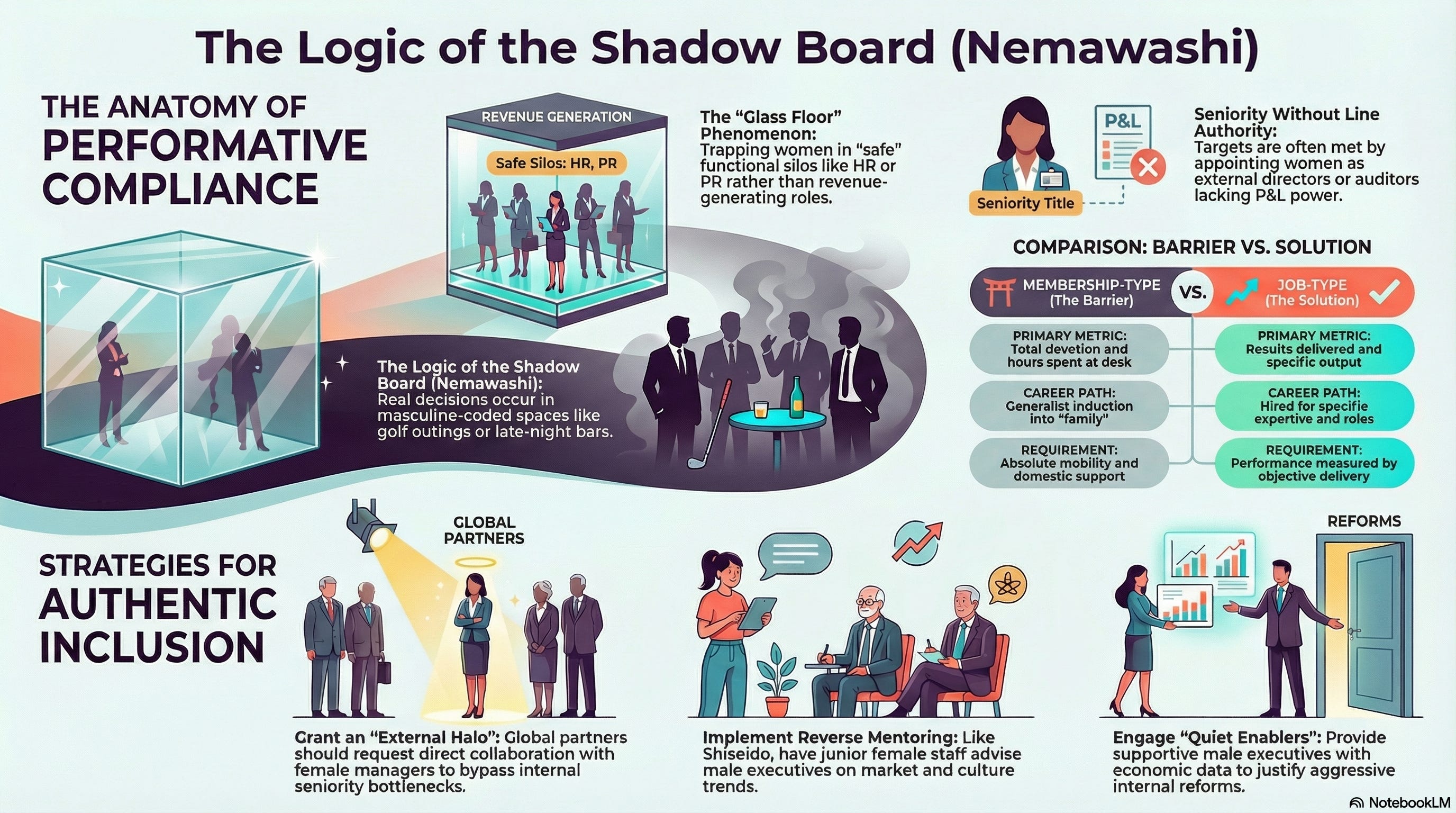
The resistance to gender parity in Japan is rarely a matter of overt prejudice. It is a structural byproduct of the “Membership-type” (Koyo) employment system. In this model, an employee is not hired for a specific job; they are inducted into a corporate family. This family demands absolute devotion. The expectation of long hours, frequent after-work drinking sessions (nomikai), and sudden regional transfers (tenshin) creates a barrier that assumes a traditional domestic support system.
Historically, the Japanese corporate world relied on a symbiotic relationship: the husband provided total labor to the firm, while the wife provided total management of the household. When we attempt to insert women into this male-coded corporate structure without changing the structure itself, we create an impossible friction. Women are asked to compete in a system designed specifically for people who have no domestic responsibilities.
A primary example of this tension exists within the Keidanren, Japan’s most powerful business lobby. For years, the organization has pushed for a thirty-percent target for female executives. However, many member companies have reached these targets by promoting women to “Auditor” roles or “External Director” positions. These roles, while senior on paper, often lack the “line authority” necessary to drive P&L decisions or shift corporate strategy. They are observers rather than architects.
Consider the case of Shiseido. Under the leadership of former CEO Masahiko Uotani, the cosmetics giant became a rare outlier. Uotani recognized that Shiseido’s customer base was almost entirely female, yet its leadership was overwhelmingly male. He didn’t just set quotas; he restructured the path to the top. He implemented a “reverse mentoring” system where younger female employees advised senior male executives on market trends and internal culture. Shiseido’s success proves that gender parity is a business necessity, but it requires a fundamental dismantling of the “Old Boys’ Club” social rituals that happen after 6:00 PM.
The Logic of the Shadow Board
The challenge for the global executive is navigating the “Shadow Board.” In many Japanese organizations, the official board meeting is a ceremonial affair where decisions already reached in private are formalized. These private discussions—the nemawashi often happen in spaces where women are traditionally excluded. Whether it is a golf outing on a Saturday or a late-night session at a Ginza hostess bar, the “real” business occurs in environments coded as masculine.
When a Japanese firm promotes a woman to a visible leadership role, they often face “corporate antibodies.” These are the middle-management layers that quietly resist changes to the status quo. To these managers, a woman in power represents a disruption to the predictable, seniority-based hierarchy they have spent decades climbing. They view diversity initiatives as a “foreign” imposition rather than a competitive advantage.
This leads to a phenomenon known as “The Glass Floor.” While the glass ceiling prevents women from rising, the glass floor keeps them trapped in specific functional silos—typically HR, Public Relations, or CSR (Corporate Social Responsibility). These are “safe” departments that do not threaten the core power centers of Finance, Engineering, or Sales. To truly understand a company’s commitment to diversity, one must look at the gender makeup of the divisions that generate the most revenue. If the women are clustered in “support” functions, the company is practicing performative diversity
.
Navigating the Stalled Revolution
For the global leader operating in Japan, the strategy must involve more than just demanding a female presence in meetings. It requires a sophisticated understanding of how to empower female colleagues without making them targets of internal resentment. The goal is to integrate diversity into the high-context reality of the Japanese workplace.
First, identify the “High-Potential Outsiders.” Within many firms, there are female leaders who possess immense informal influence but lack the formal title. Global partners should explicitly request these individuals’ input during the nemawashi phase, before the formal meetings begin. By seeking their expertise privately, you validate their authority in a way that the internal hierarchy may be slow to do.
Second, champion “Job-type” (Jobu-gata) employment practices within your Japanese partnerships. This shift moves the focus from “hours spent at the desk” to “results delivered.” When performance is measured by output rather than presence, the structural disadvantage facing women who often bear a disproportionate share of domestic labor begins to evaporate.
Third, look for the “Quiet Enablers.” These are the male executives who are secretly supportive of change but are afraid of being seen as “too Western” or “weak.” Engaging these men in private, one-on-one dialogues about the talent shortage and the shrinking Japanese workforce can provide them with the economic justification they need to push for more aggressive internal reforms. They need a “business case” to shield them from the criticism of their peers.
Instead of fighting the existing hierarchy, use the hierarchy to your advantage. When a senior foreign executive insists on working directly with a talented female manager, that manager is suddenly granted a “halo” of external legitimacy. This external validation is often the only way to bypass the internal bottlenecks of seniority.
The Bottom Line
True gender parity in Japan remains an elusive goal because corporations are attempting to fix a cultural problem with a statistical solution. Real progress occurs only when the underlying “Membership-type” structure is replaced by a meritocratic framework that values results over traditional gendered rituals. For the global executive, success depends on identifying where the real power lies and using external influence to bridge the gap between a woman’s talent and her formal authority.
Over to You
When you look at the leadership teams of your Japanese partners, do you see actual decision-makers or a carefully curated display of compliance?


