


The elevator doors opened to the executive floor of a prestigious Shinjuku trading house, revealing a hallway lined with portraits of former presidents, all of whom shared the same stoic expression and silver-grey hair. At the end of the hall, the “International Strategy Room” was buzzing with the arrival of the new Global VP, a highly recruited executive from a top-tier London firm. As he entered the conference room, the Japanese team stood and bowed. They gestured toward a seat specifically positioned near the head of the table, offering a panoramic view of the Meiji Jingu forest.
On the surface, this was the seat of honor. In reality, it was the “Gaijin Seat.” For the next six months, the VP found himself in a peculiar state of professional limbo. He was invited to every high-level meeting, yet he noticed that the agendas were finalized before he walked in. His suggestions were met with enthusiastic nodding and the phrase “we will study this,” yet the needle of corporate policy remained stationary. He was a decorative centerpiece, a symbol of the company’s “globalization” intended for the eyes of shareholders and the press, while the actual levers of power remained firmly in the hands of the domestic “Inner Circle.”
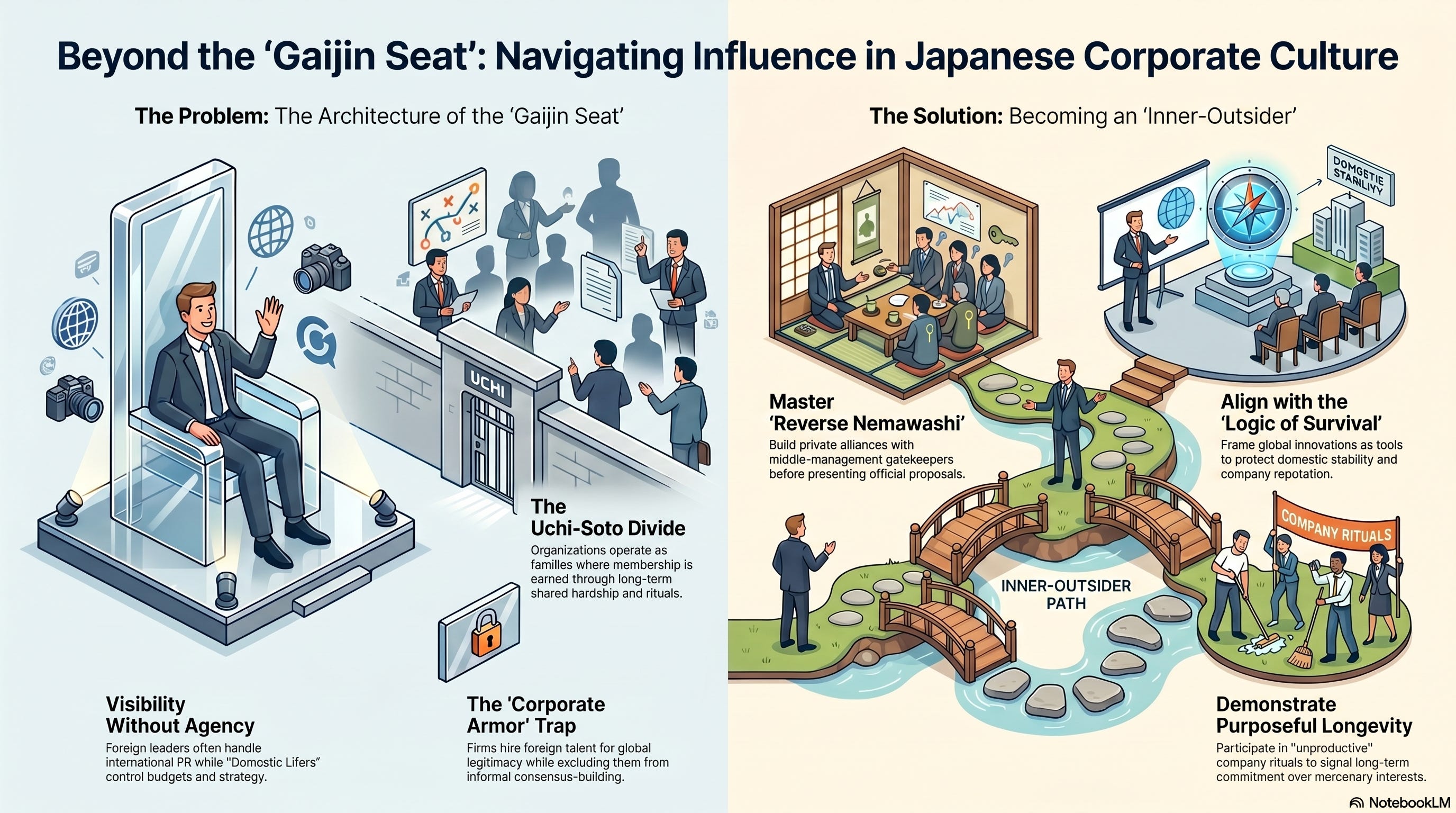
This phenomenon is a common hurdle for foreign professionals in Japan. The “Gaijin Seat” is a psychological and structural space where the outsider is granted visibility but denied agency. It is the result of a corporate culture that has historically operated on a binary of Uchi (Inside) and Soto (Outside). In this system, the foreign employee is often viewed as a permanent guest, respected, well-compensated, and politely ignored.
The Architecture of the Permanent Guest
The persistence of the Gaijin Seat is a direct reflection of the Uchi-Soto social framework. In the Japanese corporate mind, the organization is a family. Membership in this family is traditionally earned through years of shared hardship, late-night nomikai (drinking sessions), and a deep understanding of the firm’s unwritten history. A foreign executive, hired for their specific expertise or “global mindset,” enters the firm as a specialist rather than a family member.
This structural isolation is often codified in the “Global Talent” (Gurobaru Jinzai) initiatives that many Japanese firms launched over the last decade. These programs often prioritize the acquisition of foreign resumes without restructuring the decision-making process. The result is a dual-track system: a “Global Track” for foreign hires and a “Mainstream Track” for domestic lifers. The global hires handle international PR, investor relations, and foreign market research, while the domestic lifers maintain control over the core budget, personnel decisions, and long-term strategy.
A stark real-world example of the limits of the Gaijin Seat occurred during the tenure of Michael Woodford at Olympus. Woodford was a rare example of a foreign executive who rose to the position of CEO within a legacy Japanese firm. Despite his title, he discovered that the board was operating in a reality entirely separate from his own. When he began to question suspicious historical acquisitions, the “Inner Circle” closed ranks. They viewed his inquiries as an “outside” threat to the collective harmony of the “inside” group. His eventual ousting and the subsequent whistleblowing scandal revealed a fundamental truth: in many legacy organizations, the title of CEO can still be a “Gaijin Seat” if the holder is not integrated into the social fabric of the firm.
The Strategic Utility of the Outsider
The existence of the Gaijin Seat is a strategic choice by the organization. For many Japanese CEOs, hiring a high-profile foreign executive is a form of “corporate armor.” It signals to the Tokyo Stock Exchange and foreign institutional investors that the company is modernizing, transparent, and ready for international competition. The foreign hire provides the company with “Global Legitimacy” while allowing the internal culture to remain largely unchanged.
This creates a “Token Asset” dynamic. The foreign employee is valued for their appearance of influence rather than their actual exercise of it. They are expected to be the face of the company’s “new era” during quarterly earnings calls, but are excluded from the Nemawashi (informal consensus-building) that occurs in Japanese-only meetings. This exclusion is often justified by the “language barrier,” but it is more accurately a “culture barrier.” The internal team fears that the outsider will move too fast, disrupt the Wa (harmony), or fail to understand the nuance of long-standing internal alliances.
This dynamic is also prevalent in the “External Director” roles that have become mandatory under recent corporate governance reforms. Many companies fill these seats with foreign academics or retired diplomats. These individuals sit in the literal and metaphorical Gaijin Seat, they provide the “check and balance” required by law, yet they lack the deep, operational knowledge of the company to effectively challenge the status quo. They are observers in a system designed to be seen, not moved.
Designing the Inroads to Influence
To move from the Gaijin Seat to the Core, a foreign professional must transition from a “Specialist” to an “Inner-Outsider.” This requires a deliberate strategy that bypasses formal hierarchy in favor of informal integration. The goal is to prove that you are not a transient guest, but a stakeholder who is willing to bear the burden of the collective.
First, master the “Language of Logic” alongside the “Culture of Context.” While fluency in Japanese is an asset, the real currency is an understanding of the company’s “Logic of Survival.” Every legacy Japanese firm has a core fear, usually related to the loss of reputation or the disruption of its relationship with its lead bank. By framing your “Global” strategies in terms of “Domestic Stability,” you align your goals with the deepest instincts of the Inner Circle. You must demonstrate that your innovations will protect the firm, not just change it.
Second, cultivate “Lateral Alliances.” The Gaijin Seat is often isolated at the top. To break this isolation, you must build deep relationships with the “Gatekeepers”, the middle-management department heads who have been with the company for twenty years. These are the people who actually execute the strategy. By engaging in “Reverse Nemawashi“ seeking their counsel privately and incorporating their concerns into your proposals before they are officially presented, you turn the gatekeepers into your champions. When the Inner Circle sees that the middle management supports the “foreigner’s” plan, their resistance begins to soften.
Third, embrace “Purposeful Longevity.” One reason the Gaijin Seat exists is the perception that foreign executives are “mercenaries” who will leave for a better offer in three years. To be seen as a core member, you must signal a long-term commitment. This involves participating in the “unproductive” rituals of the firm, the anniversary ceremonies, the factory visits, and the morning assemblies. These actions are the social “down payments” required to earn a seat in the room where the real decisions are made.
The successful foreign leader in Japan is the one who understands that their title is a starting point, not a destination. They use the visibility of the Gaijin Seat to build a platform, but they do the real work in the shadows, building the trust required to be invited into the Uchi. They recognize that in Tokyo, influence is not granted by the board; it is whispered into existence in the hallways.
The Bottom Line
The “Gaijin Seat” is a structural reality of the Japanese workplace that reflects the historical divide between the guest and the member. True influence requires moving beyond the formal visibility of the “Global Asset” and earning a place within the informal networks of the “Inner Circle.” Success depends on the ability to translate global innovation into the language of local stability and demonstrating a commitment that transcends the duration of a standard contract.
Over to You
When you find yourself being “politely ignored” in a high-stakes meeting, do you interpret it as a lack of respect or as an invitation to begin the informal work of building consensus behind the scenes?


