


The sky over the Kanto Plain was a bruised purple, heavy with the moisture of a late-season typhoon. In a high-tech logistics hub on the outskirts of Yokohama, the atmosphere was unnervingly calm. While news reports warned of a total standstill in regional transportation, a senior procurement officer for a major automotive parts distributor sat at his terminal, watching a digital map. He had spent the last three hours quietly rerouting six shipments of specialized sensors coming from a mountain-based supplier.
His client, a Tier-1 assembly plant in Osaka, remained unaware of the impending bottleneck. No emails had been exchanged. No frantic phone calls had disrupted the afternoon. The procurement officer had monitored the barometric pressure and the river levels near the mountain roads for forty-eight hours. He moved the inventory to a secondary warehouse five hours before the local authorities closed the highways. When the assembly plant manager in Osaka opened his bay doors the following morning, the sensors were already waiting on the dock. To the client, it was a routine delivery. To the logistics provider, it was a masterpiece of Omotenashi, the art of selfless, anticipatory hospitality.
In the global business lexicon, “hospitality” is a concept reserved for five-star hotels and Michelin-starred restaurants. In Tokyo, hospitality is the bedrock of the supply chain.
The Ghost in the Warehouse
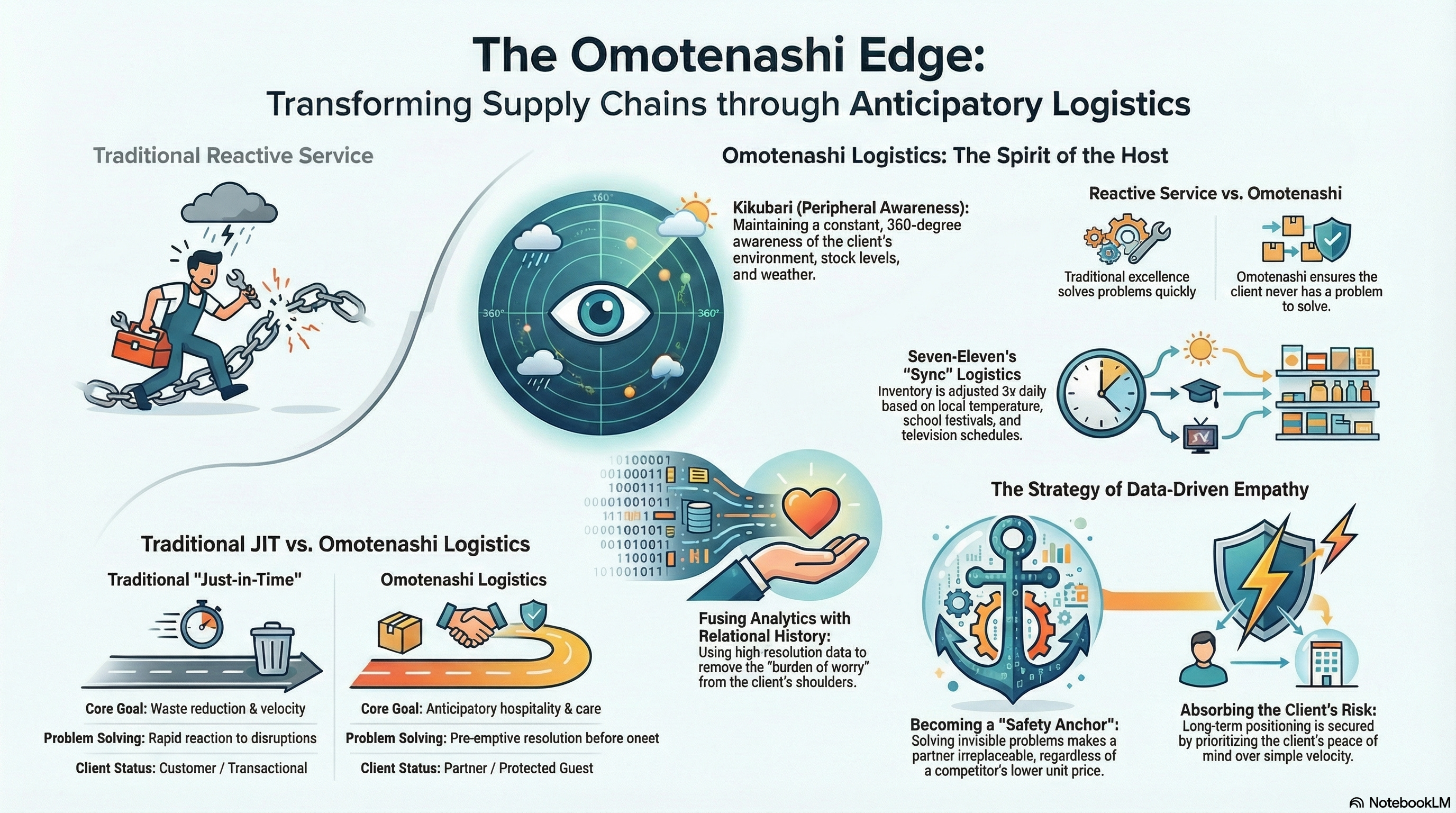
The Western interpretation of supply chain excellence centers on “Just-in-Time” efficiency; the lean, mathematical pursuit of reducing waste and maximizing velocity. While the Japanese pioneered this model, they added a psychological layer that transcends the spreadsheet. This is the B2B application of Omotenashi. The word literally means “to provide service with a whole heart,” but its operational definition is the ability to perceive a need before the customer has the chance to articulate it.
This goes beyond reactive service. In a standard global contract, a vendor is praised for solving a problem quickly. In the Japanese context, a problem that requires a phone call to the vendor is already a failure of Omotenashi. The “spirit of the host” requires the vendor to maintain a level of Kikubari, a constant, peripheral awareness of the client’s environment. This means monitoring the client’s stock levels, their seasonal sales fluctuations, and even the local weather patterns as if they were the vendor’s own.
Seven-Eleven Japan provides the definitive real-world proof of this philosophy. Known for its legendary “Tanpin Kanri” (item-level management) system, the company does not wait for a store manager to notice they are running low on cold noodles. The central logistics system analyzes the local hourly temperature, the timing of nearby school festivals, and even the evening’s television schedule to adjust the delivery mix three times a day. If a sudden heatwave is predicted for 3:00 PM, the refreshing snacks arrive at 1:00 PM. The customer finds exactly what they want without ever realizing the supply chain moved a mountain to put it there. This is a supply chain that breathes in sync with the consumer.
The Architecture of Proactive Flow
For the global executive, adapting to this expectation requires a fundamental shift from being a “service provider” to being an “intuitive partner.” Success in the Japanese market depends on your ability to prove that you are thinking about the client’s business when they are not. This is particularly critical in high-precision industries like semiconductors or medical devices, where a four-hour delay can halt an entire production ecosystem.
The strategy for achieving this involves “Data-Driven Empathy.” It is the fusion of high-resolution analytics with deep relational history. You must build a digital infrastructure that allows for real-time visibility into your partner’s operations. However, the data is merely the tool. The “spirit” of the system lies in how you use that data. When you notice a potential shortage in a client’s warehouse due to a sudden spike in their orders, your first move is to secure the inventory and then notify them that the solution is already in transit. You are removing the burden of worry from their shoulders.
Furthermore, this proactive stance builds an impenetrable wall of trust. When a vendor consistently identifies and solves “invisible” problems, they cease to be a replaceable supplier. They become a “Safety Anchor.” A competitor might offer a lower price per unit, but they cannot offer the peace of mind that comes from a partner who practices Omotenashi. In the high-stakes reality of global manufacturing, the “cost of worry” is often higher than the cost of the component. By absorbing the client’s risk into your own operations, you secure a long-term position that no procurement algorithm can disrupt.
The Bottom Line
True Omotenashi in the supply chain is the ultimate competitive advantage because it transforms a transactional delivery into a deeply felt partnership of care. When you anticipate the needs of your Japanese partner, you move beyond the status of a vendor and become a guardian of their success. The most valuable service you can provide is the one the client never had to ask for.
Over to You
Does your current supply chain strategy focus on reacting to your client’s orders, or are you actively monitoring their environment to solve problems before they arise?


