

The rain-slicked streets of Roppongi gleamed under the neon lights as three executives waited for a black Toyota Crown taxi outside a high-end ryotei. The evening had been a success; the “big fish” client from a major Japanese electronics firm was relaxed, the sake had been excellent, and the verbal agreements were promising. As the white-gloved driver operated the automatic door, the visiting American VP, eager to show respect and energy, hopped quickly into the back seat and slid all the way to the far right, directly behind the driver. He then patted the middle seat, inviting the Japanese CEO to sit next to him.
The temperature of the interaction dropped instantly. The Japanese CEO paused, his smile flickering for a fraction of a second before he gracefully moved to the left side of the rear seat. The junior Japanese staff member, looking physically pained, folded himself into the front passenger seat next to the driver. In that single, well-intentioned movement, the VP had claimed the Kamiza, the “upper seat” reserved for the most senior person leaving the client to take the secondary position. To the VP, he was just making room. To the client, the VP had just declared himself the king of the car.
In the Western business world, seating is often a matter of comfort or proximity to the whiteboard. In Japan, every room, vehicle, and elevator is governed by an invisible, military-grade map known as the Kamiza (upper seat) and Shimoza (lower seat). This system is a spatial manifestation of the Confucian hierarchy that underpins Japanese society. Ignoring these coordinates is more than a social faux pas; it signals a fundamental lack of situational awareness (kyu-yomu = reading the air) that can lead a Japanese partner to question your fitness for a long-term strategic alliance.
The Cartesian Logic of Respect
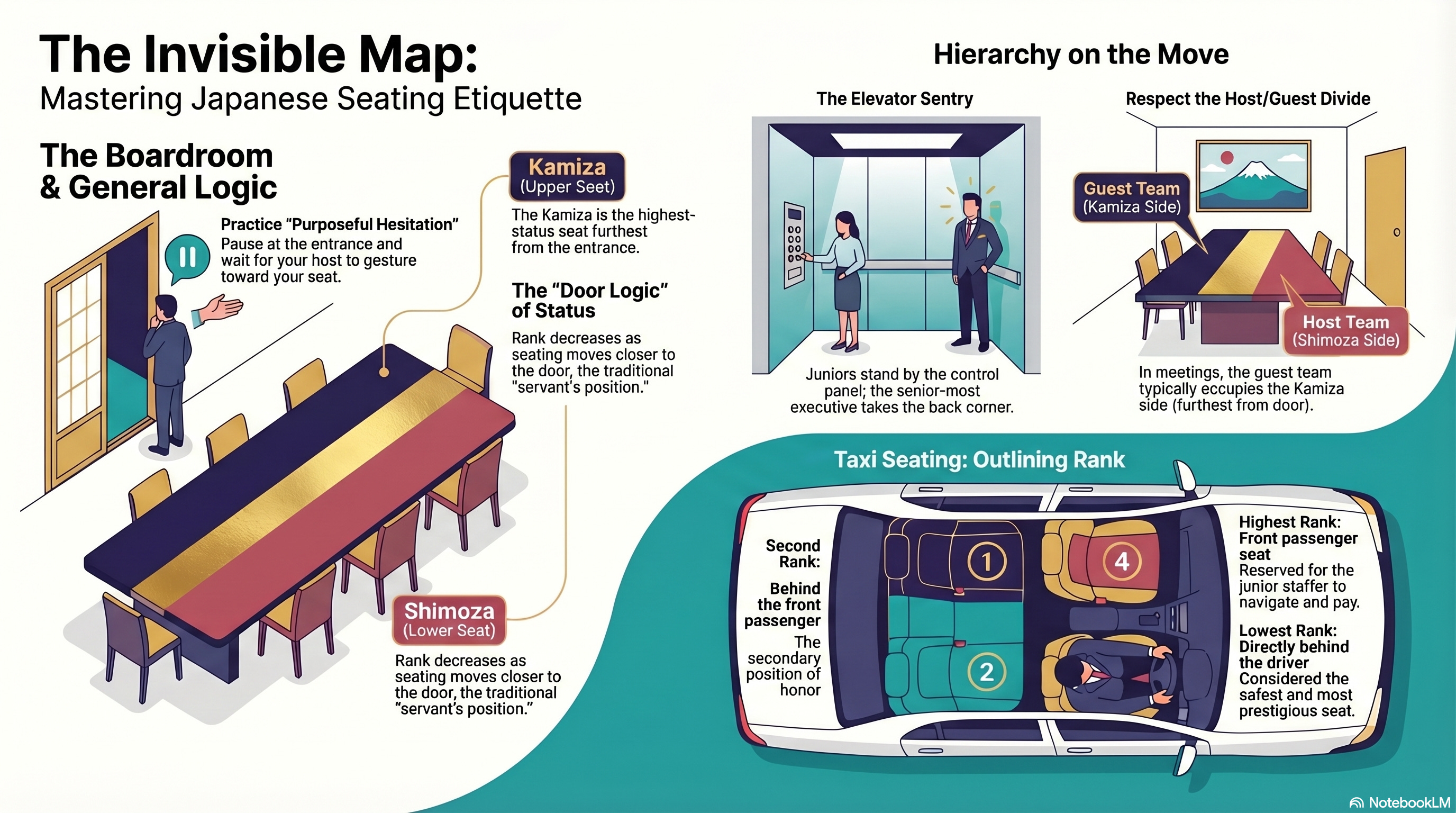
The logic of Kamiza is rooted in historical necessity and the preservation of status. In the era of the samurai, the safest place in a room was furthest from the door, away from potential assassins or the draft of the hallway. This seat typically offered a view of the garden and was positioned in front of the tokonoma (an alcove displaying art). Conversely, the Shimoza was the seat closest to the door, occupied by the person whose job was to serve tea, greet arrivals, and, if necessary, be the first to meet an intruder.
While the threat of sword-wielding assassins has vanished, the psychological weight of the door remains. In a modern Tokyo boardroom, the seat furthest from the entrance is the position of highest honor. The seats descend in rank as they move closer to the door. If there is a window with a view of the Imperial Palace or the Tokyo Tower, the seat offering the best view becomes the Kamiza. The complexity increases when you add a host and a guest. In a standard meeting, the guest team sits on the Kamiza side (furthest from the door), while the host team sits on the Shimoza side.
This spatial ritual extends into every cubic meter of professional life. In an elevator, the Shimoza is the spot next to the control panel. The most junior person is expected to stand there, holding the “open” button and managing the floor requests like a high-tech sentry. The senior-most executive stands in the back corner, furthest from the buttons. When a global executive strides into an elevator and stands directly in front of the buttons without taking charge of them, they are effectively occupying the “servant’s position” while failing to perform the servant’s duties. It is a confusing display of high status and low competence.
The Taxi and the Hierarchy of Safety
The most frequent site of Kamiza blunders is the corporate vehicle. The hierarchy of a taxi is counter-intuitive to many Westerners who prefer the legroom of the front seat or the convenience of the curbside exit. In Japan, the seat directly behind the driver is the “number one” position. It is considered the safest and most prestigious.
The order of precedence in a standard four-passenger car is as follows:
Directly behind the driver (The Seat of Honor).
Directly behind the front passenger.
The middle of the back seat (The most uncomfortable and thus the “third” rank).
The front passenger seat (The lowest rank, responsible for navigating and paying the driver).
A real-world example of this protocol in action can be seen within the rigid culture of the Sogo Shosha (giant general trading houses) like Mitsui or Mitsubishi. When a senior executive travels with their team, the junior staffer acts as a human shield. They are the first to exit the building, the first to hail the cab, and the last to sit down. They handle the payment and the interaction with the driver, ensuring the executive’s experience is seamless and uninterrupted. This allows the executive to remain in a state of “composed leadership,” unburdened by the mechanics of the journey.
When a foreign partner understands and respects this order, they demonstrate a mastery of Omotenashi (selfless hospitality) from the guest’s perspective. By pausing at the car door and gesturing for the senior Japanese partner to take the seat behind the driver, you are communicating that you recognize their status and value their comfort above your own convenience.
The Strategy of Purposeful Hesitation
Navigating the vertical social map of Japan requires a mindset shift from “efficiency” to “intentionality.” The goal is to move through space in a way that acknowledges the status of everyone in the room without appearing stiff or robotic.
The most effective strategy is the “Purposeful Hesitation.” When entering a meeting room, avoid the instinct to head for the most comfortable chair. Stand near the entrance and wait for your host to gesture toward a specific seat. They will almost certainly offer you the Kamiza. A brief, polite refusal, a slight bow and a gesture suggesting they should take the honor is a standard part of the dance. They will insist, and you will eventually accept. This ritual establishes that you are a person of consequence who is also deeply humble.
In social settings, such as a business dinner at a traditional restaurant, the Kamiza is often the seat in the center of the table if there is a specific view, or the seat furthest from the busy walkway of the restaurant staff. If you find yourself accidentally seated in the “wrong” spot, the best course of action is to acknowledge it with a light touch of humor. Mentioning that you are “still learning the beautiful complexities of Japanese protocol” can turn a potential insult into a moment of human connection.
Furthermore, empower your junior staff to play their role. In a Western context, we often encourage our younger associates to “take a seat at the table” as equals. In a formal Japanese meeting, forcing a junior associate into a high-status seat can actually make them deeply uncomfortable and cause the Japanese counterparts to view your team as disorganized. Allow the hierarchy to exist. It provides a predictable structure that actually reduces stress for your Japanese partners, as they always know exactly where they stand literally.
The Bottom Line
Seating in Japan is a silent language that speaks of respect, history, and the protective nature of hierarchy. By mastering the invisible map of the Kamiza, you demonstrate that you are a sophisticated partner capable of navigating the high-context nuances of the Tokyo business world. Where you sit determines how you are heard; choose your position with the same precision you bring to your contracts.
Over to You
Have you ever experienced a moment where a simple seating choice seemed to shift the entire power dynamic of a negotiation?


