

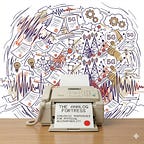
The conference room in the heart of Nihonbashi was a marvel of 21st-century engineering. Ultra-high-definition screens displayed real-time global supply chain data, and the air was cooled to a precise 22 degrees. The partnership between a Silicon Valley software firm and a legacy Japanese trading house was entering its final, critical phase. The American CEO sat back, ready to “click to sign” a digital contract via a cloud-based platform. Then, the silence of the room was shattered by a sound that felt like a haunting from the 1980s: the rhythmic, high-pitched screech of a thermal fax machine.
A junior staff member hurried to the corner, waited for the paper to emerge, and then presented it with both hands to the senior managing director. The director pulled a small, cylindrical wooden case from his pocket, pressed a red ink pad, and stamped the document with his personal seal, the hanko. For the visiting Americans, it felt as though they had suddenly stepped through a portal into a previous decade. They had spent months discussing artificial intelligence and blockchain, yet the final gatekeeper of the deal was a piece of paper that had been physically “screeched” across a phone line.
This friction is the defining characteristic of the Japanese “Digital Transformation” (DX). To the outsider, the continued reliance on the fax machine looks like a stubborn refusal to modernize. However, in the high-stakes world of Japanese corporate hierarchy, the fax machine is a defensive fortification. It is the anchor of a system that values the “tangible trail” over the “ethereal click.” In Japan, an email is a conversation; a fax is an event.
The Physicality of Consent
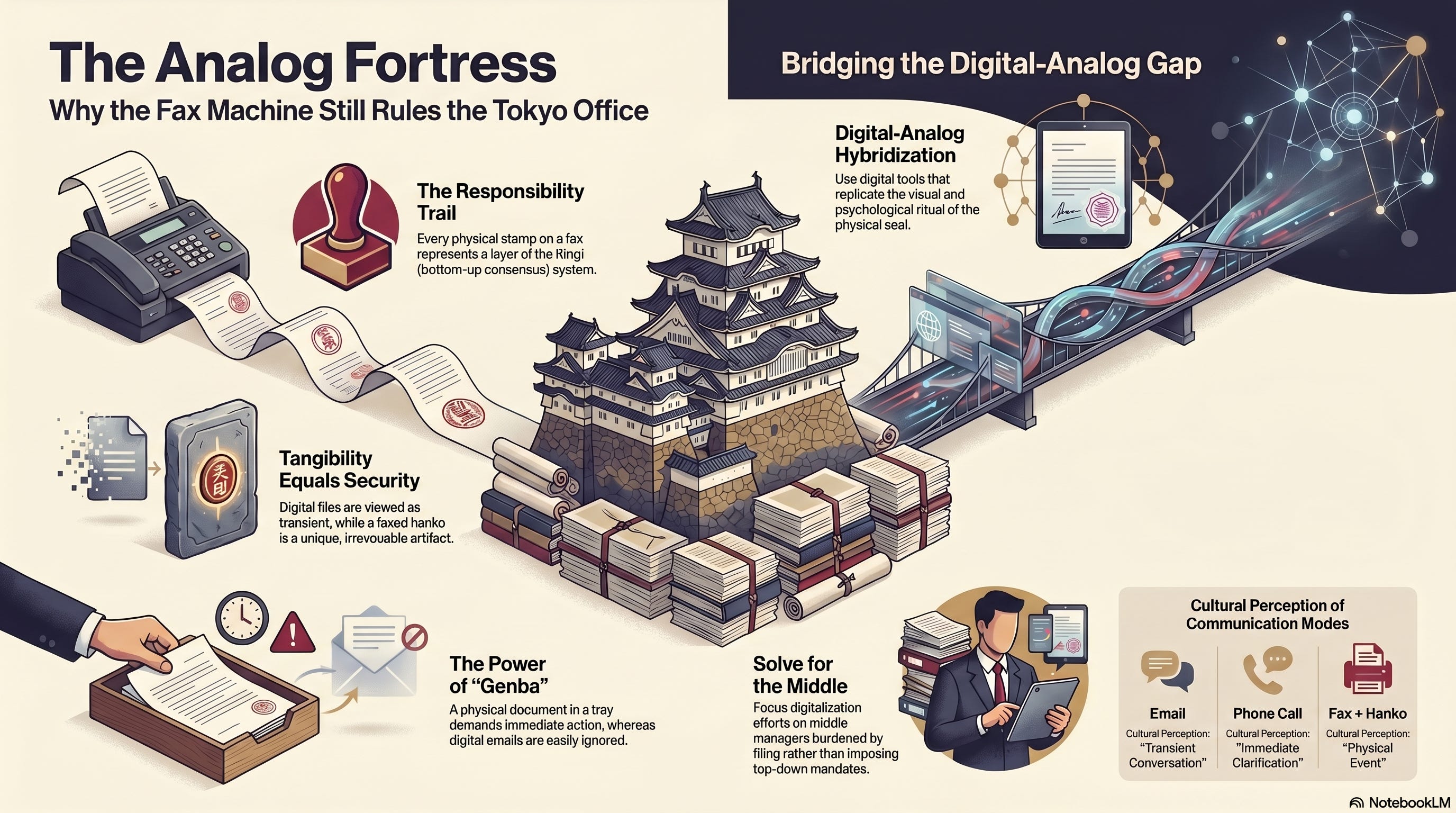
The endurance of analog tools is a byproduct of the Japanese requirement for absolute traceability and irrevocable proof. In a culture that prioritizes Anzen (safety) and Anshin (peace of mind), digital files feel dangerously transient. A PDF can be edited, a cloud server can be hacked, and a digital signature can feel like a sequence of anonymous bits. A faxed document, bearing the physical impression of a hanko, is a unique artifact. It exists in the physical world, occupying space in a file folder, proving that a specific individual at a specific time physically touched the document and granted their consent.
This preference for the physical is tied to the concept of Genba, the actual place where work happens. Japanese management philosophy often dictates that truth is found on the factory floor or in the physical document, rather than in an abstract digital dashboard. When a document is faxed, it travels from one genba to another. It arrives with a physical presence that demands immediate attention. In an inbox cluttered with three hundred unread messages, an email is easily ignored. A piece of paper sitting in a tray is a physical obligation that must be processed.
The “Paper Trail” is, in fact, a “Responsibility Trail.” Every stamp on the margin of a faxed document represents a layer of the Ringi system, the bottom-up consensus-building process. As the paper moves up the chain of command, it collects the red circles of various managers. By the time it reaches the top, the document is a map of everyone who has reviewed, vetted, and agreed to the proposal. The fax machine is the physical engine that powers this collective accountability.
The Great Hanko Standoff
The most prominent example of the struggle between the digital future and the analog past occurred during the 2020 global pandemic. As the world shifted to remote work, the Japanese government and major corporations faced a crisis: the “Hanko Trip.” Thousands of employees were forced to commute into empty offices on public transit for the sole purpose of stamping a single piece of paper with a physical seal. Without that stamp, the wheels of commerce and government literally stopped turning.
In response, the Japanese government appointed Taro Kono as the “Administrative Reform Minister” with a mandate to eliminate the hanko and the fax machine from government offices. Kono famously declared a “war on faxes,” pointing out that the reliance on these machines was the primary bottleneck preventing the digitalization of the Japanese economy. He faced immediate and fierce resistance. The “Hanko Lobby” represented by regional craftsmen who carve the seals, argued that abolishing the seals would destroy a vital piece of Japanese culture.
More importantly, the resistance came from within the bureaucracy itself. For many managers, the fax machine was the only way to ensure that “confidential” information didn’t leave the closed loop of the office. They argued that faxes were actually more secure than email because they required a physical intercept to be compromised. The result of Kono’s war was a stalemate. While the government successfully removed the requirement for stamps on thousands of administrative forms, the private sector remains deeply divided. Companies like SoftBank, under the iconoclastic Masayoshi Son, have moved aggressively toward a “paperless” environment, yet their smaller suppliers and traditional partners still demand the “screech” of the fax as a prerequisite for doing business.
Digitalization through Cultural Translation
For the global executive, the challenge is to introduce digital efficiency without triggering the “corporate antibodies” that protect the analog status quo. If you attempt to force a purely digital workflow on a traditional Japanese partner, you are not just suggesting a new tool; you are suggesting a new and to them, less secure social contract.
The strategy for success lies in “Digital-Analog Hybridization.” Rather than demanding the total abolition of paper, provide bridges that allow the Japanese partner to maintain their sense of security. Use platforms that allow for “Digital Hanko” stamps, which replicate the visual and psychological experience of the physical seal within a secure digital environment. This respects the ritual of consensus while gaining the speed of the internet.
Furthermore, recognize the “Tiered Urgency” of communication. In the Tokyo business world, an email is for information, a phone call is for clarification, and a fax is for confirmation. When you need to send a high-stakes document, consider sending it digitally and following up with a physical copy or even a fax, if you know the receiving office relies on them. This “redundancy” is often interpreted as a sign of high-level professional courtesy rather than a lack of technological sophistication.
Another effective strategy is the “Bottom-Up Digitalization.” Instead of a top-down mandate, find the “digital champions” within the middle-management layer of your Japanese partner. These are the individuals who are actually burdened by the filing and the faxing. By providing them with tools that make their specific jobs easier such as automated data entry from scanned faxes, you create an internal demand for change. You are solving a problem for the genba, which is a far more persuasive argument in Japan than an appeal to global “best practices.”
Finally, respect the archive. One reason Japanese firms cling to paper is the fear of data loss or “bit rot.” Show your partners that your digital systems have the same, if not greater, durability as a physical warehouse. Emphasize your backup protocols and long-term data sovereignty. When a Japanese executive feels that a digital file is as “permanent” as a piece of paper, their resistance to the screen begins to evaporate.
The Bottom Line
The fax machine in Japan is a symbol of a culture that refuses to trade accountability for speed. To navigate this landscape, the global executive must treat the analog paper trail as a social ritual rather than a technical failure. Success comes to those who build digital bridges that preserve the weight and the “tangibility” of the traditional Japanese consensus.
Over to You
Has your insistence on a purely digital workflow ever caused a subtle “freeze” in your relationship with a legacy Japanese partner?


