

The Vice President of Sales for a Tier-1 German automotive supplier sat in the hushed, minimalist lobby of a Nagoya headquarters, his briefcase containing what he considered an “irrefutable” proposal. His company had developed a sensor that was 15% lighter, 20% more energy-efficient, and most crucially 30% cheaper than the component currently used by the Japanese automaker. He had spent months perfecting the data. He had the endurance tests to prove the technical superiority. He even had a pilot program success story from a major Detroit manufacturer to lend global weight to the pitch.
Inside the boardroom, the presentation went perfectly. The Japanese procurement team nodded in all the right places. They asked deep, granular questions about the semiconductor architecture. They admired the sleek casing. Then came the silence, the heavy, polite stillness that precedes a “no” that sounds like a “maybe.”
“Your technology is impressive,” the lead engineer finally said. “However, we have worked with our current supplier since 1984. They have a desk in our engineering department. When the 2011 earthquake struck, their CEO was on the factory floor helping us clear debris before the fires were even out. Can you guarantee that level of presence?”
The German executive realized then that he wasn’t competing against a rival’s price list. He was competing against a blood oath. He was trying to sell a product to a family that didn’t realize they were looking for a new relative.
The Blood Type of the Supply Chain
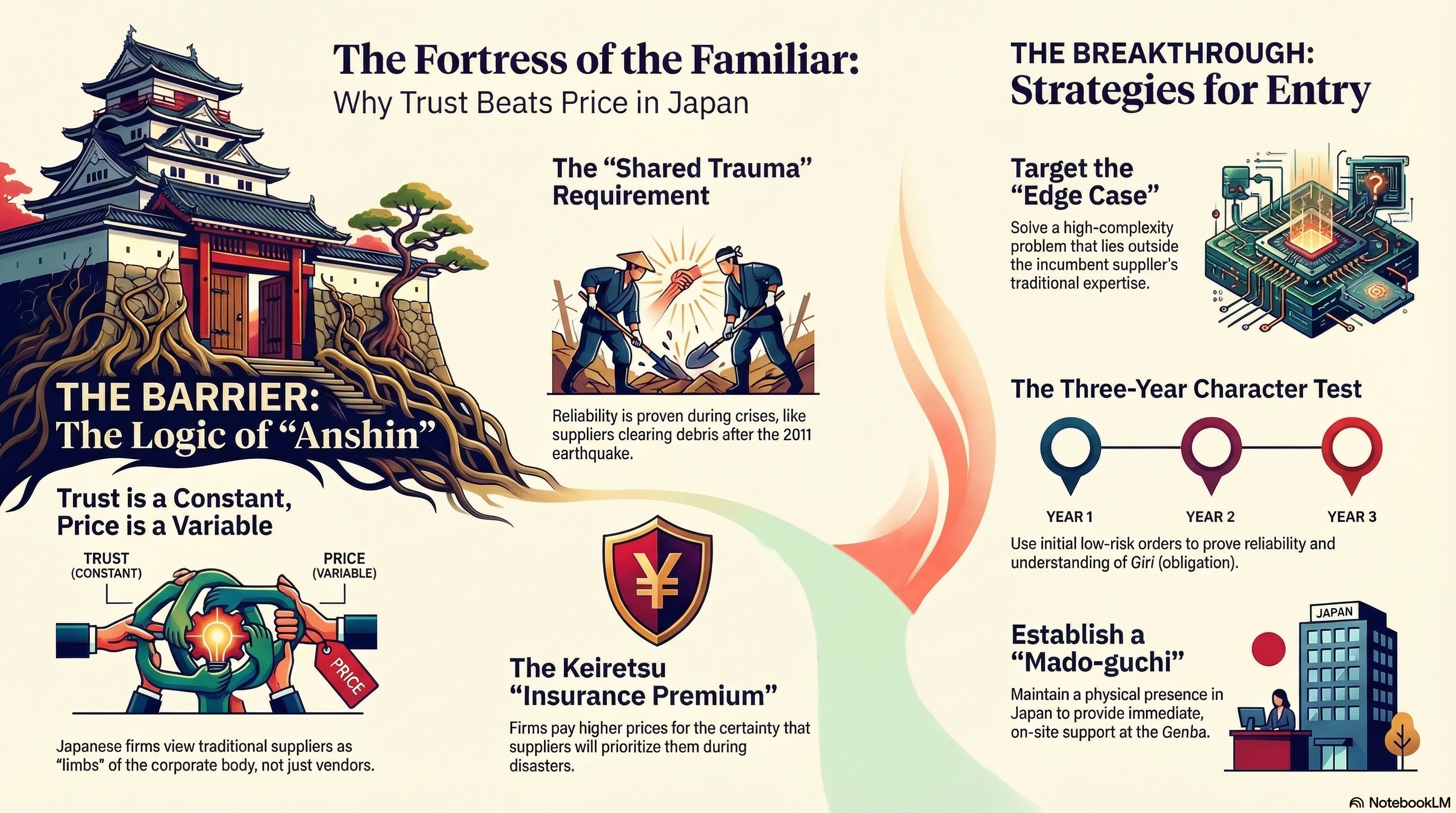
This impenetrable barrier is the hallmark of the Keiretsu, the interlocking web of relationships that defines the Japanese industrial landscape. To a foreign executive, the decision to stick with an inferior, more expensive domestic vendor looks like a violation of fiduciary duty. To the Japanese executive, however, switching to an unproven foreign entity for a 30% saving is an act of extreme recklessness.
The Japanese concept of Anshin, total peace of mind governs the supply chain. Price is a variable. Trust is a constant. In a Western context, a vendor is a service provider governed by a contract. In Japan, a vendor is a limb of the corporate body. If the limb fails, the body dies. Therefore, the “Insurance Premium” that Japanese firms pay to maintain their traditional suppliers is viewed as a necessary cost of survival. They are buying the certainty that when a crisis hits, their supplier will prioritize their needs above all other global clients, often at a financial loss, to preserve the long-term relationship.
Consider the 1997 fire at an Aisin Seiki plant. Aisin was the sole supplier of proportioning valves, a critical brake component for Toyota. Within hours of the fire, the entire Toyota production line was at risk of a total shutdown. In a Western “market-clearing” model, Toyota might have immediately scouted for global alternatives. Instead, 200 different suppliers, many of whom didn’t even manufacture valves voluntarily pivoted their operations. They shared blueprints, improvised tooling, and worked around the clock to restore production within days. This “all-for-one” resilience is the direct result of decades of loyalty. A new foreign vendor, no matter how cheap, lacks the “shared trauma” required to be trusted in such a ecosystem.
The Logic of Shared Pain
The commitment between a Japanese firm and its vendor is an affirmative pact of shared destiny. When the economy is strong, the vendor enjoys stable, predictable orders. When the economy dips, the vendor is expected to “share the pain” by proactively offering price reductions to protect the mother company’s margins. This is not a negotiation; it is a ritual of mutual protection.
In 2024, following the Noto Peninsula earthquake, several major Japanese manufacturers saw their domestic suppliers move heaven and earth to maintain “Just-in-Time” delivery schedules despite decimated infrastructure. These suppliers did not invoke force majeure clauses to escape their obligations. They treated the manufacturer’s problem as their own survival crisis.
This philosophy extends to quality control. A traditional Japanese supplier will often have their own engineers embedded within the client’s facility. They engage in Genba, the actual place of work to identify defects before they even occur. They provide a level of “invisible service” that is never codified in a contract but is deeply felt in the operational flow. A foreign vendor who ships a product from an offshore hub and provides support via a remote helpdesk is operating on a different philosophical plane. They are providing a commodity; the Japanese supplier is providing a shield
The Trojan Horse of Incrementalism
For a foreign company looking to penetrate this fortress, the “Direct Replacement” strategy is a recipe for failure. You cannot walk in and ask a Japanese firm to divorce their partner of forty years. Instead, you must adopt the strategy of the “Second Source” or the “Niche Specialist.”
The most effective entry point is the Edge Case. Identify a specific, high-complexity problem that the incumbent supplier is struggling to solve perhaps a transition to a new green energy standard or a specific software integration that lies outside their traditional mechanical expertise. By solving a problem that the “family” cannot fix, you enter the ecosystem as a specialized consultant rather than a rival. You are not replacing the heart; you are adding a sophisticated new sense.
The second strategy is the Patience of the Decades. You must be prepared for a “Trial Period” that lasts years, not quarters. In Japan, the first three years of a relationship are often a test of character. The procurement team will give you small, low-risk orders. They are watching to see how you handle a minor shipping delay or a slight defect. Do you blame the logistics company, or do you fly a senior executive to Tokyo to apologize in person? The apology is worth more than the refund. It proves that you understand the weight of Giri (obligation).
Finally, focus on Physical Presence. To be a serious contender, you must have a Mado-guchi, a “window” or a dedicated contact point within Japan. This person must speak the language of the Genba. They must be available for a 4:00 PM meeting on a Friday afternoon without hesitation. By mimicking the “on-site” availability of the domestic incumbent, you reduce the perceived risk of your foreignness. You are proving that you are willing to become a limb of their body.
The Bottom Line
Vendor loyalty in Japan is a strategic defense mechanism, not a sentimental relic. To win a seat at the table, you must prove that your reliability in a crisis matches your technical superiority in a spreadsheet. Build the history first, and the market share will eventually follow.
Over to You
Have you ever lost a deal in Japan despite having a clear technical and price advantage? Would you like me to analyze your current market-entry pitch to identify where you might be triggering “Risk Anxiety” in your Japanese prospects?


