

The fluorescent lights of the depachika, the sprawling food hall in the basement of a Tokyo department store hum with a frantic, precise energy. Amidst the towers of perfectly symmetrical strawberries and gold-flecked jellies, a foreign executive stands paralyzed. He holds a budget of five thousand yen and a vague instruction from his assistant to “bring something nice” to the meeting in Otemachi. He eventually settles on a box of French macarons, thinking the brand recognition will impress.
An hour later, as he slides the box across the polished table to his Japanese counterparts, a subtle shift occurs in the room. The lead negotiator offers a polite, tight-lipped smile and places the gift to the side. The meeting proceeds, yet the atmosphere remains cool. The executive has inadvertently signaled that he is a transient visitor, a guest who understands the price of things but remains ignorant of their value. He brought a dessert to a negotiation; he should have brought a bridge.
In the Western corporate world, a gift is often viewed as a gesture of goodwill or a polite afterthought. In the Japanese context, omiyage (souvenirs) and temiyage (hand-carried gifts) function as a critical social technology. This is the “Obligation Loop”, a self-sustaining cycle of debt and reciprocity that binds organizations together. To arrive empty-handed is to suggest that the relationship has no weight. To arrive with the wrong gift is to signal that you have not done your homework.
The Ledger of Tangible Respect
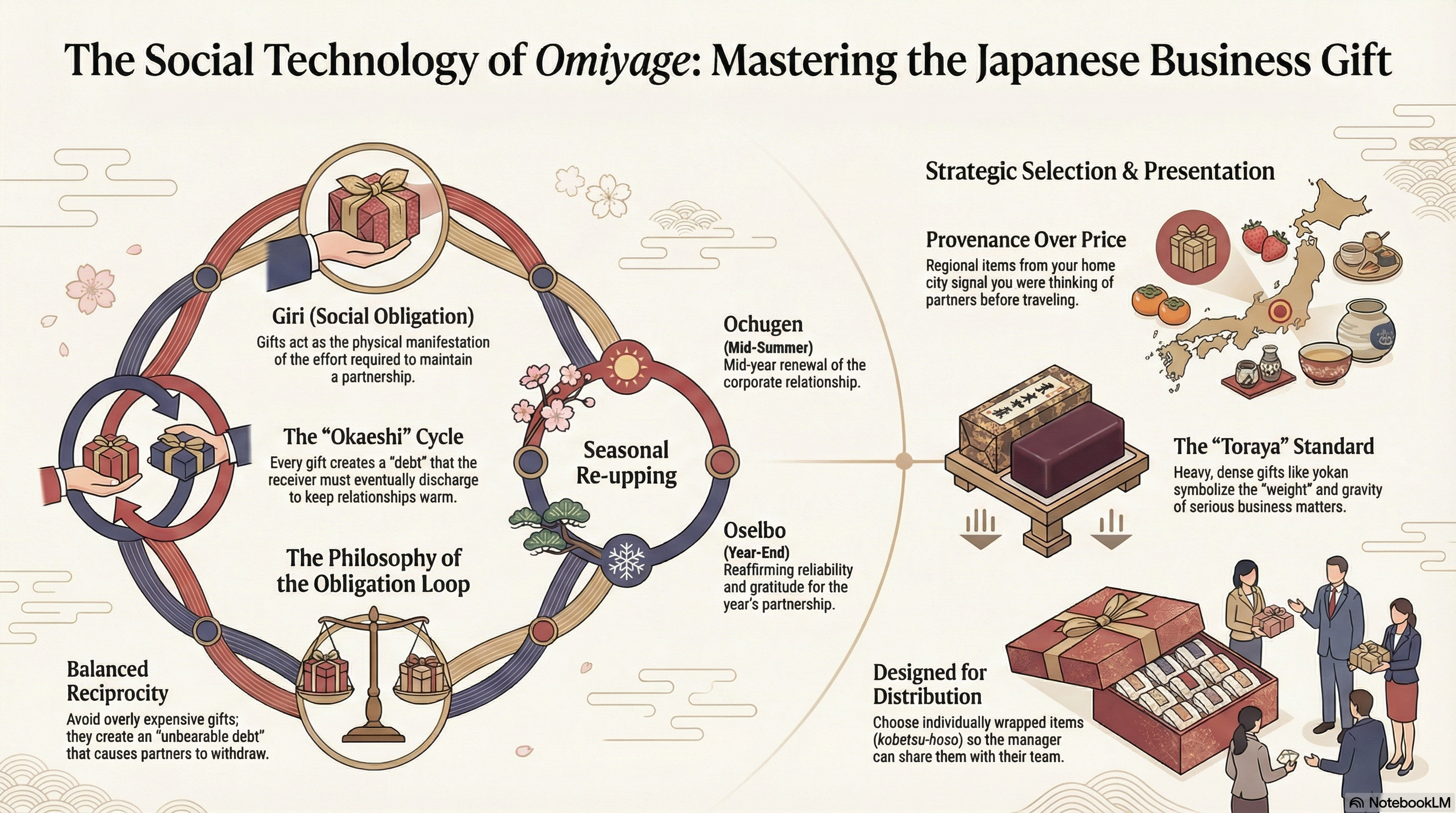
The logic of the gift economy in Japan is rooted in the concept of Giri, or social obligation. While modern business practices emphasize efficiency and digital communication, the physical exchange of goods remains a necessary friction that proves a partner’s commitment. A gift acts as a physical manifestation of the effort expended to maintain the relationship.
The choice of the gift reveals the sender’s understanding of hierarchy and geography. In Japan, the “provenance” of an item carries more weight than its caloric content. A box of cookies from a local bakery near your headquarters in Chicago or Munich tells a story of origin. It suggests that you considered your Japanese partners even before you boarded the plane. It transforms the gift from a commodity into a token of shared history.
This ritual is particularly visible during the two major gift-giving seasons: Ochugen in mid-summer and Oseibo at the year’s end. During these periods, the logistics networks of Japan are strained by the sheer volume of beer, cooking oil, and premium fruit moving between corporations. This is not mere seasonal charity. It is a systematic “re-upping” of the social contract. By accepting a gift, a company acknowledges its ongoing partnership; by sending one, it reaffirms its reliability.
The Toraya Standard: A Lesson in Heavy Gravity
To understand the stakes of this exchange, one must look at Toraya, the legendary 500-year-old confectioner that has served the Imperial Court since the 16th century. Toraya’s yokan, a dense, sweet bean jelly is the gold standard for high-stakes business interactions. The weight of a Toraya bag is famously heavy, a physical metaphor for the gravity of the occasion.
In Japanese corporate lore, a Toraya gift is the “apology of last resort.” When a major scandal erupts or a significant contract is breached, executives often arrive at the aggrieved party’s office with the largest, heaviest box of Toraya yokan available. The density of the jelly symbolizes the “weight” of the apology. To bring a light, airy sponge cake to a serious grievance meeting would be an insult, suggesting that the mistake is trivial.
This cultural mechanic extends to the choice of the shopping bag itself. The paper bag from a prestigious department store like Mitsukoshi or Isetan acts as a seal of quality. The department store has already “vetted” the gift for you. For a foreign executive, presenting a gift in its original, high-tier department store bag provides an immediate layer of credibility. It signals that you respect the local hierarchy of prestige.
The Architecture of the Return Gift
The complexity of the Omiyage obligation loop lies in the inevitable Okaeshi, or the return gift. In Japan, a gift is rarely a one-way street. It creates a “debt” that the receiver must eventually discharge. This creates a perpetual motion machine of corporate bonding.
When you provide a gift to a Japanese client, you are essentially initiating a rhythmic exchange. They will likely respond with a gift of similar (though usually slightly lower) value at the next opportunity. This cycle keeps the lines of communication open. It provides a “safe” reason to meet, to follow up, and to keep the relationship warm during the long gaps between formal contracts.
The strategic mistake many outsiders make is trying to “win” the gift exchange by spending an exorbitant amount of money. In the Japanese system, an overly expensive gift creates an “unbearable debt.” It puts the receiver in an uncomfortable position where they feel they cannot properly reciprocate, causing them to pull away from the relationship to avoid the social pressure. The goal is “balanced reciprocity.” You want to provide something that is premium and thoughtful, yet within the bounds of what the other party can reasonably return.
The Strategy of Intentionality
Navigating this loop requires a shift from a transactional mindset to a relational one. Instead of viewing the purchase of a gift as a chore to be delegated to a junior staffer at the airport, treat it as a strategic touchpoint.
A successful Omiyage strategy involves “The Story.” If you are visiting from a specific region, bring something unique to that area that is difficult to find in Tokyo. This provides a natural conversation starter (the icebreak) that moves the discussion away from the spreadsheets and toward a more human connection. It shows that you are bringing a piece of your home to theirs.
Furthermore, consider the “Internal Distribution” factor. In Japanese offices, gifts are rarely consumed by the executive alone. They are typically opened and shared among the entire team or department. Therefore, the most strategic gifts are those that are individually wrapped (kobetsu-hoso). This allows the manager to distribute the treats to their subordinates, effectively using your gift to build their own internal social capital. By providing a gift that is easy to share, you are helping your counterpart look good in front of their team.
The presentation of the gift is the final, crucial step. In the West, we often give gifts at the start of a meeting to “break the ice.” In a formal Japanese setting, the gift is more effectively presented at the conclusion of the meeting, or when the “real” business has been concluded. It serves as the period at the end of the sentence, a final, graceful note that ensures the last thing the client remembers is your thoughtfulness, not just your price point.
The Bottom Line
Omiyage is the physical currency of trust in a culture that prioritizes long-term stability over short-term gains. By mastering the nuances of the obligation loop, you move beyond the status of a vendor and become a partner who understands the unwritten ledger of Japanese business. The box you carry is never just a snack; it is the weight of your commitment to the relationship.
Over to You
Have you ever noticed a change in the “temperature” of a meeting based on the specific brand or origin of the gift you presented?


