


The conference room on the 42nd floor of a Shinjuku skyscraper felt clinical, bathed in the blue light of high-resolution monitors and the hushed hum of a server room down the hall. On one side of the mahogany table sat the visiting European CEO, his hand hovering over a sleek tablet, ready to finalize a multi-million dollar joint venture with a single, encrypted biometric swipe. On the other side, his Japanese counterpart the president of a century-old manufacturing titan sat motionless. Between them lay the thick stack of contract papers, their edges crisp and intimidating.
The silence stretched long enough to become uncomfortable for the visitor. He tapped his stylus against the glass, a rhythmic clicking that signaled his eagerness to move to the next item on the agenda. He expected the efficiency of the digital age to dictate the pace. Instead, the Japanese executive reached into his breast pocket and produced a small, rectangular case wrapped in dark, embossed leather. He opened it with a deliberate click, revealing a cylinder of polished ox horn. He pressed the tip of the cylinder into a small tin of vermilion paste, twisted it slightly to ensure even coverage, and then, with a slow, vertical descent, pressed the seal onto the paper.
The “click” of the digital signature met the heavy, silent “thud” of the wooden stamp. In that moment, the foreign executive realized that his digital confirmation felt ephemeral, while the scarlet circle on the page possessed a gravity that the cloud could never replicate. He had signed a document; his partner had committed a legacy.
The Architecture of Shared Responsibility
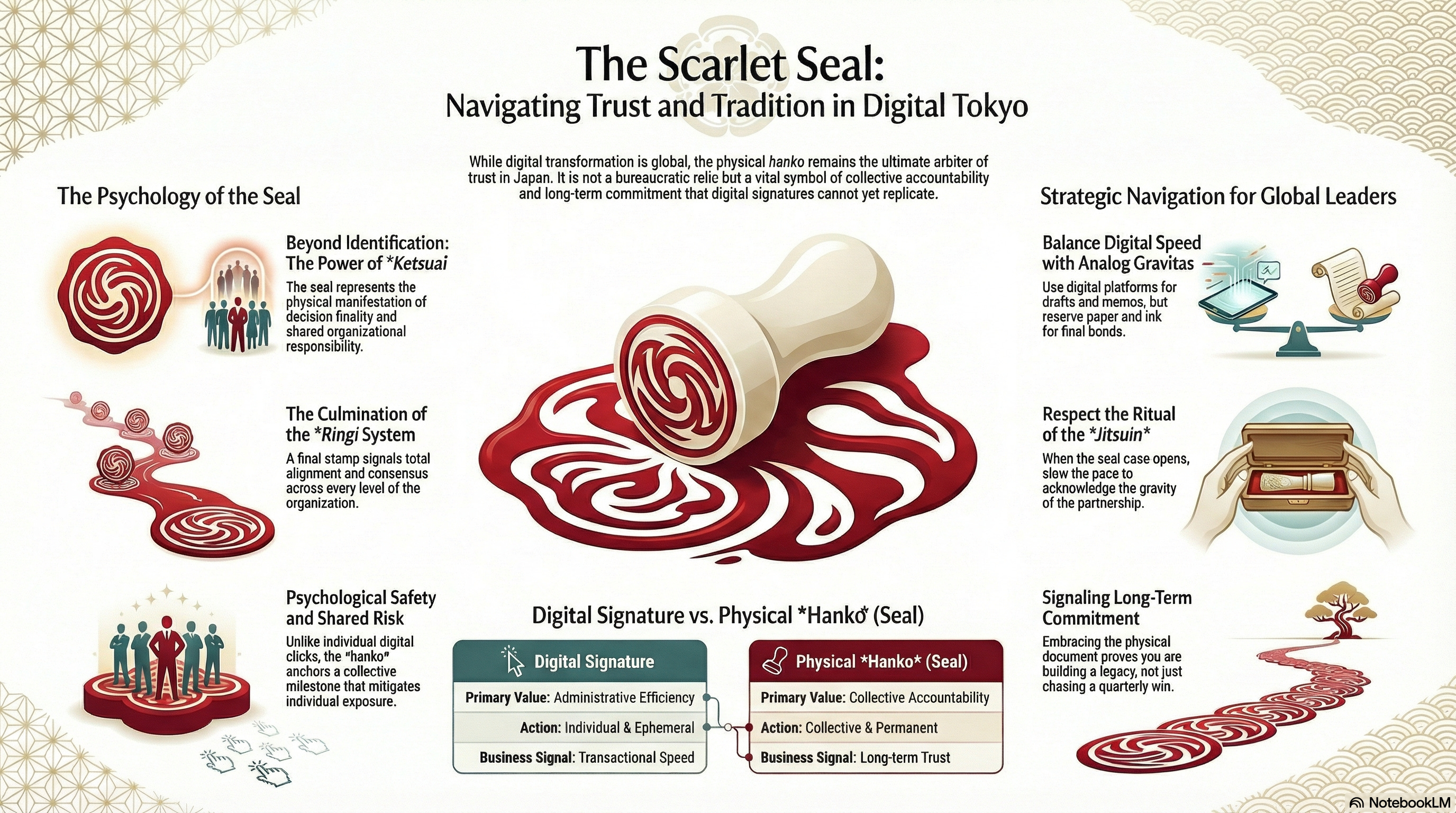
The persistence of the hanko, the personal or corporate seal often baffles the modern executive who views administrative efficiency as the ultimate virtue. To the uninitiated, the stamp appears as a relic of a bygone bureaucracy, a literal bottleneck in the flow of global commerce. Yet, the scarlet ink serves a purpose far deeper than simple identification. It functions as the physical manifestation of ketsuai, the finality of a decision that has moved through the intricate layers of a Japanese organization.
During the height of the global pandemic in 2020, the Japanese government attempted a radical “hanko war.” The then-Administrative Reform Minister, Kono Taro, famously declared a crusade against the unnecessary use of stamps to facilitate remote work. He pointed to the “hanko commute,” where employees traveled into deserted business districts solely to press a piece of wood onto a piece of paper. Many analysts predicted the immediate death of the tradition. While digital transformation (DX) surged and many administrative forms were indeed digitized, the jitsuin, the officially registered corporate seal remained firmly on the desks of senior leadership.
The reason for this resilience lies in the collective nature of Japanese corporate psychology. A digital signature is an individual act, often performed in isolation. The hanko, by contrast, is the culmination of the ringi system, where a proposal circulates through every relevant department, gathering smaller, informal stamps of approval along the way. By the time the final, large corporate seal hits the contract, it represents a total alignment of the firm’s will. The stamp provides psychological safety; it confirms that the risk has been shared and the consensus is absolute. In a culture that prioritizes harmony and the mitigation of individual exposure, the physical act of stamping creates a shared milestone that a digital “accept” button simply cannot anchor.
Navigating the Red Circle
Success in the Japanese market requires a pivot in how one perceives these “analog” hurdles. Instead of viewing the hanko as a barrier to speed, the sophisticated leader treats it as a high-value signal. The moment the stamp case is opened, the atmosphere in a room shifts. The pace slows, the focus sharpens, and the gravity of the partnership is acknowledged. This is not a moment to be rushed; it is a ritual to be respected.
The strategic move for a global executive is to integrate digital agility with analog gravitas. Use digital platforms for the iterative stages of a project, the drafts, the internal memos, and the technical specifications. These are the realms where speed is the primary currency. However, when the moment arrives to solidify a long-term alliance or a major acquisition, embrace the paper. Providing a physical document for the final signature shows an understanding of the Japanese need for a tangible record that can be filed, touched, and archived in a fireproof safe. It demonstrates that you are not just passing through Tokyo for a quarterly win, but are building a structure intended to last for decades.
Furthermore, understanding the hierarchy of stamps can yield significant tactical advantages. A stamp tilted slightly to the left is a traditional gesture of “bowing” to the superior who will stamp next, signaling humility and a request for approval. While a foreign executive is not expected to master these esoteric nuances, acknowledging the weight of the jitsuin earns immediate cultural capital. When your partner brings out the red ink, put the tablet away. Lean into the ceremony. The time saved by a digital signature is often lost in the trust that is eroded by bypassing the traditional markers of commitment.
The Bottom Line
The hanko is a physical anchor of accountability in a business culture that prizes permanence over temporary speed. By respecting the scarlet seal, you signal a commitment to the collective consensus that governs Japanese success. True integration requires the wisdom to use the cloud for work and the ink for the bond.
Over to You
Does your organization prioritize the speed of the digital click or the weight of a physical commitment when closing a high-stakes partnership?


