


The heavy thud of the three-ring binder hitting the mahogany table echoed through the executive suite in Marunouchi. On the left side of the room, the New York legal team sat back with a collective sense of pride. They had spent six weeks and four hundred billable hours “bulletproofing” the joint venture agreement. Every conceivable contingency from currency fluctuations to intellectual property theft to force majeure was codified across seventy-eight meticulous pages. They saw this document as the ultimate gesture of professional clarity and protection for both parties.
Across the table, the Japanese managing director didn’t open the binder. He stared at the sheer thickness of the spine with a look of profound exhaustion. To him, the weight of the paper was a physical measurement of his partner’s suspicion. He saw a list of every way the Americans expected him to fail, cheat, or litigate. The silence in the room was not the silence of contemplation; it was the silence of a relationship that had stalled before the first shipment had even left the dock.
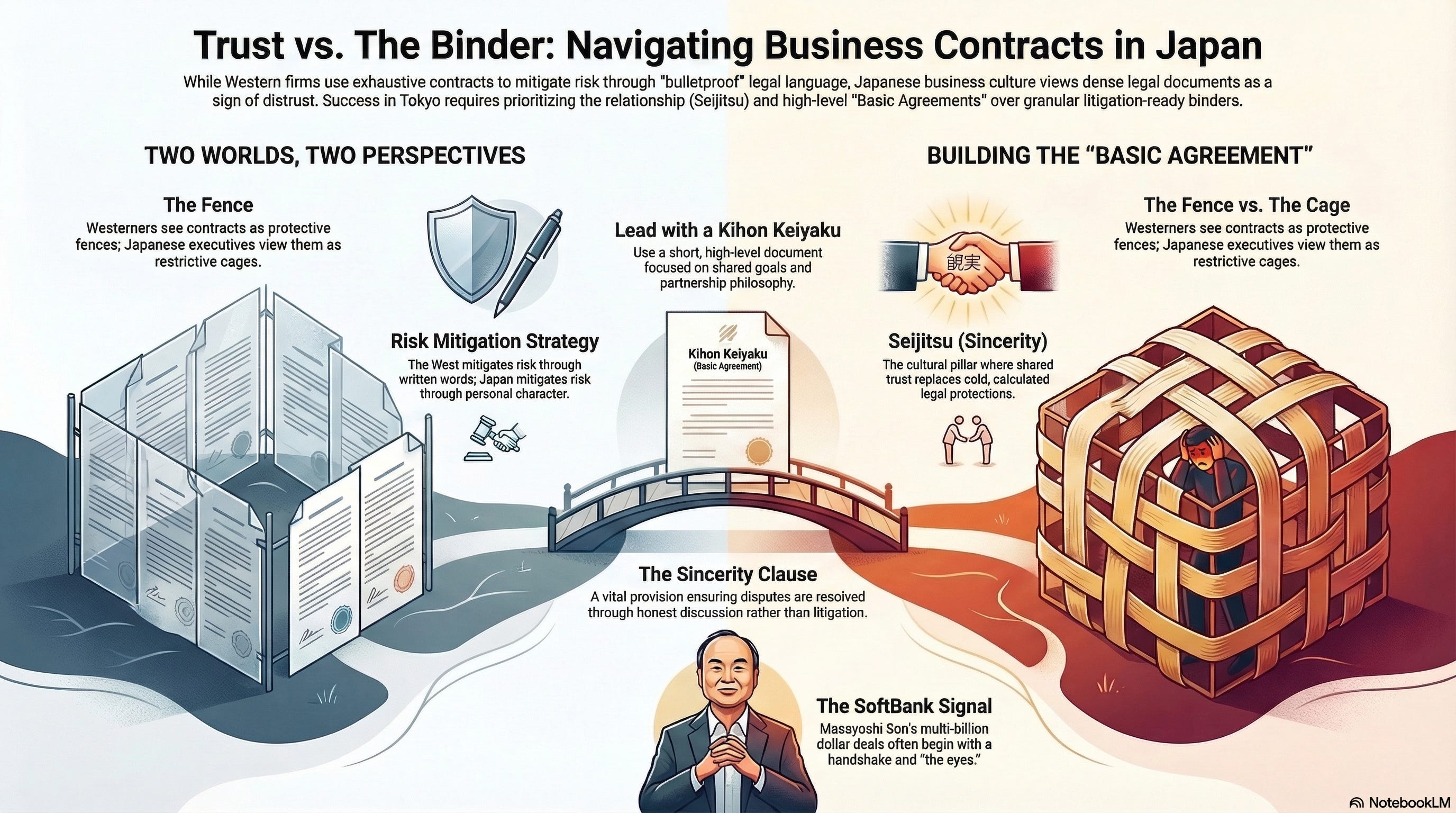
To the Western executive, a contract is a fence that defines the boundaries of a playground. It ensures everyone knows where they can run and where they must stop. To the traditional Japanese executive, however, that same fence looks like a cage. It signals that the spirit of Seijitsu, sincerity has been replaced by the cold calculation of the courtroom.
The Legalism of the Divorce Decree
The friction between Western legalism and Japanese relationalism is rooted in a fundamental difference in how risk is perceived. In the United States or Europe, risk is mitigated through the written word. If a scenario is not in the contract, it is a vulnerability. In Japan, risk is mitigated through the quality of the person sitting across from you. If you need fifty pages to ensure your partner behaves honestly, you have already chosen the wrong partner.
This cultural preference for “vague” agreements is a strategic choice for flexibility. A rigid, granular contract assumes that the world of tomorrow will look exactly like the world of today. In the Japanese mindset, business is a living, breathing entity that must adapt to unforeseen shifts in the market, technology, and society. A vague contract allows for “sincere consultation” (seijitsu kyo-gi) when trouble arises. It permits the partners to sit down as allies and find a solution that preserves the harmony of the venture, rather than retreating to their respective corners to cite Paragraph 4, Subsection B.
Consider the historical structure of the Keiretsu, the massive industrial groupings like Mitsubishi or Sumitomo. For decades, these entities moved billions of yen in goods and services based on “Master Agreements” that were often shorter than a standard household lease. The “contract” was the decades of shared history, cross-shareholdings, and the mutual understanding that the survival of the group outweighed the short-term profit of the individual. When the 2008 financial crisis hit, these groups didn’t spend their time in litigation over contract breaches; they spent their time reorganizing their internal resources to ensure every member of the family survived the storm.
The SoftBank Signal: Beyond the Fine Print
Even in the modern, fast-paced world of technology and global venture capital, this relational priority persists in surprising ways. Masayoshi Son, the founder of SoftBank, is famous for making multi-billion dollar investment decisions based on what he describes as “the look in the eyes” of a founder and a ten-minute conversation. While SoftBank certainly employs a small army of lawyers to eventually codify these deals, the initial commitment, the “real” contract is a handshake and a shared vision.
When Son invested $20 million in a struggling Jack Ma and Alibaba in 2000, there was no massive legal framework that could have predicted the eventual outcome. The investment was a bet on a person and a relationship. Had the legal teams insisted on a fifty-page document defining every exit strategy and penalty clause at the outset, the chemistry that fueled one of the most successful investments in history might have evaporated. In the Japanese context, the lawyers are the administrative cleanup crew; the leaders are the architects of trust. If the cleanup crew arrives before the architects have finished their work, the building rarely stands.
Navigating the Sincerity Clause
If you are a global executive entering the Japanese market, your goal is to reposition the contract within the hierarchy of the relationship. Attempting to force a highly granular, American-style agreement onto a traditional Japanese partner is an act of cultural aggression. It suggests that you value the letter of the law over the spirit of the partnership.
The strategic approach is to lead with a “Basic Agreement” (Kihon Keiyaku). This is a shorter, high-level document that outlines the shared goals, the philosophy of the partnership, and the commitment to mutual success. It almost always includes a “Sincerity Clause,” which states that any disputes will be resolved through honest discussion in good faith. To a Western lawyer, this clause is “unenforceable fluff.” To a Japanese executive, it is the most important sentence in the entire document. It is the guarantee that you will act like a partner, not a litigant, when things get difficult.
Instead of presenting a finished, massive binder, invite your Japanese counterparts into the drafting process. Ask them, “How should we handle the unexpected together?” This shifts the focus from “protection” to “collaboration.” You are building a framework for a relationship that can withstand a crisis, rather than a document that merely dictates who gets paid when the crisis occurs. The more you try to nail down every detail, the more you signal that you are preparing for a fight. The most successful foreign firms in Japan are those that treat their contracts as a starting point for a conversation, not the final word.
The Bottom Line
A contract in Japan is a symbol of intent, not a substitute for trust. Prioritizing legal granularity over relational depth creates a “trust deficit” that no amount of fine print can overcome. Build the relationship first, and the paperwork will eventually follow as a mere formality.
Over to You
Have you ever had a deal in Japan slow down or stall specifically during the legal review phase? How did you bridge the gap between your legal team’s requirements and your partner’s need for trust?


