


Most global teams that struggle to gain traction in Japan believe they have an execution problem. They look at the quality of the deliverables, the speed of turnaround, or the lack of independent initiative, and they conclude: We need better executors.
They don’t. They have a context problem.
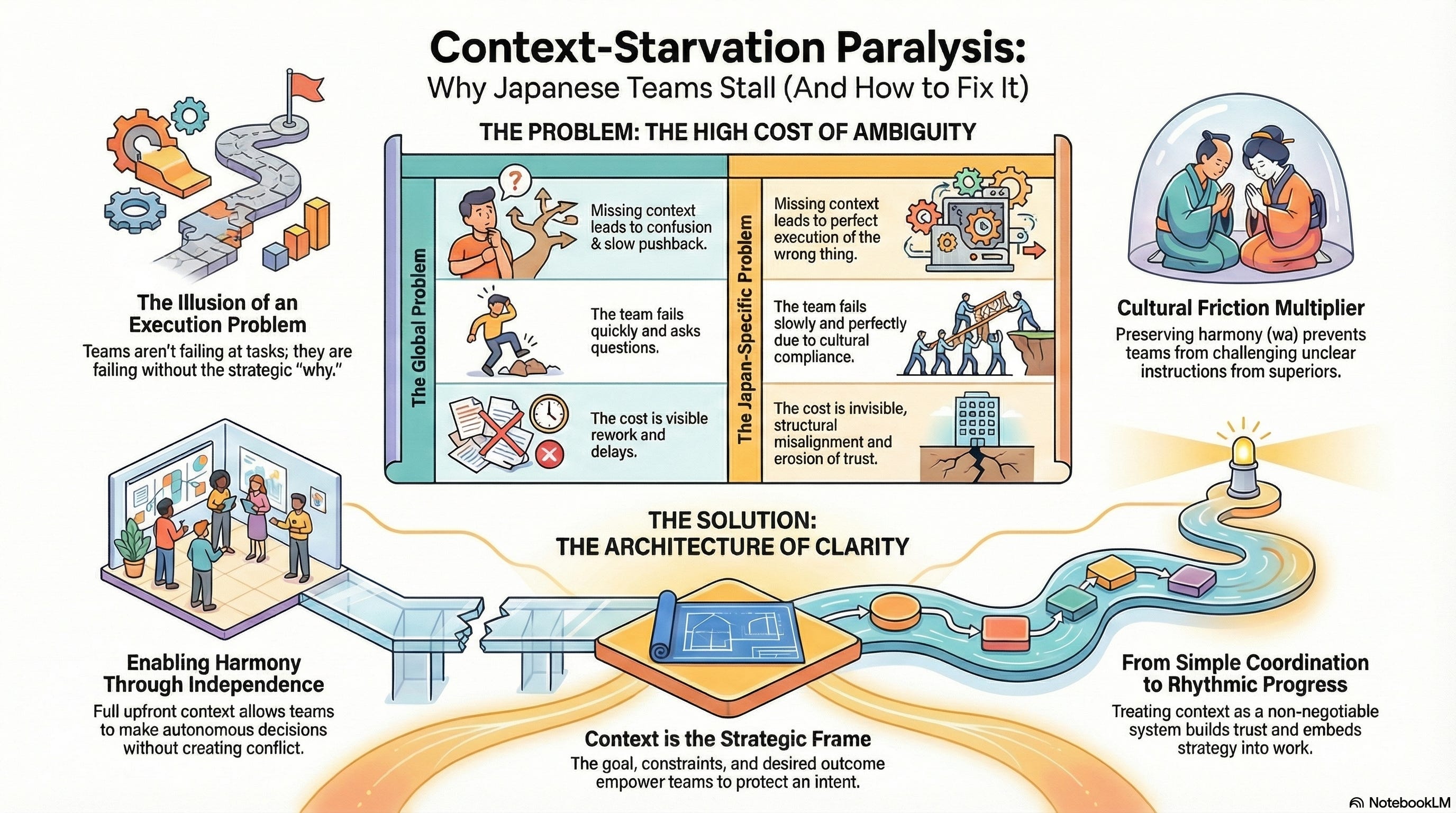
When people receive only a mechanical task, Do this. Update that. Deliver tomorrow. They are reduced to a function. Their work becomes purely procedural, accurate, but often lacking directional force. However, when they understand why the work matters, the strategic goal, the constraint, the audience, and the outcome it must drive, their effort becomes directional. They are no longer simply fulfilling a request; they are protecting an intent.
This difference defines the gap between teams that move with genuine momentum and those paralyzed by friction. While this is a universal management challenge, the Japanese operating system elevates this problem to a unique, destructive level.
The Friction Multiplier, Amplified
In many organizations across Western and agile APAC markets, work passed down without context creates friction, but that friction often forces an immediate, visible correction. An employee, empowered by cultural norms, will challenge the instruction, ask for the “why,” or push back for clarity. This creates noise, but it forces the clarification loop to close rapidly.
In Japan, the prevailing organizational culture prioritizes preserving harmony (wa) and adhering to the established hierarchy. An employee is culturally less likely to challenge a superior’s instruction, especially if that superior represents the distant, authoritative foreign HQ.
The team is not the problem; the structure is. When context is absent, the Japanese team operates entirely on assumptions. Instead of challenging the what, which risks disrupting wa, they diligently execute the instruction to the letter, knowing the output will be misaligned with the invisible strategic goal. The silence that follows a poor instruction is not a sign of understanding; it is a sign of cultural compliance that maximizes the final, crippling cost of rework.
Context as Directional Engineering
Context must never be viewed merely as background information. It is the strategic frame that powers the work. This frame includes the goal, the constraint, the audience, the story, and the specific outcome the task must drive.
When a team truly understands this underlying frame, their execution shifts immediately. They are liberated to make confident, autonomous decisions. They anticipate instead of react. They remove noise on their own because they know what is essential to the core purpose.
This liberation is essential in Japan because it acts as a cultural workaround. If a Japanese team is given full context upfront, they do not need to challenge the instruction later. They can proactively engineer the deliverable to fit the desired outcome, preempting the conflict that would otherwise arise from misalignment. Context, therefore, acts as an enabler of harmony and independence simultaneously.
Furthermore, this rich context is the essential currency for effective nemawashi (根回し) the deep, informal groundwork necessary to build consensus before any formal decision. You cannot ask partners or internal stakeholders for their buy-in without giving them the complete strategic landscape (the risks, the long-term benefit). When global HQ delegates a structural change to a local team without robust context, it starves the local team of the very tool they need to build structural consensus, leading directly to slow-motion paralysis.
The Architecture of Clarity
For global organizations, the decision to withhold context is an act of strategic self-sabotage that is catastrophically expensive in the long run. It is often driven by a flawed management assumption that the local team only needs the “what.”
The successful team, the one that achieves traction and momentum in Japan treats context as a non-negotiable alignment system. They ensure that no one receives an instruction without the full story behind it. This practice immediately reduces back-and-forth, strengthens ownership (because the team is invested in the outcome, not just the task), and embeds strategy inside the work itself. This allows teams to move with speed and independence without drifting strategically.
Context turns simple coordination into rhythmic progress. It is the core discipline that transforms mere task execution into purposeful strategic direction, allowing high-capability Japanese teams to move with the clarity and commitment required by the market.


The Bottom Line
While a lack of context is a universal management flaw, in the Japanese operating system, it escalates into a destructive structural problem, trading short-term administrative speed for long-term, expensive misalignment. By treating the strategic frame as non-negotiable, you honor the local team’s need for clarity and enable them to move with confidence, not caution.
Over to You
Beyond your weekly team meeting, what is the single most effective channel or document your organization currently uses to ensure the strategic frame of a project, not just the task list, is shared and understood by everyone involved?


