


Most global teams treat accountability as a moral idea, a personal virtue. At “Inside Brand Japan,” we view it differently: accountability is a structural requirement and an operating logic that keeps work moving without the crippling friction of ambiguity.
When every person fully owns their piece of the process, work ceases to behave like a sequential relay race where effort is lost in the handoffs. Instead, it functions as a coordinated system. This is the precise moment when organizational momentum, the ability to move quickly and cohesively becomes possible.
Why Accountability Accelerates Work
Accountability creates clarity, and clarity removes friction. Friction slows teams more than workload ever will. In high-performing environments, accountability multiplies efficiency because it systematically dismantles three common organizational barriers:
First, it eliminates bottlenecks. Clear ownership means people move proactively instead of reactively, eliminating the structural waiting that plagues ambiguous processes. Second, it eradicates blame loops. Defined responsibility allows teams to fix problems immediately and locally, rather than spending time on internal politics to protect themselves later. Finally, it prevents fragmented contribution. Every piece of work is intentionally shaped and completed, rather than loosely handed off as someone else’s cleanup job.
When ownership is active, teams stop losing time to ambiguity. This is crucial in any environment, but in a global setting, its interpretation changes dramatically.
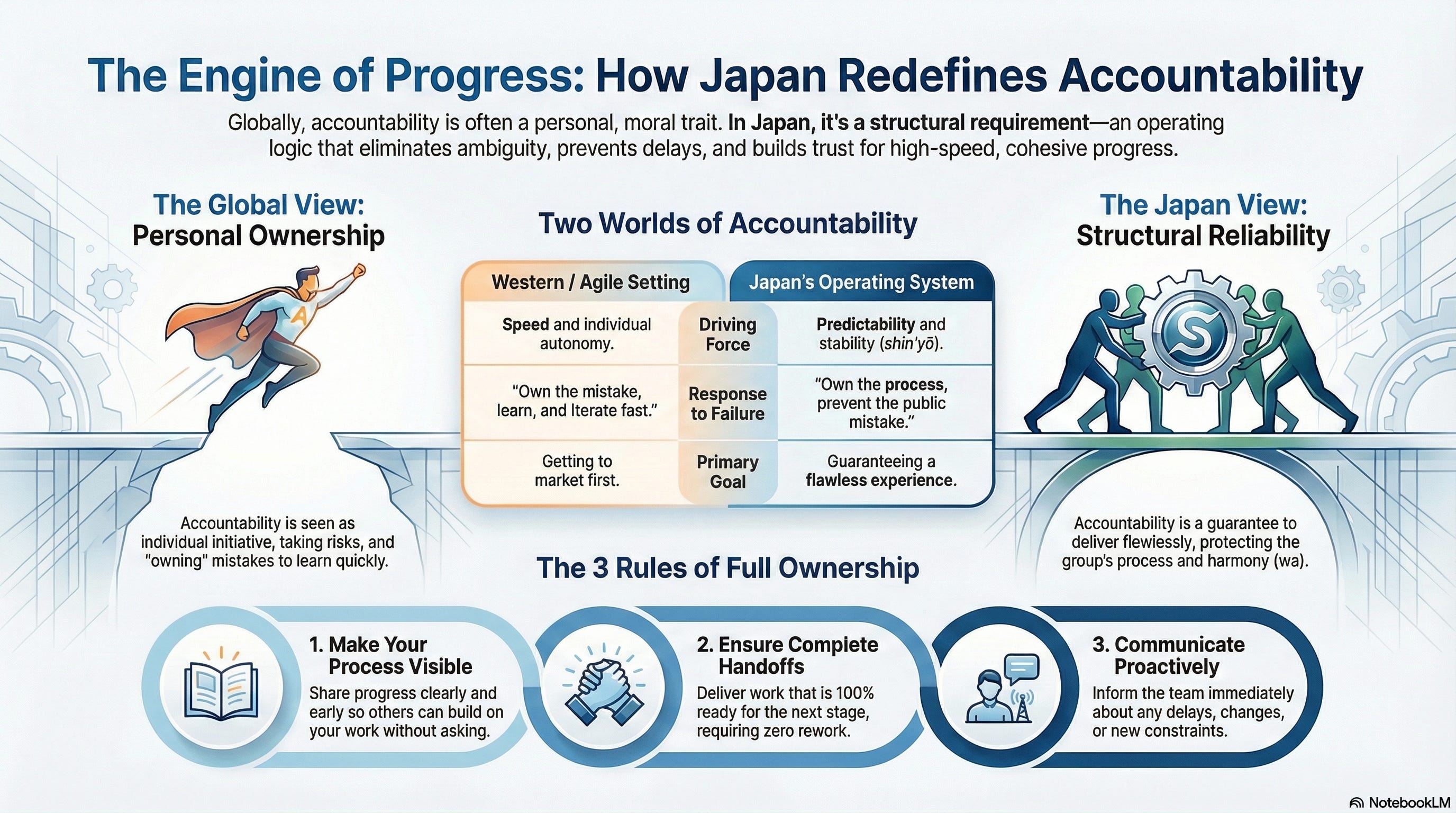
Accountability: Global vs. Japan
In the global context, accountability often means taking bold personal risks. In Japan, it primarily means reliability and trust guaranteeing that what you promise will be delivered to the required standard, thereby protecting the downstream process of your colleagues. This reliability is the foundation of wa (harmony); the confidence that you don’t have to worry about your partner’s commitment is what allows the entire collective to move forward without hesitation.
The Mandate of Full Ownership
The principle is simple: If you touch it, you own it.
In complex strategic work, ownership extends far beyond merely completing the assigned task. It is the full assumption of responsibility from start to finish, the work is carried until it lands successfully and stably for the next stakeholder.
This requires proactive, structural behavior:
Visible Process: Progress must be shared early and clearly so others can build on it without guessing or having to break wa by asking intrusive questions.
Complete Handoffs: Delivered work must be clean, documented, and immediately ready for the next stage, demanding zero rework or clarification from the receiving party.
Proactive Communication: If conditions shift, market changes, delays, or new constraints—the team is informed immediately, minimizing the eventual impact.
This structural discipline creates predictability. Predictability, in turn, gives teams the confidence to take bold steps because they know the foundation—the work of their partners—is absolutely stable.
Accountability as the Engine of Strategy
Creative strategy, market alignment, and brand work depend entirely on precision and timing. A brilliant idea only becomes a successful outcome when its execution is consistent and flawlessly integrated into the local market.
Accountability is the structure that holds strategic direction intact through every stage of development. It ensures that the initial intention is protected through every handoff, that information is never lost between contributors, and that clients see clarity and stability at every checkpoint.
In a market like Japan, where client relationships are built on years of predictable conduct and reliability, accountability is not optional; it is the structural assurance that the foreign partner is serious and will not introduce the very instability the market works so hard to avoid.


The Bottom Line
Accountability is the engine of predictable progress. In a global setting, it minimizes friction; in the Japanese operating system, it fundamentally creates the trust required for collaboration. By ensuring that every individual carries their piece to full completion, organizations eliminate the silent delays caused by ambiguity and gain the critical structural momentum to succeed.
Over to You
In your last major project, what specific moment of success or failure could have been directly tied back to a lack of defined ownership or a failure in proactive communication during a handoff?


