


The CMO sits in a glass-walled conference room in Minato-ku, reviewing the creative boards for the upcoming fiscal year. The agency team, a phalanx of suited account executives led by a senior director from one of Japan’s “Big Three” firms presents the campaign. It is polished. It features a top-tier tarento (celebrity). The media plan is exhaustive, covering every major TV network and digital touchpoint.
The work is technically perfect and strategically hollow. It looks exactly like every other campaign in the category.
When the CMO asks why the creative doesn’t push further, why it feels so risk-averse, the local marketing manager interjects with a practiced explanation of “market standards” and “consumer expectations.” But the friction in the room isn’t about the consumer. It is about the agency’s true function.
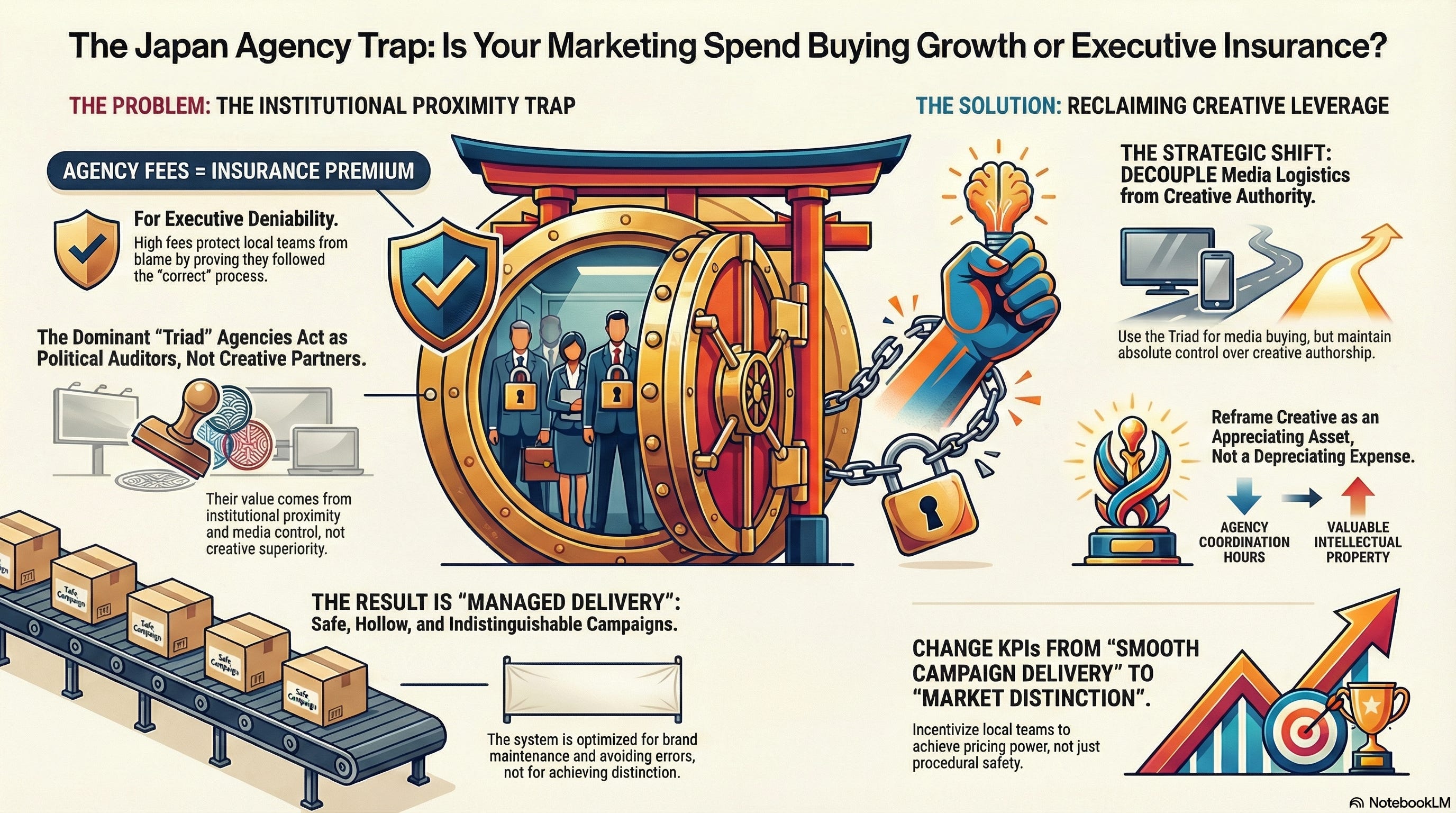
The CMO is witnessing a “Managed Delivery.” The agency has not been hired to create a competitive advantage; they have been hired to provide Institutional Cover. If the campaign fails to move the needle, the local team can point to the agency’s pedigree and the “proven” media model as proof that they followed the “correct” process. In the Japanese corporate system, following the correct process is often more important than achieving the correct result. The brand is not paying for creativity; it is paying for a shield.
The Mechanism: The Institutional Proximity Trap
This is not a culture issue. This is an Operational Asset Protection Failure.
The Japanese advertising market is governed by a three-node system, the Incumbent Triad that controls the vast majority of media spend, talent access, and corporate legitimacy. While global executives often view agencies as “creative partners,” the Triad functions as a hybrid of a Media Broker and a Political Auditor.
The Triad as Governance
The dominance of firms like Dentsu and Hakuhodo is not a result of creative superiority, but of Institutional Proximity. They are structurally entangled with the Japanese business system at a level that global firms cannot replicate.
Media Gravity: The Triad controls the “inventory” of Japanese attention. Their bulk-buying power across the five major TV networks (Nippon TV, TV Asahi, TBS, TV Tokyo, and Fuji TV) creates a system where brands are often forced to work with them simply to secure premium placements. This is a “Media-First” logic where the creative is treated as a secondary byproduct, a “lubricant” for the media spend.
The Risk Mitigation Protocol: For a Japanese Brand Manager, hiring an Incumbent Triad agency is an act of Risk Displacement. Because these agencies are deeply embedded in the governance structures of Japan’s largest corporations (often sitting on boards or maintaining decades-old cross-shareholding ties), they are perceived as “safe.” A failure with a Triad agency is a “market event”; a failure with a boutique or foreign creative agency is a “management error.”
Real-World Proof: The Hegemony of “Managed Delivery”
Consider the typical “Tier 1” Japanese brand launch. The output is almost universally recognizable: a 15-second TV spot, a celebrity spokesperson, and a safe, category-correct message. This is the Managed Delivery model.
When a global brand like Coca-Cola or P&G operates in Japan, they often find their global creative logic filtered through this Triad system. The result is “Localization” that isn’t about the consumer, but about making the brand look “legitimate” to Japanese retail buyers and internal stakeholders. The cost of this legitimacy is a “Coordination Tax”—a massive percentage of the budget that funds agency overhead and “alignment meetings” rather than actual intellectual property.
The system is not broken; it is perfectly optimized for Brand Maintenance. It ensures that nothing “wrong” happens. However, in an increasingly competitive global market, “not being wrong” is no longer a viable strategy for growth.
The Strategic Shift: From Insurance to Creative Leverage
The fundamental error made by global leaders is the assumption that their agency’s high fees are a reflection of “Creative Value.” In Japan, those fees are more likely a Political Premium.
The Single Irreversible Insight
In Japan, agency fees are not a payment for ideas; they are an insurance premium paid for executive deniability.
If your agency spends 70% of its time on “coordination” and “internal alignment” and only 30% on “authorship,” you are not running a marketing department; you are running a compliance office. To break this, you must separate Media Access from Creative Authority.
Explicit Reframing: Not Partnership, but Procurement
The Problem is not “Creative Quality”: It is Structural Entanglement. Your local team is likely prioritizing the safety of the Triad over the efficacy of the message.
The Shift is not “Finding a Better Agency”: It is Decoupling Media from Creative.
In the Triad system, the “Creative Department” is structurally subordinate to the “Media Buying Department.” The creative’s job is to ensure the media spend is approved without friction. To reclaim your brand’s edge, you must treat creative as an Appreciating Asset (Intellectual Property) rather than a Depreciating Expense (Managed Delivery).
This requires a shift in how you measure your local marketing lead. If their primary KPI is “Smooth Campaign Delivery,” they will always choose the Triad. If their KPI is “Market Distinction and Pricing Power,” they will be forced to look outside the “Safety” of the incumbent nodes.
Global brands that successfully disrupt the Japanese market (such as Apple or Netflix) consistently bypass the Triad’s creative logic. They use the Triad for what they are actually good at Media Logistics while maintaining absolute, uncompromising control over their creative authorship. They recognize that in Japan, “Polite Acceptance” by the agency system is the first sign of a brand’s impending invisibility.
The Bottom Line
Your brand’s creative expenditure is currently being utilized as an insurance policy to protect your internal decision-makers from the risk of distinctiveness. Until you decouple your creative authorship from your media logistics, your marketing spend will continue to fund the “Managed Delivery” of your own irrelevance.
Over to You
Does your current agency’s fee structure incentivize the creation of high-leverage intellectual property, or does it primarily reward the “Coordination Hours” required to keep your local stakeholders comfortable?


