


A friend working in regional marketing told me a story that exposes a mistake many founders and CMOs still make.
Her APAC headquarters is in Bangkok, managing Southeast Asia with speed, flexibility, and confidence. When they decided to enter Japan, they followed a familiar, seemingly logical structure: Strategy, decisions, and brand logic remained firmly anchored in Bangkok, while the local Japanese staff in Tokyo were tasked simply with executing the plan.
This model had worked brilliantly across Southeast Asia, a region that thrives on agility and rapid experimentation. So, they assumed it would work in Japan.
It didn’t.
Not slowly. Not partially. Not with minor friction. It did not work at all.
Their campaigns landed flat, their messaging vanished into the market, and their Japanese hires waited for instruction rather than daring to shape the strategy.
Japan didn’t argue. Japan didn’t push back. Japan didn’t criticize. Japan simply... did nothing.
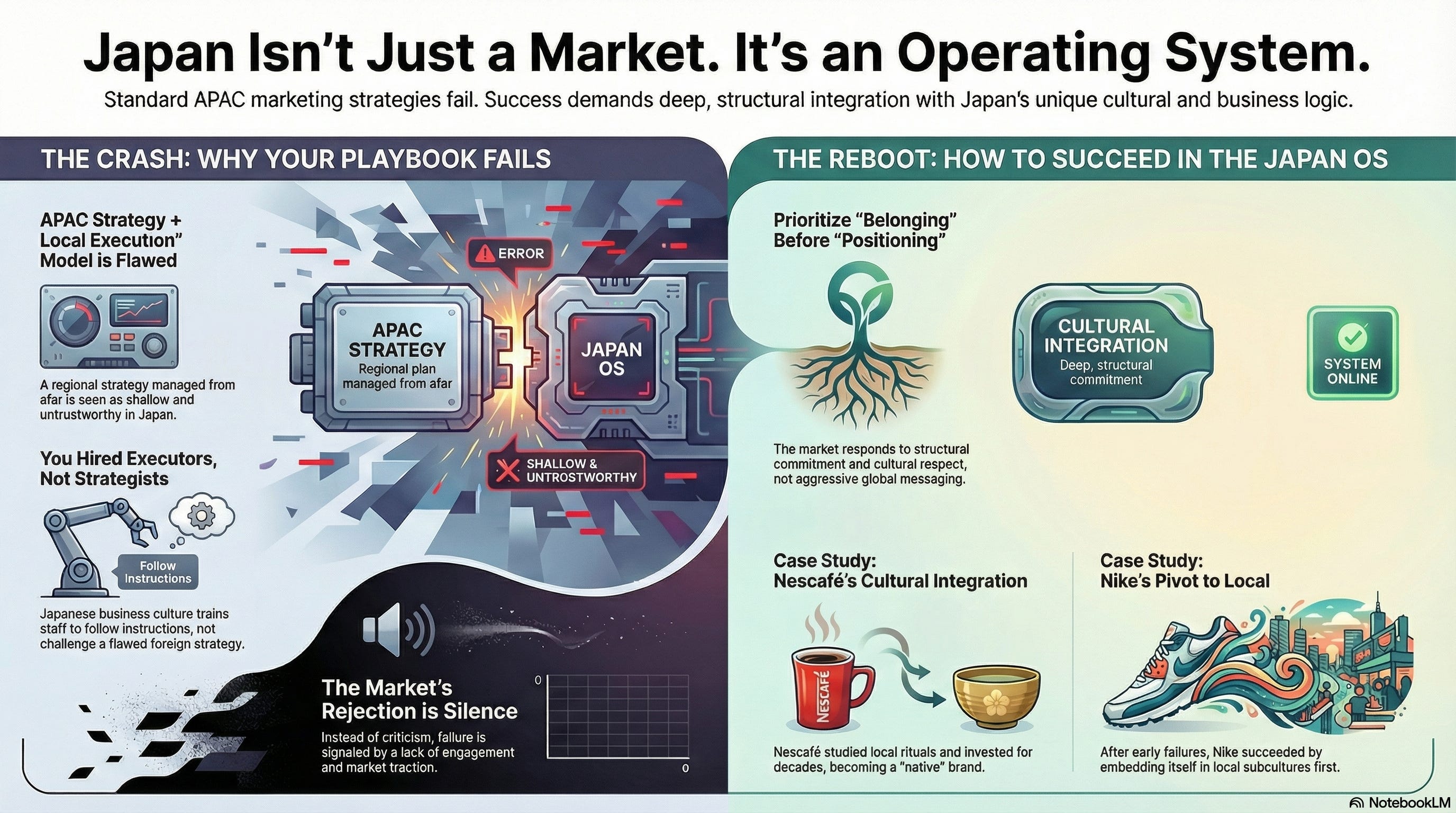
This is Japan’s quiet, definitive form of rejection. Not dramatic failure, not an explicit feedback loop. Just silence. It is the market’s subtle, yet devastating, way of signaling: “If your structural commitment is shallow, your brand isn’t entering.”
This is the core insight global executives must internalize: Japan is not a market. It is an operating system. And brands that attempt to run an incompatible foreign framework on it crash immediately upon entry.
The Bangkok-Tokyo Miscalculation
The assumption that the Southeast Asian growth playbook can be ported directly into East Asia, specifically Japan is fatal. The two regions operate on fundamentally different logics of trust and time.
Where Southeast Asia is fast, flexible, and open to external ideas, allowing brands to gain traction quickly based on visibility, Japan is structured, hierarchical, and precedent-driven. Trust moves slowly here, built not on promotional momentum but on demonstrable depth, conduct, and structural commitment. Japan is the most structured system within East Asia, more formal, more stable, and more resistant to foreign frameworks than even China or Korea.
The regional logic of Bangkok, speed, visibility, and agility cannot be copy-pasted into this environment. This is why the formula of Bangkok-Strategy + Tokyo-Execution always breaks. Japan does not trust brands managed from afar. It trusts brands that build Japan-specific leadership and architecture, demonstrating irreversible, tangible commitment. Without that structural belonging, the Japanese market defaults to strategic inertia.
The Illusion of Local Hiring
My friend’s company proudly claimed, “We hired locals in Tokyo.”
But they hired what most foreign companies unknowingly hire in Japan: Japanese executors, not Japanese strategists.
This is not a reflection of individual talent, which is immense, but a reflection of corporate culture. Japanese business culture systemically trains employees to follow instruction, reduce risk, avoid conflict, and maintain wa (harmony). It trains them to execute precedent. It does not train them to challenge headquarters, pressure leadership, or take creative ownership that disrupts existing frameworks.
Consequently, Bangkok expected strategic leadership from Tokyo, but Tokyo believed they were expected to execute instructions only. The entire structure collapsed under the weight of this cultural mismatch. You cannot outsource Japan’s market strategy to a culture trained not to challenge strategy. The local team becomes a passive filter for instructions they know won’t work, yet feel obligated to follow. This is the structural flaw global CEOs never see until the market shows them through protracted silence and zero traction.
Belonging Before Positioning
The campaigns my friend’s team used worked flawlessly across Southeast Asia. They collapsed in Japan because they relied on external frameworks the local system does not value.
The Japanese market does not respond to regional consistency, global logic, or aggressive, top-down positioning built on brand confidence. Instead, it responds to belonging, structure, respect, presence, and behavioral proof of long-term intent. This distinction is the difference between brands that fail immediately and those that compound success over decades.
Consider the case of Nescafé, a brand every CMO should study. They didn’t enter Japan by exporting a global message; they entered with profound cultural literacy. Instead of assuming coffee was a natural part of Japanese life, they studied the context: the routines, the rituals, the home habits. They learned why coffee wasn’t integrated, and then worked to fill that vacuum with ritual, not just product. They built belonging, not just awareness, ensuring packaging, visuals, and messaging became intrinsically Japanese in tone and rhythm, transforming coffee from a foreign commodity into a social component of daily life. Crucially, they strategized in decades, accepting the long timeline and investing in infrastructure and partnerships that signaled irreversible commitment. The result is a brand that doesn’t feel successful in Japan; it feels native. They adapted Nescafé to Japan’s operating system.
Contrast this with the early struggles of Nike. It is the strongest brand in the world, yet it failed multiple times in Japan not because the product was wrong, but because the operating logic was incompatible. Early efforts clashed violently with Japanese athletic culture: Nike sold “stand out” and Western individualism, while the local system celebrated discipline, unity, and respect for the team. Furthermore, they underestimated domestic loyalty to brands like Asics and Mizuno. They tried to achieve mass culture immediately, scale before depth. Nike’s eventual success came when it stopped exporting “Global Nike” and allowed a Japan-specific Nike to emerge, focused entirely on the local ground. They pivoted their strategy toward engaging youth basketball communities and streetball courts, deeply integrating with Harajuku and other distinct local subcultures, adopting a community-first approach that prioritized credibility before visibility. This strategic retreat proved that even the strongest global brand must bow to the Japan OS: Depth before scale. Belonging before positioning.
For global executives, the lesson is clear. Long-term thinkers in Japan compound trust. Short-term thinkers burn money. The choice is about whether you are willing to localise your governance structure and behavioral signals, not just your marketing copy.
The Bottom Line
Japan does not reject brands; it rejects shallow commitment. The APAC–Tokyo trap of regional strategy plus local execution with no structural belonging will always fail. Global playbooks will always misfire. Japan only opens its door to brands built with its unique operating system in mind. Those who respect this structural reality win slowly and then they win for decades.
Over to You
If your organization were forced to choose only one thing, long-term structural commitment or short-term agile speed to secure success in Japan, which one would your leadership select, and what would that choice signal to the market?


