

The scene is Tokyo on Christmas Eve. It’s not the scent of pine and nutmeg that dominates, but the pervasive, irresistible aroma of Colonel Sanders’ Original Recipe. The lines outside every KFC location from Ginza to Shinjuku stretch down the block, meticulously organized queues of families, young couples, and solo travelers, all patiently waiting to collect their pre-ordered “Party Barrel” or “Premium Series” box. It’s a surreal moment for any Western executive: the centerpiece of a major national holiday is not a home-cooked feast but a bucket of fried chicken. If you walk into this scene expecting to find the Western concept of “Christmas Spirit,” you’ll be baffled. If you look deeper, however, you won’t see a quirky marketing success; you’ll see a perfectly executed lesson in strategic market design that every global executive should internalize. The confusion of the outsider is exactly where the lesson begins, because this tradition was not inherited by Japan; it was manufactured with surgical precision.
The Architecture of Clarity
The global business narrative loves to reduce the KFC Christmas phenomenon to a charming accident, a simple “lost-in-translation” moment where a smart manager saw an opening. This is a profound misreading of Japanese market mechanics. KFC didn’t simply sell fried chicken; they offered a solution to an ambient structural problem.
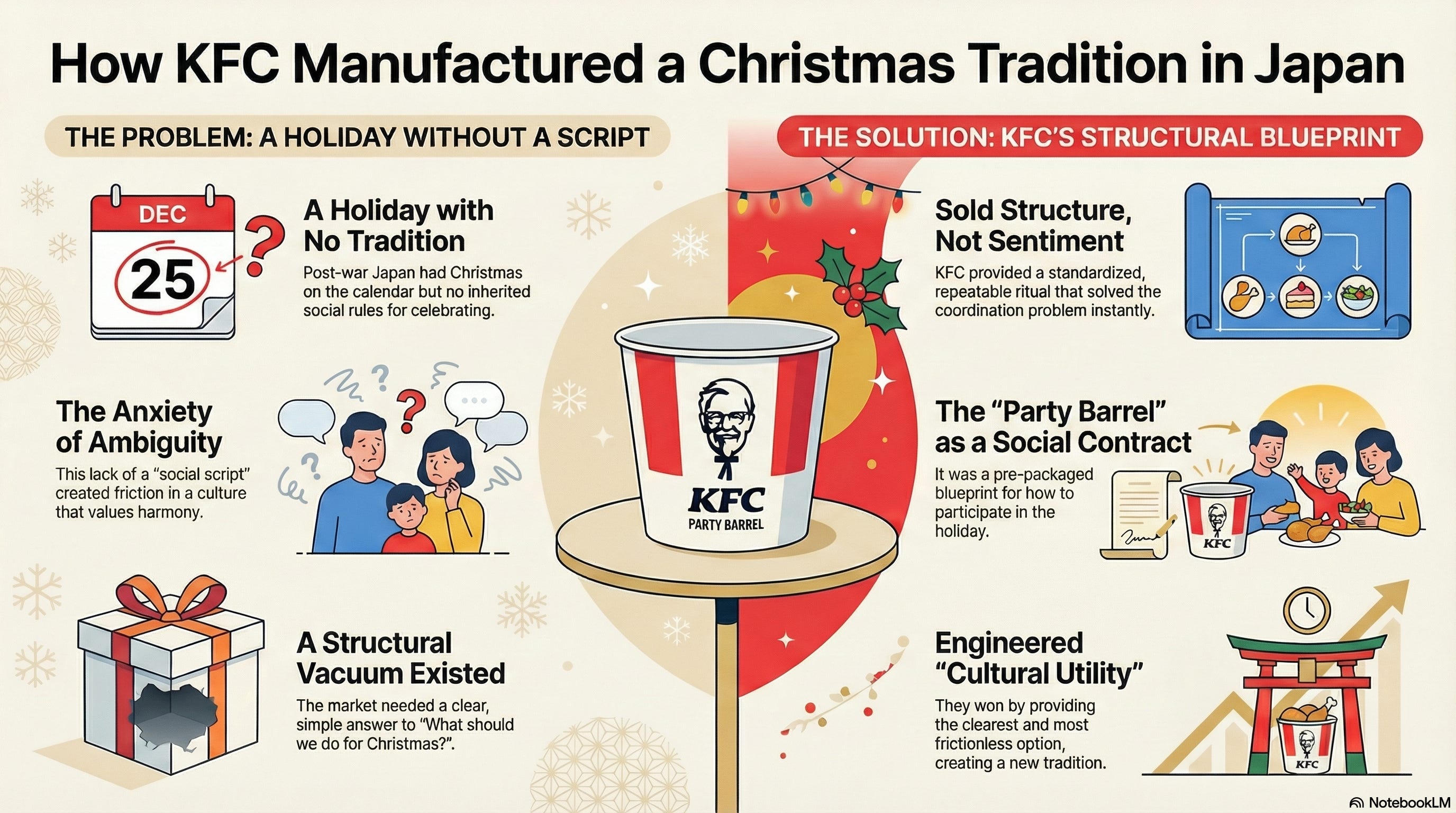
When Christmas arrived in post-war Japan, it was not accompanied by centuries of religious and familial tradition. It was a modern, secular import, a calendar date devoid of an established social script. There was no inherited default behavior. This vacuum of convention is a source of anxiety in a culture that prizes social harmony, coordination, and the avoidance of friction (wa, 和). When the communal script is unclear, decision-making becomes exhausting. What should we eat? What should we do? What are others doing?
KFC’s stroke of genius was not in the advertising; it was in the system design. They didn’t sell the meaning of Christmas; they sold the structure of the celebration. They introduced a defined, standardized, and repeatable set of actions: the “Kentucky for Christmas” (ケンタッキーをクリスマスに, KFC o Kurisumasu ni) ritual. This solved the coordination problem instantly. The Party Barrel was not just a container of food; it was a pre-packaged social contract.
Consider the famous example of Toyota’s production system, the relentless pursuit of Jidoka (automation with a human touch) and the elimination of Muda (waste). This philosophical approach is not confined to the factory floor; it is a cultural preference for frictionless coordination. KFC applied this operational logic to a holiday. They eliminated the waste of decision-making and the friction of social ambiguity. By offering a clearly defined, pre-orderable, fixed-price meal, they provided utility first. The emotional significance, the sense of “tradition” followed years later, after the behavior had become socially reinforced and expected.
Designing the Consumption Script
The true mastery of the KFC case is that it bypassed the need for cultural authenticity and instead engineered cultural utility. Many global brands arrive in Japan chasing an ill-defined idea of “localization,” believing they must mimic existing tradition. KFC recognized that on Christmas, there was no existing culinary tradition to mimic. They weren’t fighting for a slice of the existing pie; they were defining the size and shape of the entire pie itself.
The strategy hinges on understanding the Japanese consumer’s preference for shared norms. When a collective behavior is established, adopting it is a low-risk, high-reward move. It ensures alignment with the group and reduces decision fatigue. The pre-ordering system itself is critical: it requires planning, signaling a commitment that reinforces the seriousness and predictability of the ritual. This structured commitment aligns perfectly with a society that values long-term planning and perfect execution.
Think of the way new consumption patterns take hold in Japan whether it’s the annual fukubukuro (lucky bag) frenzy on New Year’s Day, or the seasonal release of a specific flavor of KitKat. Once a social loop is established where media coordinates around it, retailers coordinate around it, and the consumer expectation is set—the behavior becomes self-perpetuating. KFC achieved category ownership not through overwhelming advertising spend but through structural creation. They didn’t just sell the chicken; they sold the blueprint for how to participate in Christmas in Japan. By providing the clearest answer, they made themselves the only viable answer. Their strategy was less about marketing and more about behavioral infrastructure.
The Bottom Line
KFC’s success is a warning to global executives who believe success in Japan relies on replicating Western marketing tactics. They did not win by appealing to sentimentality or inherited tradition; they won by aligning with Japan’s deep-seated preference for clarity, coordination, and frictionless social structure. The KFC bucket is a masterclass in building a cultural operating model that the market can step into without hesitation.
Over to You
Beyond the holiday season, what structural vacuum in the Japanese business or consumer landscape is your company currently positioned to fill, offering clarity instead of complexity?


