


In the suburban sprawl of 1980s America, a peculiar sound echoed through wood-paneled living rooms: the rhythmic, mechanical “chk-chk-chk” of a scanning radio. It was the sound of the Uniden Bearcat. Long before the era of instant push notifications or social media “citizen” apps, if you wanted to know why three fire trucks just tore down your street, you didn’t check Twitter. You turned on your scanner.
You were listening to the pulse of the city—police dispatches, ambulance coordinates, and storm chasers. To the average consumer, Uniden felt as American as a backyard barbecue. It was the brand of the trucker, the hobbyist, and the nosy neighbor. But behind this ubiquitous “American” hardware sat Hideo Fujimoto, a visionary Japanese entrepreneur who understood a fundamental human truth: information is the ultimate commodity, especially when it’s traveling through the air for free.
The Japanese Architect of the American Ear
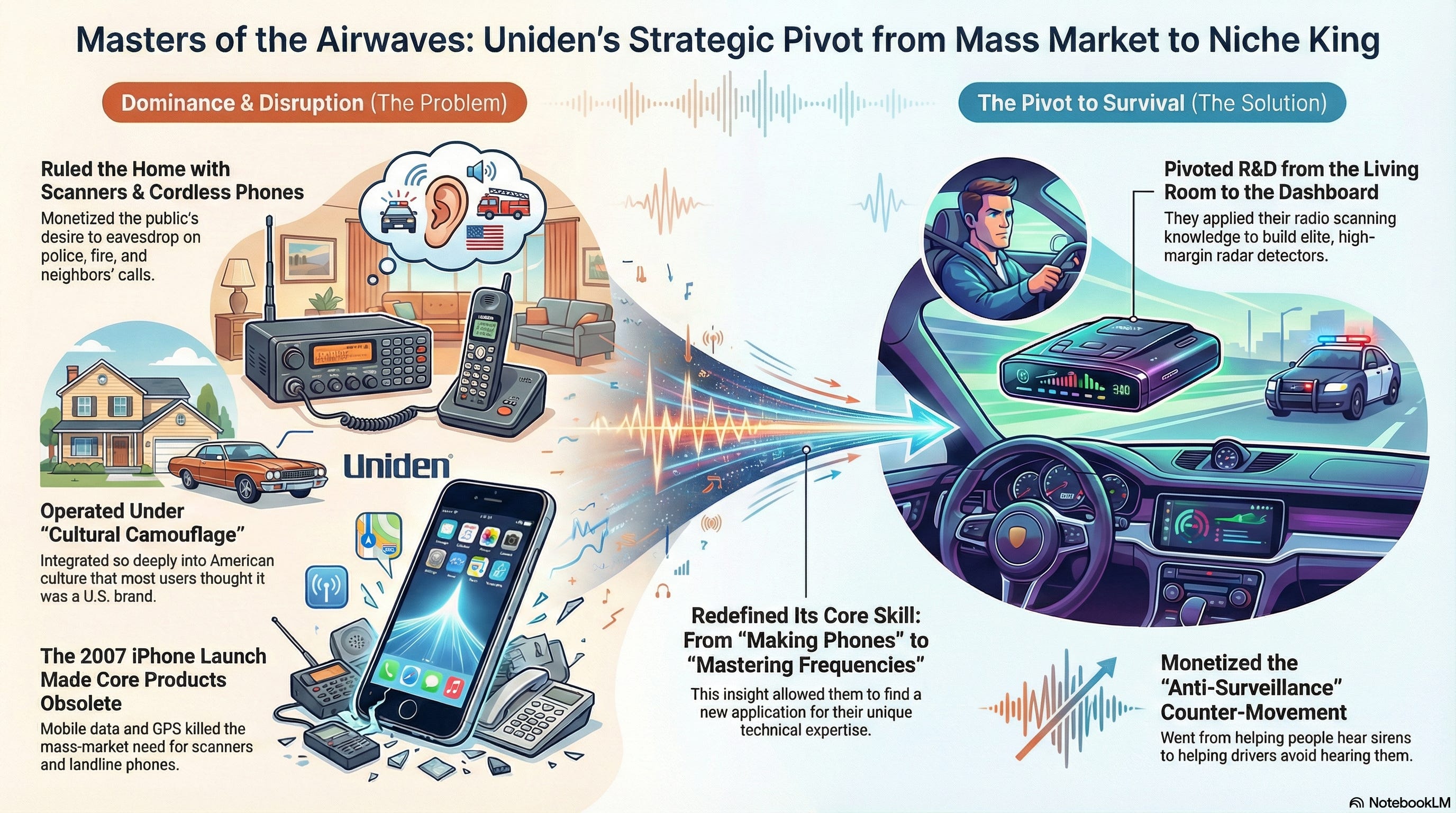
Uniden’s rise is a masterclass in “Stealth Japan.” Unlike Sony or Nintendo, which wore their Japanese heritage as a badge of futuristic cool, Uniden integrated itself so deeply into the American tactical and domestic landscape that most users had no idea the company was headquartered in Tokyo.
Founded in 1966, Uniden’s genius lay in identifying “gray spaces” in technology—areas that were legal but overlooked by the giants. By the 1980s, they had perfected the Bearcat Scanner. They weren’t just selling radios; they were selling a form of legal spying. This was the “Original Twitter.” It provided a real-time, unedited feed of reality that newspapers couldn’t match.
This dominance extended into the cordless phone revolution. If you owned a high-end cordless phone in 1992, chances are it was a Uniden. They were the undisputed kings of the 900MHz frequency. However, this power came with a notorious cultural glitch. Because their signals were so robust and the encryption so primitive, it wasn’t uncommon for a Uniden user to pick up their handset and hear their neighbor’s private conversation. It was a bizarre, accidental social network—a time when the “privacy of the home” was a porous concept mediated by Japanese circuitry.
The iPhone Impact and the Tactical Pivot
The year 2007 was a memento mori for the landline and the scanner. When Steve Jobs pulled the iPhone out of his pocket, he wasn’t just launching a phone; he was signing the death warrant for every single-purpose device Uniden produced. GPS rendered scanners obsolete for the casual user, and mobile data killed the need for a landline.
Many Japanese firms of that era, paralyzed by their own previous success, followed their legacy products into the grave. They tried to make “better” cordless phones for a world that no longer wanted them. Uniden, however, executed a pivot that was as cynical as it was brilliant.
They realized that their core competency wasn’t “making phones”—it was “mastering radio frequencies.” If the world no longer needed to listen to the police, perhaps the world needed help avoiding them.
Uniden shifted its R&D from the living room to the dashboard. They took their decades of experience in frequency scanning and applied it to the world of high-end radar detectors. Today, the Uniden R8 is considered the “gold standard” for automotive countermeasures. They went from being the company that helped you hear the siren to the company that ensures you never have to hear it from the backseat of a patrol car.
The Strategy of the Invisible Giant
Uniden’s survival provides a vital playbook for the modern executive: The Strategy of Frequency Mastery.
Own the Niche, Not the Category: Uniden never tried to beat Apple at smartphones. They stayed in the “frequency” niche where they held an unfair advantage. They moved from a mass-market commodity (phones) to a high-margin enthusiast market (radar detectors).
Cultural Camouflage: Uniden’s ability to “localize” was so effective that they became part of the American cultural fabric (the “CB radio” culture) without the friction often faced by foreign brands. They understood the American obsession with liberty and “knowing what’s going on” and built tools to facilitate it.
Monetizing the Counter-Movement: When technology moves in one direction (increased surveillance, digital tracking), there is always a profitable counter-movement. Uniden pivoted to the “anti-surveillance” market, selling peace of mind to car enthusiasts who feel increasingly squeezed by automated traffic enforcement.
The Bottom Line
Uniden proves that a company’s longevity isn’t found in its most popular product, but in the specific technical problem it solves better than anyone else. They didn’t just sell radios and phones; they sold a way to navigate the invisible waves of information that surround us, proving that even when the medium changes, the desire to “know” remains constant.
Over to You
When your core market is disrupted by a “black swan” event like the iPhone, do you try to fix your product, or do you find a new way to apply your “unfair advantage”?


