


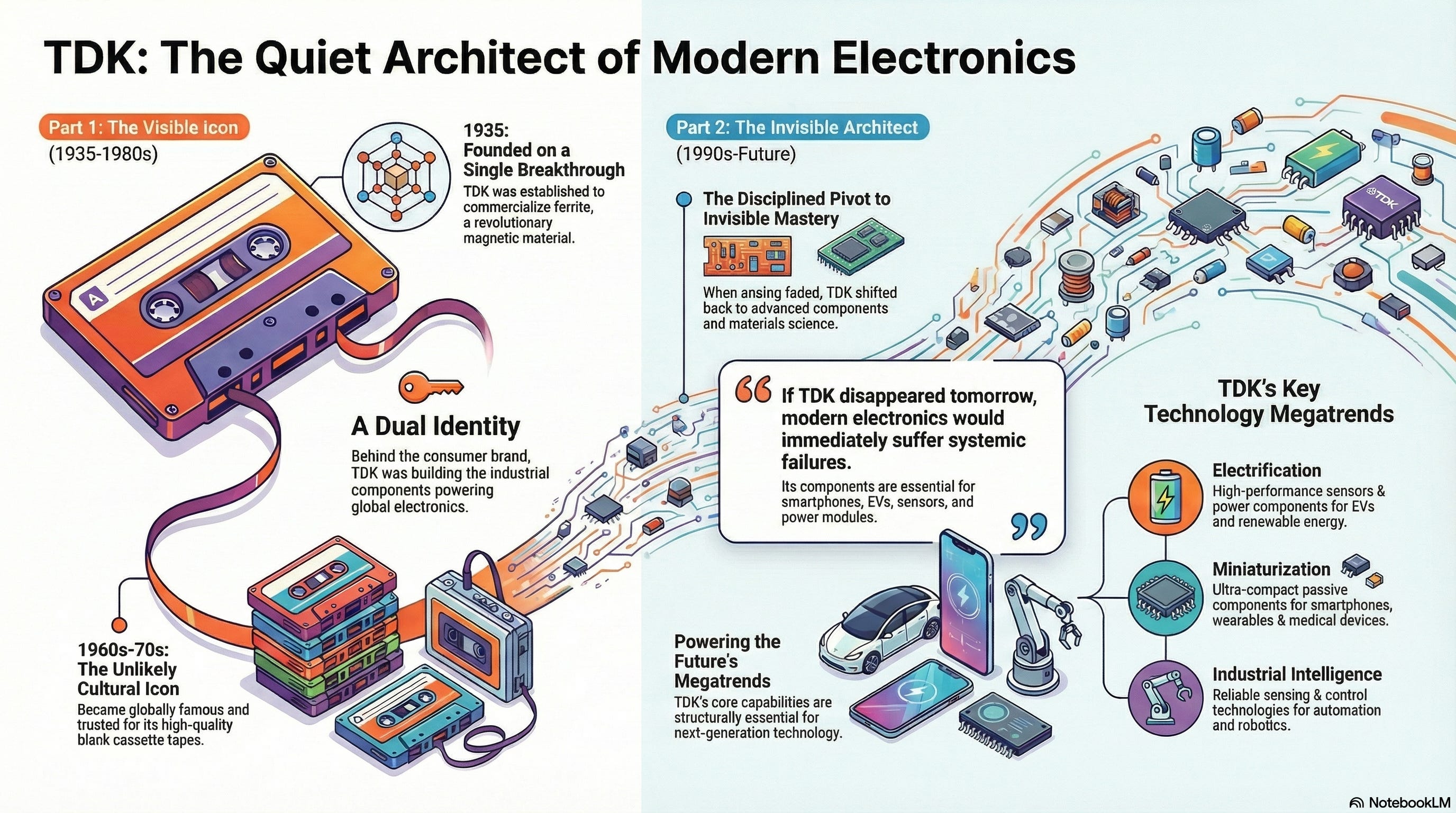
If TDK disappeared tomorrow, modern electronics would immediately suffer systemic failures. Smartphones would go dark. Electric vehicles (EVs) would malfunction. Sensors, power modules, and critical passive components, the unheralded essentials of the digital world would cease to function.
Most of the global public remembers TDK, if at all, for its iconic role in the cassette tape era. In reality, its specialized materials and components sit inside nearly every device that defines contemporary life. TDK is one of the quiet architects of the digital era, a company whose enormous global influence is felt everywhere but seen almost nowhere.
Understanding TDK means grasping a crucial aspect of Japan’s industrial power: how it built the technical backbone of global electronics long before the world realized it needed one.
Origins: Built on a Single Breakthrough
TDK was founded in 1935 with a singular, disciplined purpose: to commercialize ferrite, a revolutionary magnetic material discovered at the Tokyo Institute of Technology. Ferrite changed the calculus of electronics manufacturing. It allowed radios and communication devices to be smaller, more reliable, and, crucially, more affordable. Before TDK, Japan was dependent on imported magnetic materials. After TDK, Japan had established a domestic, advanced foundation for its burgeoning electronics industry.
The company’s identity was set early: research first, industry second. TDK did not chase transient consumer trends. Its focus was structural, it built the materials and components that made those future trends possible.
Postwar Expansion and the Cultural Spotlight
As Japan rebuilt after the war and demand for radios, televisions, and eventually computers exploded, ferrite cores became indispensable for filtering noise and managing power in circuits. TDK scaled rapidly, becoming a foundational supplier to both domestic giants and international manufacturers, solidifying its role as a key element of Japan’s emergence as a global electronics power.
By the 1960s and 1970s, TDK extended its capabilities into the magnetic recording field, a pivot that inadvertently brought the company into the cultural spotlight. For the general public, TDK became synonymous with the blank cassette tape. From Tokyo to New York, its tapes captured personal recordings, underground music exchanges, and the defining culture of portable audio. TDK tapes were trusted because they delivered: they were durable, consistent, and backed by the same rigorous materials science that defined the company’s core industrial business.
Yet, this celebrated consumer-facing chapter was only one layer of TDK’s identity. Behind the cultural icon, the company continued building the high-precision technologies that powered the broader global electronics industry, preparing for the next pivot.
Reinvention: The Disciplined Pivot to Invisible Mastery
When the world definitively moved past magnetic tape and analog audio, TDK did not decline. It performed a masterful, disciplined pivot back to its true, structural strength: advanced components and materials science.
Today, TDK is a quiet global leader across critical high-tech domains. Its influence is now deeper than during its cassette-era peak, sitting inside products from the world’s most advanced manufacturers. The company excels in electronic components, high-performance passive devices, energy solutions, and cutting-edge sensors and MEMS technology” the tiny, complex components essential for miniaturization.
TDK’s evolution from an analog audio icon to a digital infrastructure enabler is a model of disciplined, long-term transition. It demonstrated that technical depth, not consumer visibility, guarantees long-term relevance.
Why TDK Still Matters: Aligning with Megatrends
The global shift toward electrification, intense miniaturization, and sensor-driven industrial systems directly aligns with TDK’s core capabilities. Modern electronics depend utterly on compact, efficient, and precise components made from highly specialized materials.
TDK is essential today because it is a structural enabler of these three defining megatrends:
Electrification: EVs, hybrid systems, and renewable energy grids depend on high-performance sensors and power components that TDK manufactures.
Miniaturization: Smartphones, advanced wearables, and critical medical devices demand ultra-compact, precise passive components where TDK’s materials expertise is paramount.
Industrial Intelligence: Automation, robotics, and smart factories require reliable sensing, control technologies, and power modules that ensure stability and precision.
TDK’s materials expertise is not a legacy asset; it is a strategic capability for the next generation of global technology, a quiet force shaping the future.
Cultural Significance: The Archetype of Japanese Industrial Power
TDK represents a distinct and powerful Japanese industrial archetype: the company that does not seek visibility but shapes the world from beneath the surface.
Alongside foundational firms like Murata, Kyocera, and Nitto Denko, TDK builds the indispensable components that allow global brands to function. Their contribution is measured not in marketing budgets or public announcements but in technical integration and operational reliability.
TDK’s enduring identity rests on three defining principles: Fundamental Research (its roots in academia and materials science), Precision Manufacturing (the disciplined process that built Japan’s global electronics reputation), and Strategic Humility (influence achieved through capability, not visibility). These principles have successfully carried TDK across analog, digital, and now the electric and sensor-driven eras.
The Bottom Line
TDK’s story is a study in long-term discipline. A company founded to commercialize a single material became one of the quiet, defining forces behind modern electronics. Its consumer chapter made it famous, but its industrial depth made it indispensable. To understand how Japan truly shaped global technology, you must understand companies like TDK. They are not the names on the devices. They are the structural reason those devices work.
Over to You
Beyond its role in consumer electronics and EVs, what is the single most critical, “invisible” TDK component or material that you believe is essential for the next generation of industrial robotics?


