

The year was 1989, and the playground was a battlefield. Before the arrival of the Game Boy, portable gaming was a fractured landscape of cheap, single-use LCD toys that felt more like calculators than adventures. But when Nintendo released that gray, brick-like handheld, they didn’t just launch a device; they launched a social protocol. To play a Game Boy in public was to signal a specific type of membership. The Link Cable, a physical tether between two devices, created the first real-world “multiplayer” social circles, long before the internet made the concept invisible and frictionless.
For many global executives, Nintendo is viewed through the lens of a successful consumer electronics firm. This is a mistake. Nintendo is a cultural architect. They didn’t just survive the transition from Hanafuda cards to silicon; they took the intimate, tactile social culture of Japanese card rooms and baked it into the global psyche. They have shaped not just the “gaming industry,” but the very concept of digital collection, the psychology of brand loyalty, and the architecture of modern subcultures.
The Curation of the Digital Soul
To understand the subculture Nintendo built, one must look at their refusal to be “cool.” In the 1990s, when Sony’s PlayStation was marketing to the club-going, techno-listening “X-Generation” with edgy graphics and mature themes, Nintendo doubled down on primary colors and whimsy. This was a strategic choice in cultural engineering. By prioritizing a “universal” aesthetic, they bypassed the shelf-life of teenage rebellion.
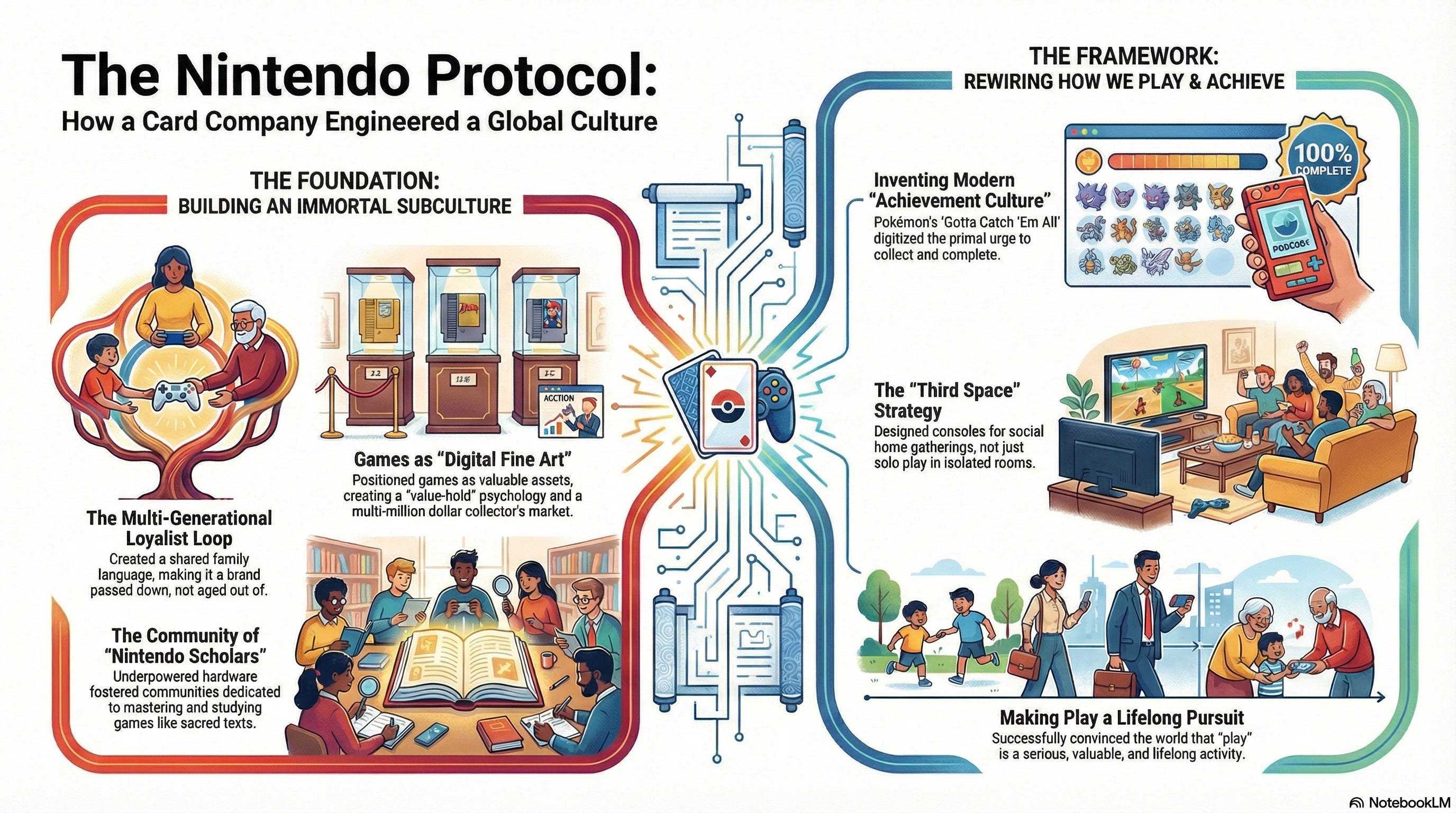
This decision birthed the most powerful subculture in the entertainment world: the Multi-Generational Loyalist. Unlike other tech brands that people “age out of,” Nintendo created a loop. A parent who played Super Mario Bros. on the NES in 1985 now introduces their child to Mario Odyssey in 2024. This isn’t just nostalgia; it is the creation of a shared family language.
Nintendo’s influence on the collector industry is the ultimate proof of this cultural grip. The market for vintage Nintendo products isn’t driven by utility—you can play these games for free on an emulator—but by the “Seal of Quality” mindset. A factory-sealed copy of Super Mario 64 recently sold for over $1.5 million. Why? Because Nintendo successfully positioned their games as “Digital Fine Art.” They treated their software with the same reverence a gallery treats a painting, strictly controlling supply and rarely discounting their titles. This created a “value-hold” psychology: when you buy a Nintendo product, you believe it will retain its worth, both emotionally and financially.
The Cartography of the Collector’s Mind
The most profound way Nintendo shaped the human mind is through the “Completionist Impulse.” Before Pokémon arrived in the late 90s, “collecting” was something you did with physical stamps or coins. Nintendo took that primal urge and digitized it with the slogan: Gotta Catch ‘Em All.
This wasn’t just a marketing gimmick; it was a shift in how an entire generation processed information and goals. By linking the act of playing with the act of cataloging, Nintendo essentially invented the modern “Achievement Culture.” This has bled out of gaming and into the corporate world—from LinkedIn progress bars to airline loyalty programs. We are now a society obsessed with “filling the Pokédex” of our lives.
Furthermore, Nintendo fostered a subculture of “reverent tinkering.” Because their hardware was often underpowered compared to rivals, the community didn’t discard it; they optimized it. The “modding” and “speedrunning” communities—where players find glitches to finish games in record time—are disproportionately focused on Nintendo titles. These subcultures treat Nintendo games like sacred texts: they are to be studied, pulled apart, and mastered. This has created a global army of “Nintendo Scholars” who provide the brand with millions of dollars in free cultural capital every day through YouTube essays, fan art, and competitive tournaments.
The Strategy: Designing for the Inner Child
The Nintendo strategy for global leaders is a masterclass in Brand Immortality. While most companies chase the “Next Big Thing,” Nintendo protects the “Enduring Human Thing.”
Tactile Intimacy: Even as they moved to digital, Nintendo kept the “feel” of their playing card roots. The “click” of the Joy-Con, the tactile rumble of the controllers, and the whimsical sound effects are designed to trigger a dopaminergic response that is unique to their ecosystem.
Controlled Scarcity: By carefully managing their back catalog—often taking games off the market or releasing them for limited windows—they ensure that the “demand” for their culture remains at a fever pitch.
The “Third Space” Strategy: Nintendo consoles are designed to exist in the “Third Space” (the home and social gatherings), rather than just the “office” or the “dark bedroom.” They marketed the Wii and the Switch as social bridges, effectively reclaiming the living room for a brand of wholesome, collective play that feels distinctly Japanese in its focus on harmony (Wa).

The Bottom Line
Nintendo’s true legacy isn’t the 100 million consoles they sell; it is the fact that they have successfully convinced the world that “play” is a serious, lifelong pursuit. They didn’t just build a gaming company—they built a secular religion of imagination that turned the act of collecting digital monsters into a global standard for value and status.
Over to You
If your brand disappeared tomorrow, would your customers miss a product, or would they feel like they lost a piece of their personal history?


