

Japan moves on trucks. Every product in every home from the components of your computer to the food on your table is delivered, lifted, or carried by someone driving a heavy machine most people never consciously think about.
And that very invisibility is the heavy-duty logistics industry’s biggest, most insidious challenge.
At the Japan Mobility Show, Isuzu and UD Trucks wanted to change that. Not through aggressive messaging. Not through isolating technology demonstrations. But through connection. This is the story of how a simple idea ”let kids become drivers for a day” turned into one of the most human and structurally effective brand activations at the show.
The Starting Point: A Category Seen but Not Felt
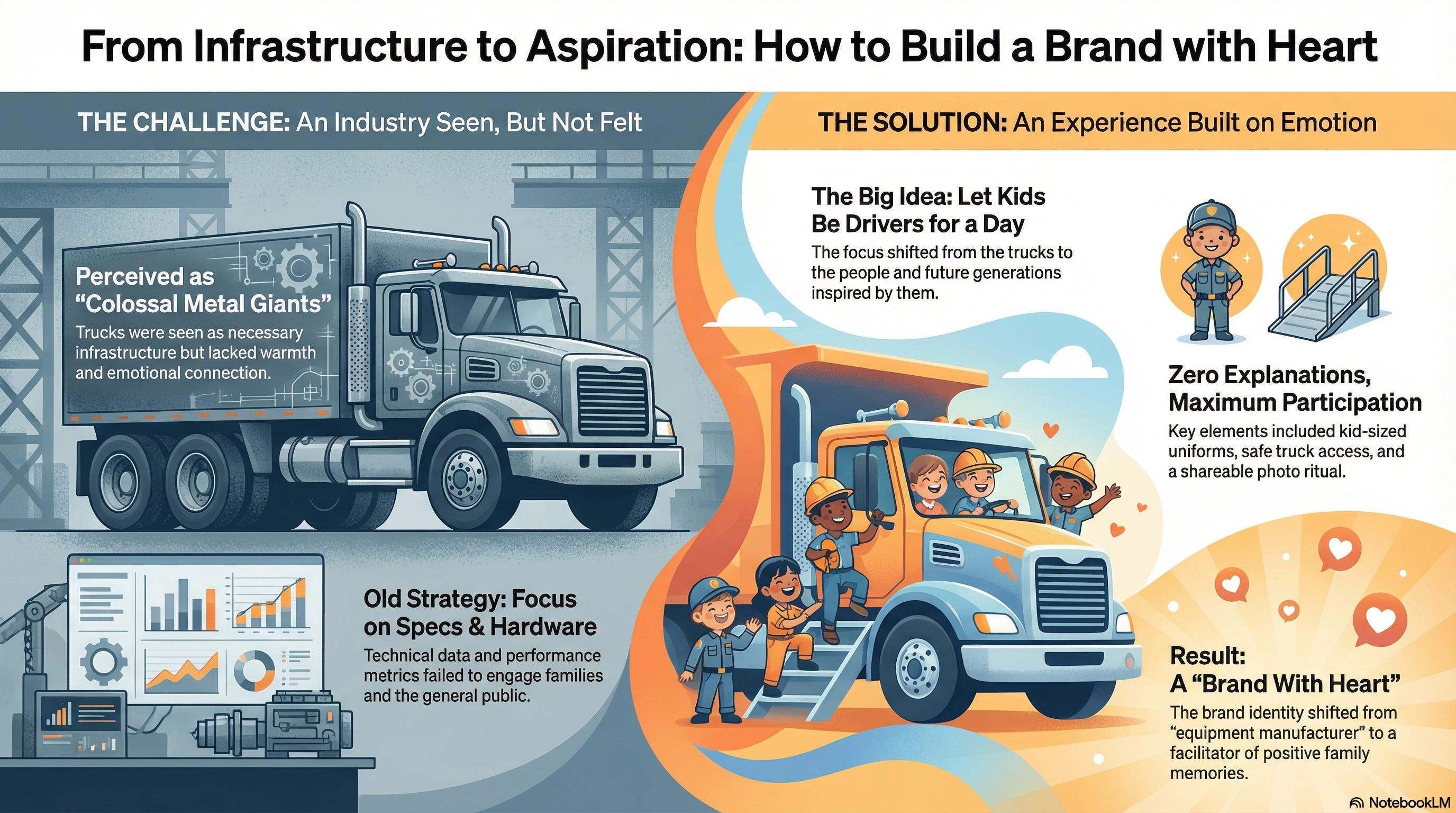
Heavy-duty trucks dominate the economic infrastructure, but emotionally, they sit at a distance. Adults treat them as necessary infrastructure; children see them as intimidating, colossal metal giants.
The brands recognized this gap immediately. The challenge was not brand awareness; it was cultivating warmth and accessibility. How do you make something this large feel human, relatable, and even inspirational?
The foundational shift in thinking was key: Instead of asking, “How do we showcase the trucks?” we asked, “What if the experience isn’t about trucks, but about the people who use them, and the future generation who might be inspired by them?”
The moment that unlocked the solution was simple: Kids love powerful machines, but trucks feel distant. Give them safe, curated access, and the emotional connection forms instantly.
The Insight That Changed the Event’s Architecture
Historically, the Isuzu and UD Trucks booth had been structurally technical: engineering specifications, component performance data, and detailed operational efficiency metrics. But families and the general public don’t engage with specs; they engage with play and aspiration.
We replaced the complex, technical format with a single, clear idea: Let the kids step into the role of the driver. Let them feel proud and important. Let their parents witness that moment of pure wonder.
That emotional triangle, kid seeing themselves as powerful, parent sharing a meaningful memory, and the brand facilitating it is the foundation of lasting perception. Brands often talk about purpose and serving the community. This activation showed purpose without needing to deploy a single marketing word.
Zero Explanations, Maximum Participation
The entire experience was designed around one principle: Zero explanations, maximum participation. There were no speeches, no product talk beyond quiet information screens, and no barriers to engagement. Just an open invitation to participate in a genuine, emotional ritual.
The key elements were simple, yet structurally effective:
Custom kid-size uniforms and hats, designed to mimic the professional gear.
Real, massive trucks staged as hero objects, accessible but safe.
A guided, professional moment for the children to climb up and stand in the driver’s seat, a gesture of respect for their curiosity.
A choreographed photo ritual that parents naturally wanted to share immediately on social platforms.
A safe, welcoming flow managed by staff specifically trained not in sales, but in family interaction and crowd management.
The moment the hall doors opened, the trucks were transformed, not as machines of commerce, but as something close to magic, instantly bridging the gap between infrastructure and aspiration.
Value Created: A Structural Shift in Perception
The activation created compound value across every audience segment, transforming brand presence from functional requirement into emotional capital.
For the Kids: A moment of genuine wonder and pure pride. Standing in front of machines ten times their size, they felt brave and important.
For the Parents: A meaningful family memory. A positive, human encounter with a brand that treated their children’s dreams with care and thoughtfulness.
For Truck Drivers and Industry Professionals: A rare, powerful moment of recognition. They saw their demanding, often thankless work honored by a future generation, instilling professional pride.
For Isuzu and UD Trucks: A deep, structural shift in brand identity, moving from “equipment manufacturers” to “brands with heart.” This perception was earned because families felt it directly, rather than being told it in an advertisement.
The result was simple and visible: The area stayed full from opening to closing bell. Uniforms ran out. Thousands of photos landed online organically. The booth became the emotional, “family stop” at the Mobility Show, proving that it is not the technology that changes brand perception, it is the human moment engineered around it.
The Takeaway: Identity Over Hardware
This activation was not fundamentally about selling trucks; it was about identity and building long-term trust.
In Japan, trust does not come from high-volume advertising campaigns. It comes from quietly and consistently doing something meaningful, something that feels safe, warm, considered, and genuinely human.
The same principle applies across all industries and categories:
Show the experience, don’t merely explain the spec sheet.
Build rituals people feel compelled to share organically.
Treat your physical presence as a relationship space, not a showcase display.
Lead with humanity, not hardware, because parents are powerful brand multipliers.
A truck didn’t change its design. A booth didn’t change its location. But the frame changed instantly from machine to shared, positive memory. And that profound shift in frame is what the audience will remember long after the event ends.
The Bottom Line
Isuzu and UD Trucks successfully disrupted the invisibility of the logistics industry by replacing technical communication with human connection. By designing an experience that honored both the child’s sense of wonder and the parent’s desire for a meaningful memory, they created emotional capital that structurally altered their brand identity in the minds of the non-industry public.
Over to You
If your product or service is seen as “infrastructure” by the public, what is the single most powerful, non-technical human ritual you could design to transform its perception into an aspiration?


