


When we work inside Japan’s deeply technical market, we often observe the same frustrating pattern: a global brand with a fundamentally strong product, but an invisible value story. The technical superiority is proven, yet the emotional or aesthetic impact remains abstract.
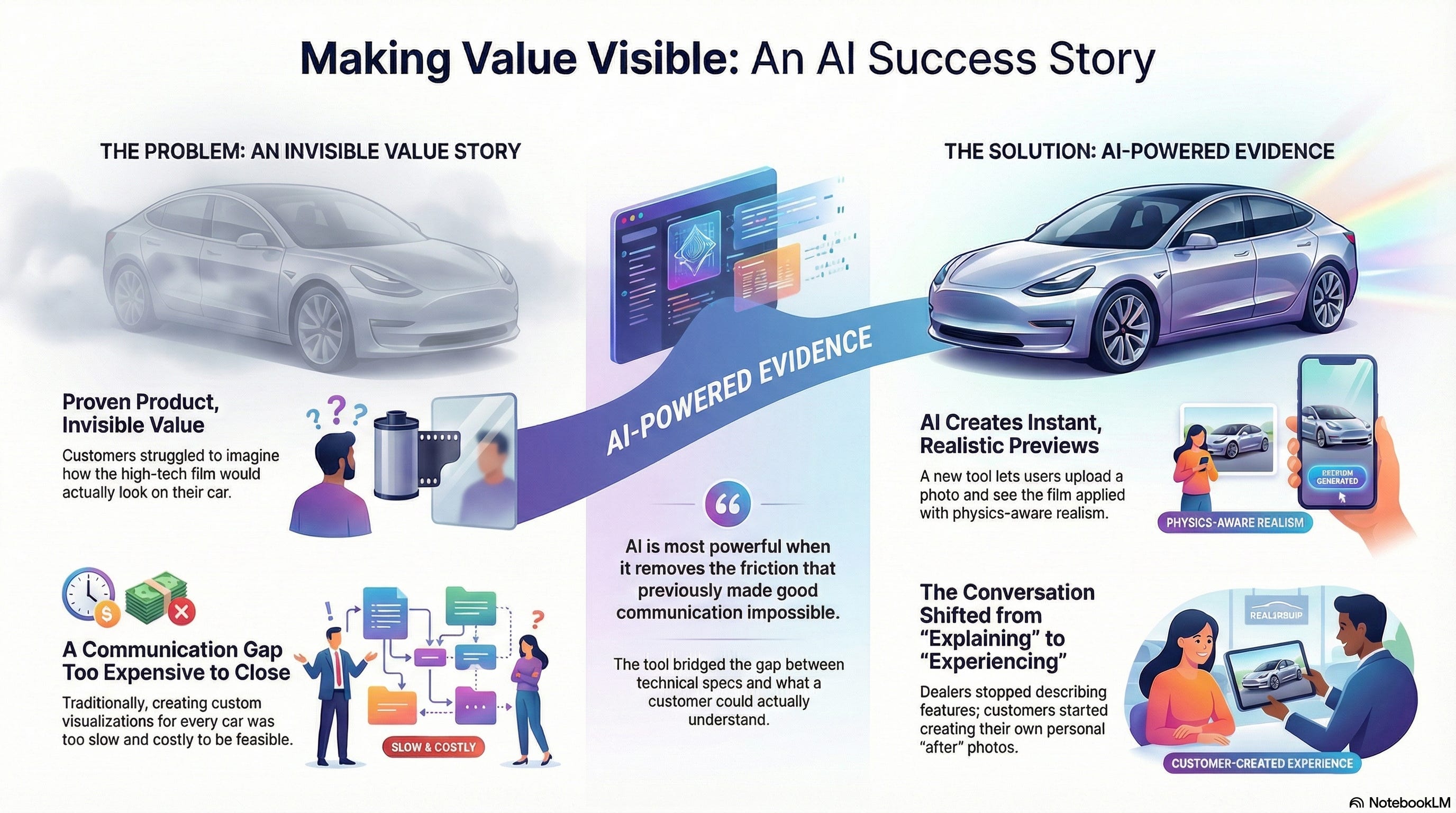
XPEL’s protective films, for instance, have a fierce, loyal following. The product’s excellence is proven. Yet, at dealer and customer events, a consistent and critical issue kept surfacing: People, the final customers could not vividly picture how the film would look on their own car. Posters, slides, and printed samples failed to bridge this imaginative gap.
This wasn’t a technology problem with the film; it was a communication gap in translating its visual value. That gap was the strategic opportunity.
The Problem: Great Product, Abstract Value
Installers know the material science. Customers understand the benefit of protection. But the final “look”—the gloss, the clarity, the texture—remained intangible. You can explain gloss levels and hydrophobic properties all day, but what consumers buy is evidence.
Before the advent of generative AI, solving this problem for hundreds of unique vehicles would have required a heavy, non-scalable infrastructure: manual 3D modeling for each car type, texture artists, specialized rendering software, and significant budget and time for iterative revisions. It was a communication gap that was historically too expensive to close.
The strategic question became: How do we eliminate this abstract friction at scale?
The Solution: An AI-Powered Visualizer Built for Instant Proof
We designed an experience tool powered by AI, built not for show, but for communication clarity. The tool accepts an uploaded photograph of the user’s vehicle and applies XPEL’s film with remarkable, physics-aware precision.
This was not a simple filter or a generic mockup. The engine rendered the application with: real reflections that interact correctly with the film, accurate light behavior that respects the photo’s original source, and surface-level detail that captures correct texture and depth.
The critical advantage provided by AI was feasibility. Where traditional methods demanded weeks of modeling and rendering time, the AI provided an instant, physics-aware render. It replaced the resource burden of a specialized production pipeline with a single, scalable solution.
We then pushed the concept further by allowing users to place their newly protected car into striking, context-rich environments—a clean studio, Shibuya Crossing, or Times Square. Why? Because context sells what description cannot. By placing their transformed vehicle into aspirational or high-visibility settings, the product ceased to be abstract. It became immediate, personal, and profoundly real.
The Impact: Imagination Shifts to Evidence
The introduction of the visualizer caused a quiet, immediate shift in the entire event dynamic:
Dealers stopped struggling to explain gloss and clarity. Guests stopped guessing about the final finish. Crucially, phones immediately came out, taking pictures of their own car—not the brand’s stock assets.
The experience reframed the entire customer journey. It moved from Product explanation to Emotional engagement to Actionable evidence. For XPEL, AI was not a gimmick or a futuristic feature; it became a structural communication tool, a perfect bridge between technical value and human understanding. This case serves as a vital scenario for global leaders: AI is most powerful when it removes the organizational friction that previously made good communication impossible.
What This Case Teaches Global Leaders
The lesson here transcends automotive film; it applies to any global brand struggling to convert technical excellence into market momentum.
The key insight is simple: If people can’t vividly visualize your value, they cannot buy it. AI is most powerful not when it adds complex features, but when it systematically removes the frictional gap between product capability and customer comprehension. Context shifts perception far more effectively than copy ever could.
This is how modern brand experience should be designed, especially in a detail-oriented market like Japan: simple tools, undeniable evidence, and immediate clarity. The goal is to transform events from mere product displays into powerful, personal experiences by eliminating abstraction.
The Bottom Line
XPEL successfully mobilized AI to solve a fundamental communication problem, proving that the technology’s highest value is its ability to convert technical specifications into instant, personal, and actionable visual evidence. The brand’s value story, once abstract, became undeniably visible through the power of context and precision, a feat that would have been structurally unfeasible using traditional methods.
Over to You
What is the single most abstract, yet valuable, technical detail of your product that could be instantly visualized using AI to remove a point of friction in your current sales cycle?


