


The boardroom was tense. After two decades of relying on a local distribution partner, XPEL, a leader in paint protection film was taking the critical, high-stakes step of operating its Japan business directly. For headquarters, this move signaled control, ambition, and a commitment to future growth. But for the network of Japanese dealers, tuners, and applicators who were the lifeblood of the brand, the move signaled one thing: risk. Markets built on long-term personal relationships and reliability do not grant foreign companies the benefit of the doubt. In Japan, structural shifts, even those intended for improvement, are initially read as sources of uncertainty. The crucial task was not to announce the change, but to de-risk the change—to turn a moment of potential withdrawal into an indelible proof of presence.
The Anxiety of Abandonment
When a foreign entity assumes control from a long-standing local distributor, the market is not primarily concerned with the new logos or the organizational chart. The core, unspoken anxiety is one of abandonment and accountability.
Dealers and practitioners, the professionals whose livelihoods depend on supply consistency, technical support, and long-term brand stability immediately ask:
Who is responsible now?
Will the supply chain become unstable?
Will the technical support understand our unique market needs?
This deep, structural anxiety is rooted in Japan’s business history. Unlike some Western markets that embrace disruptive “startup culture,” Japan rewards predictability. The long-term relationship, the belief that the partner will be there next month, next year, and a decade from now is the foundation of trust.
This dynamic is not exclusive to foreign brands. Consider the internal anxieties that emerge during major structural reforms at companies like Nissan or Toshiba. Even when such firms restructure to survive, the immediate concern among employees and partners is the integrity of the commitment. Is the new structure designed for stability, or is it a prelude to a chaotic retreat? For XPEL, a foreign brand, this concern was magnified tenfold. Reassurance could not come from a press release; it had to come from a visible, verifiable, and consistent system of behavior that proved the new structure was built to last. For executives, the realization must be immediate: In Japan, confidence is an observable product of conduct, not a result of clever messaging.
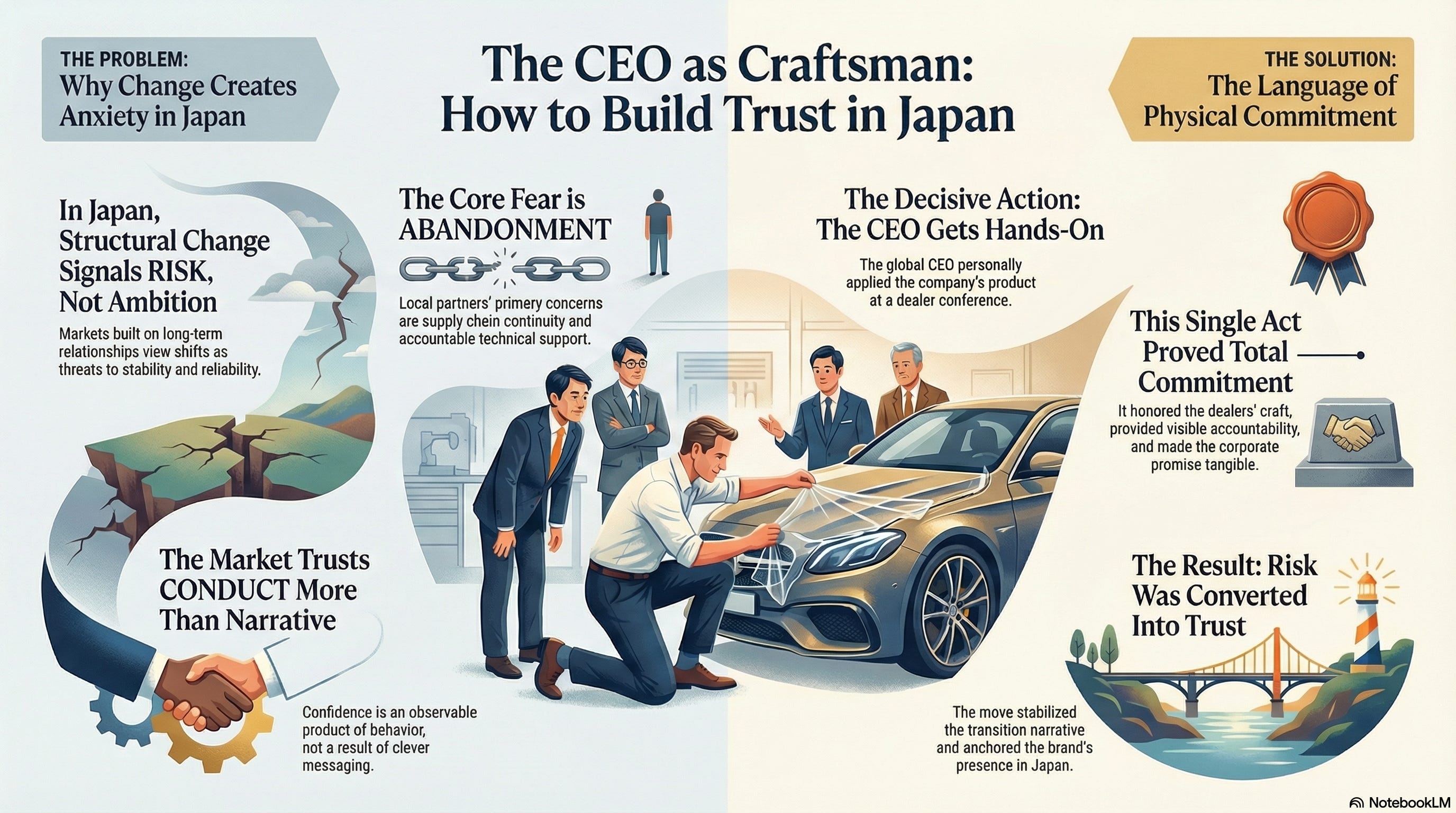
The Language of Physical Commitment
XPEL’s target audience: garage owners, detailers, and applicators are craftsmen. They evaluate a product and a partner the same way: by the quality of the material and the precision of the technique. Their confidence is built through hands-on experience, not through abstract claims. The solution, therefore, had to speak their language: the language of physical commitment.
The annual dealer conference, a typical venue for announcing organizational changes, was strategically redesigned. The goal was simple: make the market experience the brand’s intent directly. Every element was calibrated to project stability, clarity, and seriousness. But the moment that translated abstract commitment into concrete trust occurred during the keynote presentation.
The global CEO, who had flown to Tokyo for the transition, stepped onto the stage. Instead of merely delivering a speech on strategy or projections, he personally picked up the tools and applied the paint protection film.
This gesture, simple as it may sound, is profound in the Japanese business context.
Honoring the Craft: It showed respect for the work of the audience. The highest executive was not removed; he understood the film, the squeegee, and the precision required. It signaled: “We are technical partners, not merely financial managers.”
Visible Accountability: It grounded the corporate promise in a physical act. The CEO was standing behind the product, literally. It collapsed the distance between the global headquarters (HQ) and the local applicator, instantly countering the market’s fear of abandonment.
Embodied Clarity: The change was no longer a theoretical power shift on an organizational chart. It became tangible proof that the highest authority was present, serious, and engaged with the core material.
This single, choreographed act was the fulcrum that tipped the market from concern to clarity. It translated the risk of transition into the reliability that the audience could feel and trust.
Localize Behavior, Not Just Language
The result was telling: more than 150 dealers attended, and the narrative around the transition was immediately and decisively stabilized. The change ceased to be an external, worrisome event and began to feel like an anchored commitment. The brand started to belong.
This case provides a critical, universal principle for executives struggling in the Japanese market: Change creates vulnerability; behavior converts it into trust.
Global brands routinely make the fatal mistake of localizing their language and their advertising while neglecting to localize their behavioral structure. They assume that if they communicate clearly, the market will accept the risk. Japan operates differently: the market trusts conduct more than narrative. It trusts stability more than ambition. And perhaps most importantly, it trusts leadership signals that demonstrate technical respect and long-term commitment.
For any executive planning a structural change. A shift in ownership, a new partner, or a major strategic pivot in this market, the lesson is clear: You must embody the change before you declare it. You must demonstrate reliability before you seek momentum.
The Bottom Line
XPEL successfully navigated a high-risk transition by replacing abstract corporate promises with a single, powerful act of technical commitment, proving that the foundation of the new structure was not paper, but the visible, immediate responsibility of its highest leadership.
Over to You
What is the single most important non-verbal action your CEO or leadership team could take today to visibly reinforce your long-term commitment to your Japanese partners?


