


The Luxembourg Pavilion at the Osaka Expo faced a diagnostic crisis that global CMOs encounter daily. Their strategic narrative which is innovation, openness, and forward-looking progress was analytically flawless. It had performed with high efficiency across Europe. Yet, in Japan, visitors were politely disengaging.
Nothing was technically “wrong,” but the data was flat. Visitors were skimming. Dwell times were low. The engagement wasn’t failing; it was simply failing to arrive. HQ’s typical response in this scenario is to “increase the volume”, more media spend, bolder headlines, or simplified copy. However, in Japan, high-volume storytelling often triggers the opposite of engagement: it triggers suspicion.
The problem was not the content of the message, but the Communication Cadence. Luxembourg was attempting to run Western high-frequency logic on a Japanese low-frequency operating system. In this market, if the rhythm of the delivery feels foreign, the intelligence of the message is never even processed.
The Mechanism: Communicative Rhythm Dissonance
This is not a culture issue. This is a Communicative Rhythm Dissonance.
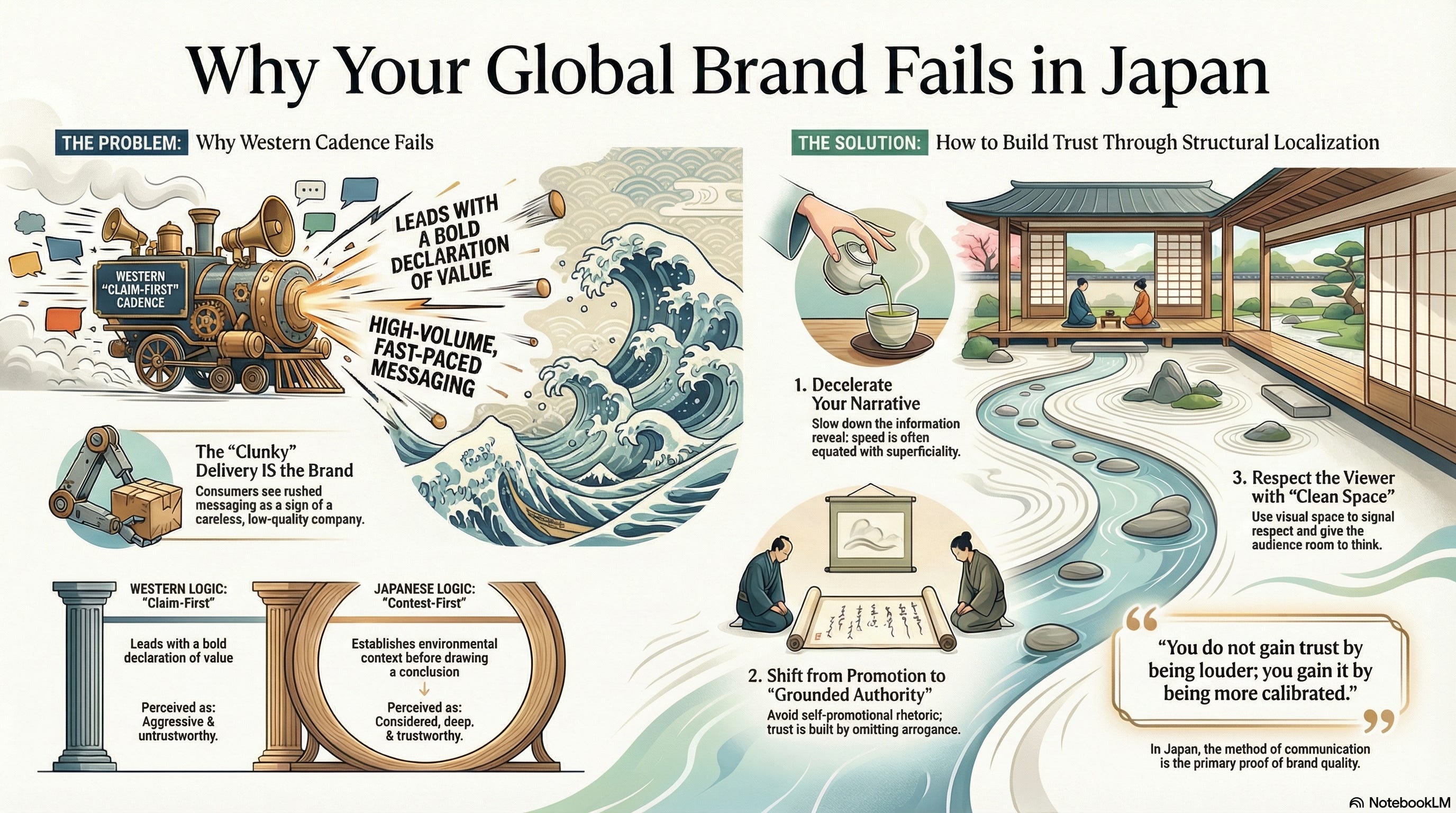
Global brand logic typically follows a “Claim-First” architecture: the brand makes a bold declaration of value, followed by supporting evidence. In Japan, authority is built through “Context-First” architecture. If you lead with the conclusion before establishing the environmental context, you are seen as aggressive, untrustworthy, and culturally illiterate.
The Physics of Trust in Japanese Messaging
To fix the Luxembourg Pavilion’s engagement, the strategy had to move beyond translation into Structural Localization. The intervention was not an aesthetic polish; it was a re-engineering of the narrative’s social temperature.
Contextual Deceleration: The narrative flow was restructured. Instead of rapid-fire “Innovation Facts,” the information was revealed slowly. In Japan, speed is often equated with superficiality. A slower reveal signals depth and consideration.
The “Wa” (Harmony) Adjustment: Tone was shifted from “Self-Promotional Rhetoric” to “Grounded Authority.” In Western markets, brands are expected to be their own biggest cheerleaders. In Japan, a brand that shouts about its own excellence creates social friction. Trust is generated through the omission of arrogance.
Aesthetic Governance: Visuals were re-indexed for Japanese spacing logic. “Clean space” in Japan is not just a design choice; it is a communicative signal that the viewer is respected enough to be given room to think.
The results were immediate and observable. Dwell times increased. Organic sharing began without prompting. This was not “virality”, a Western concept of sudden, chaotic growth. This was Systemic Alignment. The Pavilion hadn’t changed what it was; it had changed how it existed in the space.
The Strategic Shift: From Transference to Transduction
The irreversible insight for global leaders is that Meaning is not transferred; it is transduced. Like an electrical signal moving between incompatible grids, your brand’s logic must be converted into a different frequency to function in Japan.
The Single Irreversible Insight
In Japan, the method of communication is the primary evidence of the brand’s quality.
If your messaging feels rushed, loud, or “translated,” the Japanese consumer does not just ignore the ad; they conclude that your internal operations, your supply chain, your customer service, your product engineering are equally careless. The “Silent Failure” of global messaging is the assumption that the audience will “look past” a clunky delivery to find the “good idea” underneath. They won’t. In Japan, the clunky delivery is the brand.
Explicit Reframing: Not Expression, but Governance
It is not “Marketing Content” → It is Social Infrastructure. Your messaging is a test of your brand’s ability to behave correctly within the Japanese social system.
It is not “Localization” → It is Operational Calibrations. Adjusting the rhythm of your campaign is not a creative choice; it is a requirement for the system to accept your presence as a “Fixed Point” of reliability.
When HQ insists on “Global Consistency” (which usually means Western cadence), they are essentially demanding that the Japanese office burn credibility for the sake of an internal KPI. This creates a friction point where local teams stop trying to make the message work and start trying to make the message pass internal approvals.
The Bottom Line
Your brand is currently invisible in Japan not because your story is weak, but because your rhythm is disruptive. Until you decouple your “Global Strategy” from your “Western Cadence,” your messaging will continue to function as noise rather than authority. In this market, you do not gain trust by being louder; you gain it by being more calibrated.
Over to You
Which part of your current global campaign is HQ insisting on keeping “Consistent,” even though your local Japanese team has subtly signaled that it feels “aggressive” or “premature”?


