


The quarterly business review in Tokyo typically follows a predictable script. The regional head presents a slide titled “Key Initiatives for Q3.” Underneath, there are fifteen bullet points, each marked with a red “High Priority” tag. The deck is beautiful, the data is granular, and the sentiment in the room is one of industrious commitment. Everyone is working twelve-hour days. Every department—from logistics to creative—is fully booked.
Yet, the needle hasn’t moved. The product launch is delayed by three weeks because the local team was busy “refining” the font on a secondary POS display. The CRM integration is stalled because the marketing lead spent four days attending “alignment” meetings for a minor sponsorship deal that yields zero ROI.
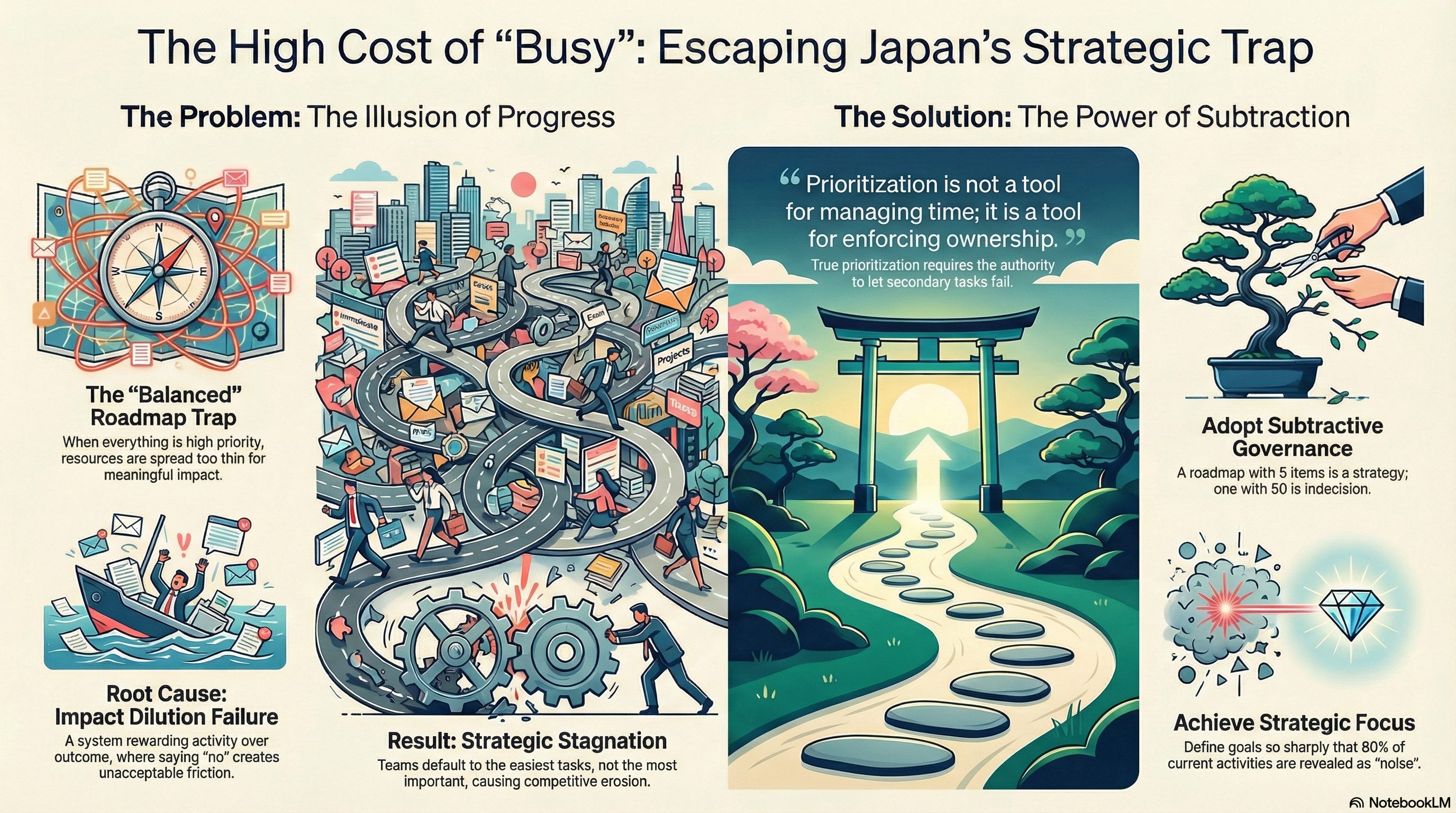
When HQ asks which of the fifteen items is the true driver of growth, the answer is usually a variation of: “They are all interconnected and essential for the Japanese market.” This is the sound of a strategy dying. In this environment, “prioritization” is often used as a synonym for “listing everything we want to do.” The result is a team that is perpetually busy but strategically stagnant. The cost is not just fatigue; it is the erosion of your competitive advantage in a market that does not wait for you to sort through your cluttered inbox.
The Mechanism: Impact Dilution Failure
This is not a culture issue. This is an Impact Dilution Failure.
Global executives often mistake the Japanese commitment to “Ganbaru” (doing one’s best) for strategic alignment. They assume that because the team is working hard, they must be working on the right things. However, in many Japanese corporate structures, the system is designed to reward activity over outcome. When authority is diffused across multiple stakeholders, the safest path for a local manager is to say “yes” to every request. To prioritize one task over another is to inherently de-value the request of a colleague or a superior, which creates friction.
To avoid this friction, the team adopts a “balanced” approach. Resources are spread thin across all possible fronts to ensure no single stakeholder feels ignored. In practice, this results in a total loss of strategic velocity.
Consider the historical decline of Japan’s consumer electronics giants in the 2000s. Companies like Sony and Panasonic didn’t fail because they lacked talent or technology; they failed because they refused to kill underperforming product lines. They attempted to maintain “balance” across dozens of business units, while leaner competitors focused entirely on the mobile shift. They chose the comfort of internal harmony over the brutality of market-driven prioritization.
In your organization, this failure manifests as “Priority Creep.” Because no one has the authority—or the courage—to say “this does not matter right now,” everything becomes urgent. When everything is urgent, the system defaults to “Convenience Sequencing”—doing what is easiest or what has the loudest proponent, rather than what moves the outcome most.
The Strategic Shift: Subtractive Governance
The irreversible insight is this: Prioritization is not a tool for managing time; it is a tool for enforcing ownership.
To fix an Impact Dilution Failure, the leadership must shift from additive management (adding more tasks to the list) to subtractive governance. You must realize that a roadmap with five items is a strategy, while a roadmap with fifty items is a confession of indecision.
Not Time Management > Operating Authority Design
True prioritization requires the authority to let certain things fail. If your local team in Japan does not have the explicit permission to ignore secondary requests in favor of “Deep Work” on primary objectives, they will always default to activity-based work. They will choose the safety of being busy over the risk of being impactful.
You must reframe the “Sequence with intent” principle from the YF framework not as a productivity hack, but as a governance mandate. “Sequence with intent” means that the order of operations is dictated by the desired outcome, not by the internal political pressure of the local office.
Not Activation > Strategic Focus
Most global brands in Japan fail because they attempt to “activate” across every channel simultaneously—Line, Instagram, PR, Pop-ups, and Retail—without the resource density to win in any of them. This is the “Everything, Everywhere” trap.
The shift requires moving toward a “Strategic Focus” model. This means defining the goal so sharply that 80% of current activities are revealed as “noise.” When you define the goal—for instance, “Capturing 5% market share in the luxury skincare segment within 12 months”—it becomes operationally impossible to justify spending time on a general brand awareness campaign for a mass-market sub-brand.
Prioritization, in this context, is the act of protecting your most expensive resources (talent and time) from being consumed by the “inertia of the existing.” It is the operating system that ensures energy goes where it counts, rather than where it is most “polite” to send it.


The Bottom Line
A team that tries to do everything will eventually do nothing of consequence. In Japan, “busy-ness” is the primary camouflage for a lack of strategic direction. If you do not force a hierarchy of impact, the market will eventually force one on you through stagnating growth and rising overhead.
Over to You
Which “High Priority” item on your current Japan roadmap is only there to satisfy an internal stakeholder rather than to drive a measurable business outcome?
Would you like me to draft a diagnostic framework for identifying “Impact Dilution” within your regional team’s current project list?


