


The email from the regional director in Tokyo arrived with a succinct, almost cryptic finality: “The decision will be deferred until the second week of April. Thank you for your patience.”
For the Vice President of a Silicon Valley tech firm, this was the third such delay in a month. It was March 15th. He had been chasing a signature on a partnership agreement since January. The product was ready, the budget was allocated, and the technical teams were aligned. Every logic of global commerce dictated that the deal should have closed weeks ago to maximize the first quarter’s momentum. Instead, he found himself staring at a sudden, impenetrable wall of administrative silence. His Japanese counterparts, usually meticulous and responsive, had seemingly vanished into a flurry of internal meetings and farewell dinners.
This is the “March Paralysis,” a phenomenon that costs uninitiated global firms months of momentum every year. To the outsider, it looks like a collapse of productivity. To the Japanese organization, it is a necessary period of hibernation before a total structural rebirth.
The Architecture of the Great Shuffle
The Japanese business cycle is governed by the April 1st start of the fiscal year, a date that carries a weight far beyond mere accounting. While the rest of the world views the changing of the calendar year in January as a time for personal resolutions, the Japanese corporate world views April as the true moment of creation. This is the period of Jinji Ido, the massive, centralized personnel reshuffle that defines the life of every salaryman.
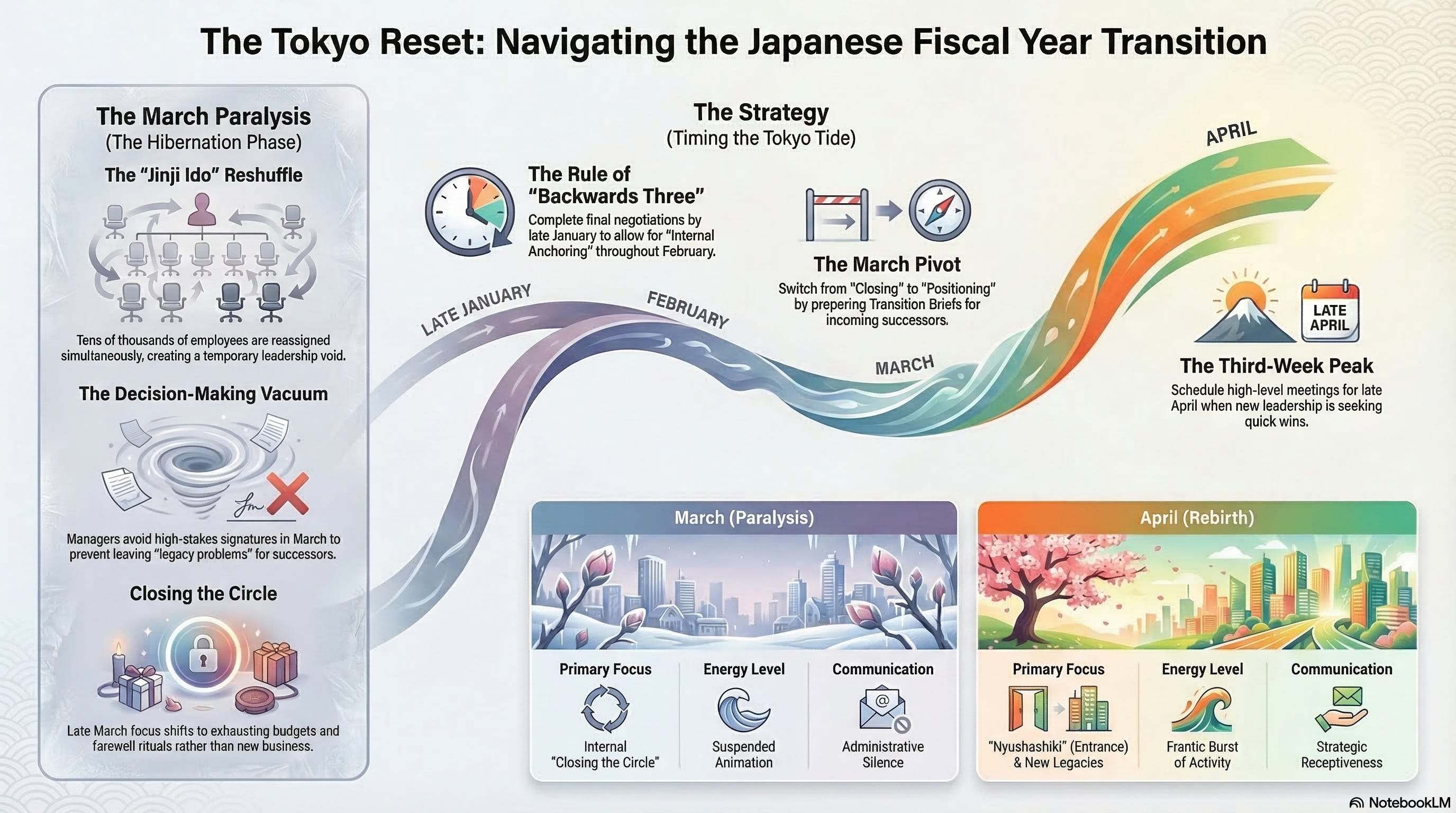
In a traditional corporation like Hitachi or Mitsubishi, the scale of this reshuffle is staggering. Tens of thousands of employees, from junior associates to senior directors, are reassigned to different departments, cities, or international branches simultaneously. A logistics manager in Tokyo might find themselves leading a procurement team in Fukuoka with only two weeks’ notice. This system is designed to create generalists who understand every facet of the company, but it creates a massive “decision-making vacuum” in the month of March.
During this period, the “Air of Transition” dominates the office. The manager you have been negotiating with for six months is currently packing their desk. They are mentally transitioning to their next role. Signing a high-stakes contract on March 20th is a significant risk for them; if the project encounters issues in May, they will not be there to manage the fallout. Their successor, however, hasn’t arrived yet. Consequently, the organization enters a state of suspended animation. Decisions are pushed “across the line” into the new year, where the new team can assume collective responsibility.
The Ritual of the Clean Slate
The logic behind this paralysis is rooted in the Japanese obsession with Keimei clarity and the proper naming of things. The final weeks of March are dedicated to “closing the circle.” Budgets must be exhausted to the last yen to ensure next year’s allocation remains intact. Farewell parties (Sounenkai) consume the evenings, as teams pay respects to the departing leadership. This is a period of mourning for the old structure and preparation for the new.
A historical look at the “Big Bang” financial reforms in the late 1990s illustrates this rhythm perfectly. Even when the government introduced radical changes to the banking sector, the actual implementation was synchronized with the April 1st start. The Japanese system prefers a synchronized, massive change over incremental, rolling adjustments. This creates a predictable, albeit slow, heartbeat for the nation’s economy.
When April 1st finally arrives, the atmosphere shifts instantly. The “Freshman” suits, thousands of new graduates in identical navy outfits fill the streets. Nyushashiki (entrance ceremonies) take place in every major headquarters. The new bosses are at their desks, eager to establish their own legacy. The energy that was suppressed in March is suddenly unleashed in a frantic burst of activity. If you are not prepared to ride this wave the moment it breaks, you will find yourself at the back of a very long queue
.
The Strategy: Timing the Tokyo Tide
Success in Japan requires you to stop fighting the calendar and start using it as a tactical map. If you are approaching a Japanese partner with a major proposal, your timeline should be “The Rule of the Backwards Three.”
To ensure a deal is finalized before the March freeze, your final negotiations must be completed by late January. February is the month of “Internal Anchoring,” where your supporters inside the Japanese firm build the consensus necessary to get the stamp before the Jinji Ido announcements are made in early March. If you miss the February window, you must pivot your strategy from “Closing” to “Positioning.”
Instead of pushing for a signature in March, use the month to gather “soft intelligence.” Ask your counterparts who their likely successors will be. Prepare “Transition Briefs”, one-page summaries of the project’s history and value, specifically designed to be handed over to the new team on April 1st. By making the transition easy for the incoming manager, you position yourself as a “solution” rather than a “legacy problem” they inherited from their predecessor.
Furthermore, recognize that the first two weeks of April are dedicated to internal alignment. Do not expect meaningful progress during this “orientation” phase. Instead, schedule your high-level meetings for the third week of April. This is when the new leadership has found its footing and is looking for quick wins to prove their competence in their new roles. By timing your “big ask” to coincide with this fresh energy, you bypass the bureaucracy that stalled you in the spring.
The Bottom Line
The March paralysis is a structural necessity of the Japanese corporate lifecycle, not a sign of disinterest. By respecting the rhythm of the personnel shuffle and preparing your “handover” strategy in advance, you transform a period of frustration into a competitive advantage. The goal is to be the first project on the new manager’s desk when the cherry blossoms fall.
Over to You
Have you ever had a project “disappear” during the March transition, only to have it resurface with a completely different team in April? Would you like me to help you draft a “Handover Brief” designed to introduce your project to a brand-new Japanese leadership team?


