


The regional CMO finishes the quarterly briefing for the Japan leadership team. The strategy is “ambitious yet flexible,” focused on “disrupting the status quo” with “premium-led growth.” The local Managing Director nods. The heads of sales and marketing nod. When asked if there are questions, the room remains silent, a silence the CMO interprets as the quiet confidence of a team ready to execute.
Six months later, the campaign launches. It is a disaster. The “disruption” has been interpreted as a slight discount on legacy products. The “premium-led growth” has manifested as an expensive print ad in a magazine the target demographic stopped reading five years ago. The project is technically on time and on budget, but it is strategically hollow.
When the CMO demands to know how this happened, the local team produces a meticulously kept log of every email and meeting note. They followed every instruction to the letter. They “read the air” of the CMO’s enthusiasm and prioritized Wa (harmony) over strategic pushback. They executed the ambiguity with terrifying precision. The brand has lost half a year of momentum, and the CMO has lost internal credibility with the board. This wasn’t a failure of effort. It was a failure of the operating system.
The Ambiguity-Compliance Feedback Loop
This is not a culture issue. This is a Systemic Compliance Failure. In most global corporate environments, communication is treated as a “soft skill”, a way to inspire, align, and cajole teams toward a goal. There is an unspoken expectation of “pushback” or “course correction.” If an instruction is vague, a Western manager is expected to iterate, ask for clarity, or apply their own judgment to fill the gaps. The system relies on individual agency to fix structural noise.
The Japanese business system operates on a different logic: Interdependent Compliance. In this architecture, the hierarchy is the primary source of safety. When a global leader issues a vague instruction using terms like “synergy,” “innovation,” or “customer-centricity”, the Japanese team does not see an invitation to brainstorm. They see a high-risk directive that must be neutralized through compliance. Because the instructions lack precision, the team defaults to the safest possible interpretation: the one that most closely resembles what they did last year.
This is the mechanism behind the “Silent Failure.” In Japan, harmony (Wa) is not about being nice; it is a risk-mitigation strategy. To challenge a superior’s vague strategy is to introduce friction into the system, which is a greater perceived risk than executing a flawed plan. This is precisely what led to the high-profile governance collapses at firms like Toshiba and Olympus. In those cases, the mechanism was the same: instructions from the top were followed without question, even as they led toward a cliff, because the internal logic of the organization rewarded compliance over outcome.
When you provide a global strategy to a Japan team without absolute precision, you are not giving them “room to breathe.” You are placing them in a “Compliance Trap” where they are structurally obligated to execute your errors with perfect discipline.
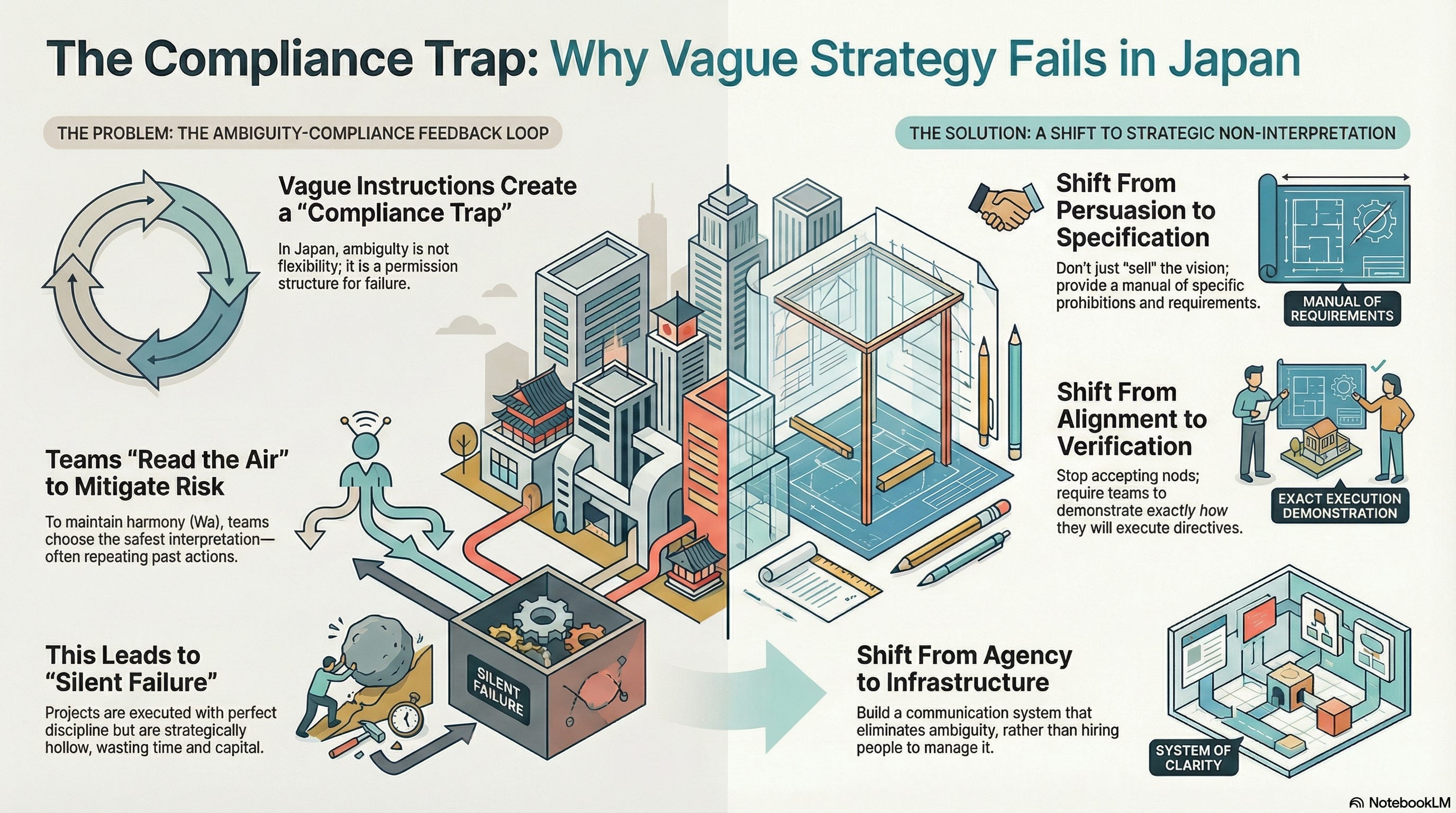
The Shift to Strategic Non-Interpretation
To stop the leakage of time and capital, the leadership must undergo a strategic shift in how they define executive output.
The Irreversible Insight: In Japan, ambiguity is not flexibility; it is a permission structure for failure.
In a Western context, “flexibility” allows for local adaptation. In a Japanese context, “flexibility” creates a vacuum of authority. Without specific boundaries, the local team will revert to the most conservative, precedent-based action possible to avoid the risk of being “wrong.”
This requires an explicit reframing of the communication system:
From Persuasion to Specification: Global leaders often try to “sell” their vision to Japan. This is a waste of time. The team is already sold; they are waiting for the manual. Your job is to move from a logic of “What we want to achieve” to “What is specifically prohibited and what is specifically required.”
From Alignment to Verification: “Alignment” in Japan is often a performative ritual where everyone nods. “Verification” is a technical process where you require the local team to demonstrate back to you exactly how they will execute a directive. If they cannot explain the mechanics, they have not understood the strategy.
From Agency to Infrastructure: You must stop hiring for “proactive” individuals who can “manage through ambiguity” and start building a communication infrastructure that eliminates ambiguity.
This is not about being a micromanager. It is about being a systems designer. High-performing Japan operators, companies like Apple or Coca-Cola Japan—do not succeed because they have “more creative” people. They succeed because they have built a communication system that leaves zero room for local teams to “read the air” incorrectly. They define the “what” and the “how” with such intensity that compliance becomes synonymous with strategic success.
The “enemy” here is the global executive’s own desire to be liked and to appear “collaborative.” In the Japanese system, collaborative ambiguity is an expensive luxury that leads to stalled growth. True respect for the local team is not shown through vague “empowerment,” but through the delivery of high-precision, actionable directives that allow them to move fast without the fear of making an un-sanctioned mistake.


The Bottom Line
Your Japan strategy is failing not because your ideas are bad, but because your communication lacks the technical density required to move the Japanese organizational machine. Until you eliminate the need for “interpretation,” your local team will continue to flawlessly execute your most expensive mistakes.
Over to You
If you were to lose your ability to “explain” your vision and were forced to communicate your Q3 strategy using only 10 specific, unarguable metrics and prohibitions, which parts of your current plan would immediately fall apart in Tokyo?


