

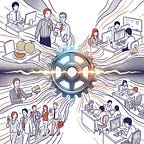
The morning sun filtered through the high windows of a mid-sized trading firm in Otemachi, illuminating a scene of perfect corporate synchronization. Every desk was occupied. Every employee wore the same muted palette of charcoal and navy. At 9:00 AM sharp, the department head stood for the Chorei, the morning stand-up meeting. He praised the team for hitting their monthly targets and announced that, as a small token of appreciation, a box of premium seasonal melons from Shizuoka would be distributed during the afternoon break.
The room hummed with a polite, collective gratitude. However, a keen observer would notice a subtle, physical shift in the room’s energy. At the cluster of desks near the printer, three women continued to type, their eyes fixed on their monitors. They did not participate in the applause. When the melons were sliced and served at 3:00 PM, the department head personally delivered a plate to every desk in the main rows. He walked past the cluster by the printer without a glance.
Those three women were Haken, dispatched workers from an external agency. To the casual visitor, they were indistinguishable from their colleagues. They shared the same air, used the same software, and labored under the same deadlines. Yet, in the eyes of the Japanese corporate structure, they occupied a different dimension of existence. The melons were for the “family”, the Seishain (regular employees). The Haken were guests who had stayed for years, yet remained perpetually uninvited to the table.
The Ghost in the Machine
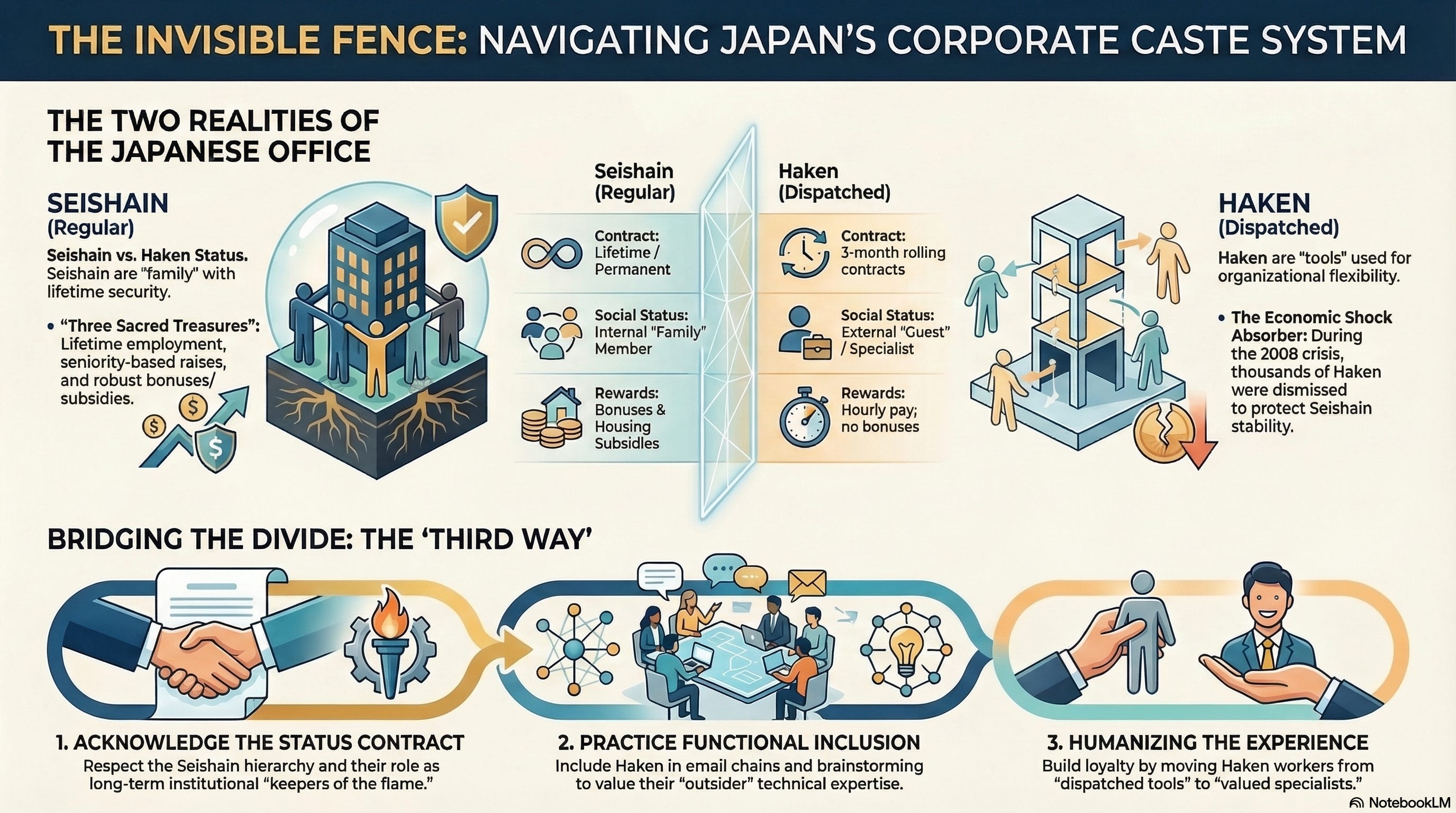
This dual-track employment system is the defining characteristic of the post-bubble Japanese labor market. To understand the friction it creates, one must understand the Seishain as more than just a “full-time worker.” A Seishain is a member of the corporate household. They are granted the “Three Sacred Treasures”: lifetime employment, seniority-based pay raises, and a robust safety net of bonuses and housing subsidies. In exchange, they offer the company total, unrestricted loyalty.
The Haken, by contrast, is a tool for flexibility. The system was significantly deregulated in the late 1990s as Japanese firms struggled to maintain their “lifetime” promises to regular staff while navigating a stagnant economy. The Haken worker became the “shock absorber.” They are hired for specific tasks, usually on three-month rolling contracts. They receive no bonuses, no retirement allowance, and, as seen in the Otemachi office, fewer social graces.
The most visceral illustration of this divide occurred during the 2008 global financial crisis. As the “Lehman Shock” hit Japan’s manufacturing heartland, companies like Sony, Toyota, and Panasonic faced a sudden, massive contraction in demand. Because the legal and social cost of firing a Seishain is prohibitively high, the brunt of the adjustment fell entirely on the contract staff. Within months, tens of thousands of Haken workers were dismissed.
The crisis culminated in the “Haken Mura” (Haken Village) in Hibiya Park, where hundreds of newly homeless workers set up a tent city in the shadow of Tokyo’s elite corporate headquarters. This was a moment of national trauma. It exposed the reality that the stability of the Japanese “Regular Employee” is physically subsidized by the precariousness of the “Dispatched Worker.” The two groups sit side-by-side, but they live in different economic realities.
The Psychology of the Buffer
The tension on the office floor is rarely vocal. It is a quiet, atmospheric pressure. Because the Haken worker is often excluded from the Nomikai (after-work drinks) and the internal Ringi (consensus-building) process, they possess a different type of institutional knowledge. They see the inefficiencies that the Seishain are too culturally entrenched to notice. Conversely, the Seishain often feel a quiet resentment toward the Haken, viewing them as “mercenaries” who leave exactly at 5:00 PM while the regular staff remains until 9:00 PM to prove their devotion to the firm.
This “Caste System” creates a significant hurdle for the global executive. In a Western firm, a manager sees “the team.” In a Japanese firm, the manager must see “the tiers.” If you attempt to bridge this gap too aggressively, you risk alienating your regular staff, who feel their hard-earned status is being devalued. If you ignore the gap, you leave a significant portion of your workforce feeling demotivated, invisible, and ready to walk out the door the moment a better agency contract appears.
The Japanese government attempted to address this with the “Equal Pay for Equal Work” legislation in 2020. The law mandates that companies eliminate “unreasonable” disparities in treatment between regular and non-regular staff. While this has led to some cosmetic changes, Haken workers now occasionally receive small commuting allowances, the fundamental psychological divide remains. Status in Japan is not just about the yen in the bank; it is about the “membership” in the organization
.
Leading Across the Divide
For a leader coming from a culture of meritocracy, the Haken-Seishain divide feels like an operational inefficiency. Your instinct is to treat everyone the same. However, a blunt “one-team” approach can trigger a defensive reaction from the Seishain gatekeepers. The strategy requires a more nuanced, two-pronged approach.
First, acknowledge the Status Contract. For your Seishain staff, emphasize their role as the “keepers of the flame.” Give them the long-term projects that require deep institutional memory. Respect the hierarchy that they have spent years climbing. When you provide benefits to the Haken staff, frame them as “operational enhancements” rather than a leveling of the social playing field. You are making the team more effective, not making everyone “equal” in a way that threatens the regular employees’ sense of security.
Second, practice Functional Inclusion for your Haken staff. While you may be legally or budgetarily restricted from giving them the same bonuses as regular employees, you have total control over the “Social Currency” of the office. Include Haken staff in the CC lines of relevant emails. Invite them to the internal brainstorming sessions where their “outsider” perspective can provide the most value.
The goal is to move the Haken worker from a “dispatched tool” to a “valued specialist.” By recognizing their technical expertise and giving them a voice in the how of the work, you build a secondary layer of loyalty that the traditional system ignores. You are creating a “Third Way”, a professional environment where the Haken worker stays because they are respected, and the Seishain stays because they are secure. This hybrid model is the hallmark of a truly modern, globally-minded office in Tokyo.
The Bottom Line
The divide between Haken and Seishain is a structural necessity for Japanese firms seeking flexibility, yet it remains a psychological minefield. Success as a global leader depends on your ability to respect the security of the regular staff while humanizing the experience of the contract workforce. Balance the two, and you turn a fractured floor into a high-performance machine.
Over to You
Do you know exactly which members of your team are “regular” employees and which are “contract” staff? Would you like me to help you design a “Recognition Framework” that honors the contributions of your contract workers without disrupting the established hierarchy of your permanent staff?


