


The fluorescent lights of the Shiodome office hum with a particular frequency this late in March. It is Thursday, March 19th. Across Tokyo, thousands of mid-level managers are currently being called into small, windowless meeting rooms for a conversation that lasts less than five minutes. There is no negotiation. There is no PowerPoint presentation. There is only a white envelope containing a single sheet of paper: the Naishi, or the unofficial announcement of a personnel transfer.
For a forty-two-year-old department head at a leading electronics firm, the paper might state that as of April 1st, exactly thirteen days from today, his place of work is no longer Tokyo. It is now a satellite branch in Akita, a snowy prefecture hundreds of miles to the north. His mortgage is in Tokyo. His children are halfway through middle school in Tokyo. His wife has a career in Tokyo. Yet, as he bows and accepts the envelope, he says only one thing: “I understand. Thank you for the opportunity.”
He will spend his weekend looking for a tiny, one-room apartment near the Akita station. He will pack a single suitcase. On April 1st, he will begin his life as a Tanshin Funin, a “solo-post worker” living in a different city from his family for the next three to five years. This is the reality of the Japanese corporate nomad, a figure whose total mobility is the ultimate currency of loyalty.
The Logic of the Corporate Nomad
The phenomenon of Tenkin (mandatory relocation) is a pillar of the traditional Japanese employment pact. In the post-war era, Japanese corporations offered the “Three Sacred Treasures” of employment: lifetime security, seniority-based pay, and enterprise unionism. In exchange for this absolute security, the employee granted the company absolute authority over their time and geography. The company provides a job for life; the employee provides a body that can be placed anywhere on the map at a moment’s notice.
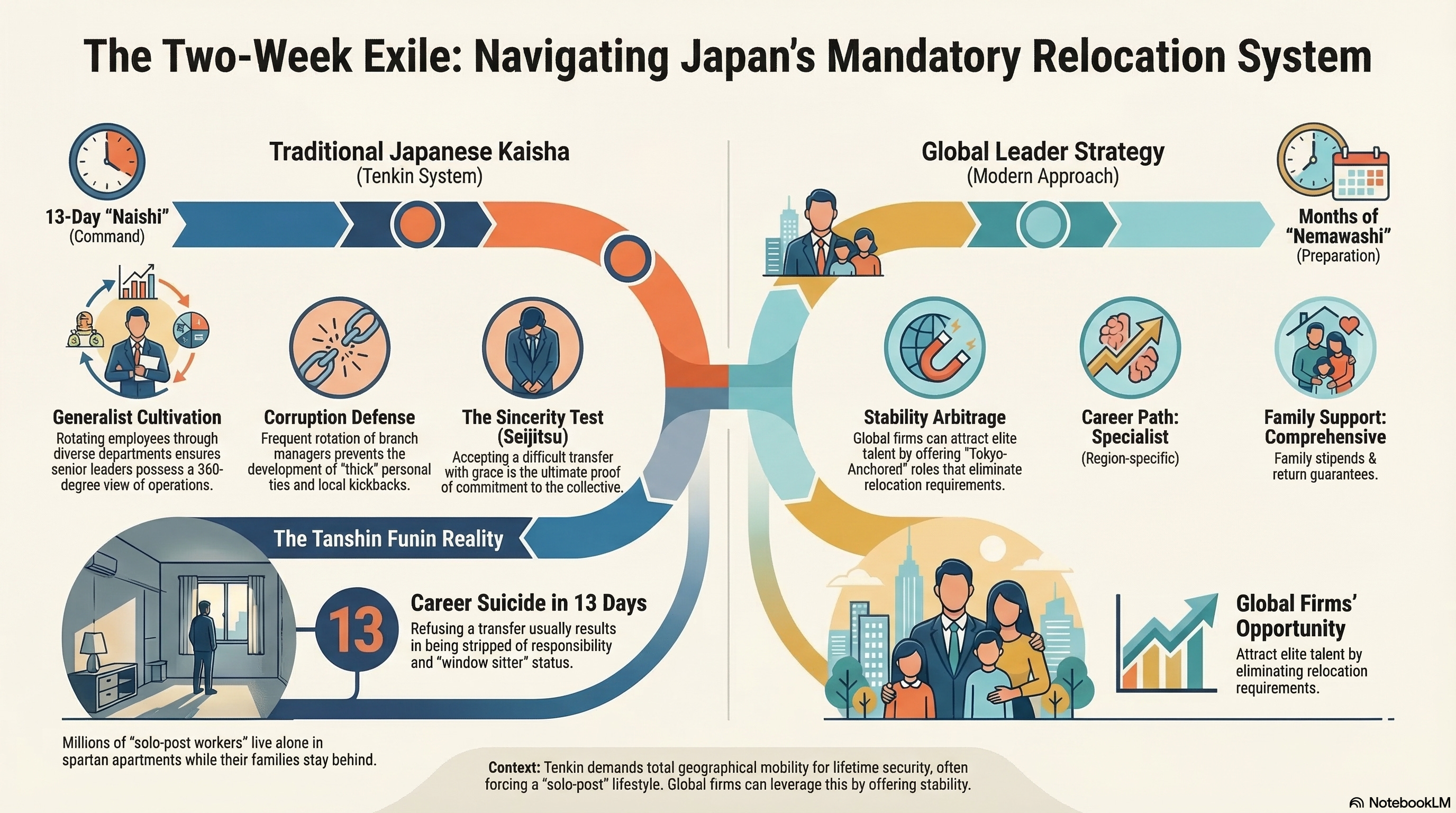
This system persists because it serves three strategic functions within the Japanese kaisha. First, it is a mechanism for “Generalist Cultivation.” By moving an employee from Sales in Osaka to Human Resources in Tokyo to Logistics in Sapporo, the firm ensures that its senior leaders have a 360-degree view of the entire operation. Specialized silos are seen as a weakness; the “Generalist” who understands the pulse of the whole company is the ideal executive.
Second, in industries like banking and government procurement, frequent relocation is a defense against corruption. The “Mega Banks” Mitsubishi UFJ, SMBC, and Mizuho frequently rotate branch managers every two years to prevent them from becoming too close to local clients. A manager who stays in one place for ten years might develop “thick” personal ties that could lead to preferential lending or kickbacks. The constant shuffle ensures that the individual remains an agent of the center, rather than a king of the periphery.
Finally, Tenkin is the ultimate loyalty test. Accepting a difficult transfer to a remote outpost with a smile is proof of Seijitsu (sincerity) and commitment to the collective. It is a ritual of sacrifice. The company observes how the employee handles the disruption. Those who endure the exile with grace are marked for the “Fast Track” back to headquarters. Those who hesitate or complain are quietly moved off the promotion ladder.
The High Cost of the “No”
To understand why refusal is perceived as career suicide, one must view the company as a family and the transfer as a call to duty. Declining a relocation request is a breach of the unspoken social contract. It signals that the individual’s personal life, their family, their hobbies, their comfort has taken precedence over the needs of the firm. In a culture that prizes Wa (harmony) and the collective, this is an act of profound selfishness.
When an employee refuses a transfer, they effectively opt out of the lifetime employment system. While the company may not legally be able to fire them immediately due to Japan’s strict labor laws, the professional consequences are absolute. The employee is often moved to a “dead-end” role, stripped of significant responsibilities, and bypassed for all future promotions. They become a “window sitter,” a ghost in the machine who is tolerated but no longer trusted.
This pressure creates the Tanshin Funin lifestyle. Millions of Japanese men live in spartan “leopace” apartments, eating convenience store meals alone, while their families remain in the suburbs of Tokyo or Osaka to maintain stability for the children’s education. The psychological toll is immense, yet it is borne in silence because the alternative, the loss of the “Salaryman” status is considered even more devastating to the family’s long-term security
.
The Strategy: The Stability Arbitrage
For the global executive leading a team in Japan, the Tenkin system presents a unique opportunity for “Stability Arbitrage.” As the younger generation of Japanese professionals begins to prioritize work-life balance and family involvement, the prospect of sudden, mandatory relocation is becoming the primary reason for talent flight from traditional firms.
If you are looking to hire top-tier talent from a domestic giant like Toyota or Nomura, your strongest selling point is often not the salary, but the “Region-Specific Contract.” By offering a “Tokyo-Anchored” role where relocation is off the table, you provide a level of personal security that the traditional kaisha refuses to match. This allows you to attract high-performers who are brilliant, loyal, and desperate to avoid the Tanshin Funin trap.
However, you must manage this strategy with cultural nuance. If you are managing a Japanese team and you do need someone to move to a new office, do not issue a cold, administrative “Naishi.” Instead, engage in Nemawashi, the process of “quietly preparing the soil.”
Start the conversation months in advance. Understand the employee’s family situation. Frame the move as a high-value growth opportunity that has a clear end date. If you can provide a “Return Guarantee”, a written promise that they will return to their home base after twenty-four months, you will gain a level of loyalty that exceeds the traditional system. You are replacing the “command” with a “partnership.”
Furthermore, support the family. In the traditional system, the company pays for the apartment but ignores the emotional cost. By providing a “Family Support Stipend” or funding for monthly flights back home, you demonstrate a modern leadership style that respects the individual. You are proving that your firm offers the prestige of a global brand without the “exile” requirements of the old guard.
The Bottom Line
The mandatory relocation system is a legacy of an era that demanded total sacrifice for total security. While traditional firms still use the transfer as a loyalty test, the modern global leader can win the talent war by offering the one thing the kaisha cannot: a career that doesn’t require a suitcase.
Over to You
Have you ever had a top-performing Japanese employee resign because they were faced with a mandatory relocation from a previous employer? Would you like me to help you draft a “Regional Stability” clause for your upcoming recruitment drive in Tokyo?


